


Through Section 117 of the Higher Education Act of 1965 (HEA), universities must report “gifts and contracts with a value of $250,000 or more annually” to the US Federal government. The section has been a rule for over 30 years since 1986, yet there has been little oversight until recently. In 1995 and 2004, the US Department of Education sent out reminders to universities of this responsibility, but apparently, there was still confusion on the process and apathy by the US government regarding enforcement.
In the name of improving “public transparency,” the Donald Trump administration recently announced a “New and Improved Portal for Universities to Report Foreign Funding” that would include a searchable dashboard released this year. In the announcement, US Secretary of Education Linda McMahon blamed the Biden Administration for neglecting the management. Of note, the issue does seem to cover every administration dating back to 1986, including Trump’s first term.
The new portal and dashboard promise to remedy these oversight issues. The initiative is part of broader efforts by President Donald Trump to “end the secrecy surrounding foreign funds in American educational institutions and safeguard America’s students and research from foreign exploitation.” Last year, he signed Executive Order 14282, entitled “Transparency Regarding Foreign Influence at American Universities.”
Various media outlets and political commentators have pointed to the information released in this database as evidence of diabolical plots on American campuses. Trump himself made that very claim, too. There seems to be widespread belief that universities have been hiding foreign funding on a grand scale. I have published academic research on these kinds of influences and relations to national security, so I wanted to dig into these new data and dashboard myself. I was sorely disappointed.
What’s in the Dashboard?
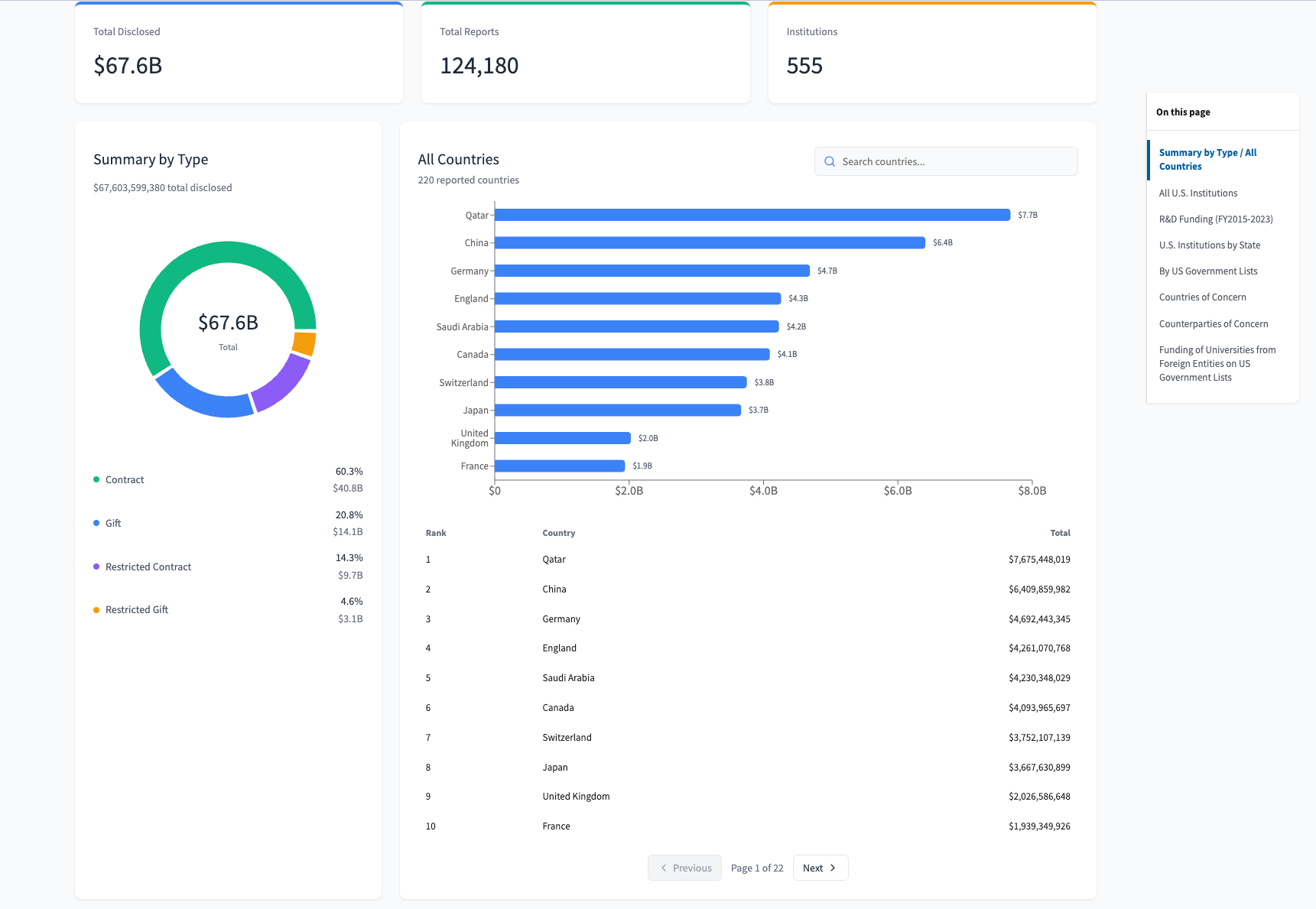
The new dashboard provides an overall summary of the universities, funding total, and country of origin. There is also a label for various funding of “concern” via China, Cuba, Iran, North Korea, Russia, or Venezuela. A total of 555 reporting institutions are included, with $67.6 billion in gifts or contracts. Qatar ($7.7 billion), China ($6.4 billion), Germany ($4.7 billion), England ($4.3 billion), and Saudi Arabia ($4.2 billion) were the top-listed countries.
Unfortunately, the dashboard does not provide a breakdown by year. So it is difficult to contextualize the scope. In fact, it is unclear what years this data even covers. In a comment thread on her reporting of the initiative, I asked Karin Fischer about the dates, and she mentioned that “supposedly, the Ed Department's data should go back to the passage of the provisions, in 1986.” This seems like something very basic that is completely missing.
Furthermore, while the overall numbers are broken down by gifts versus contracts, each individual institution only shows overall funding with no distinction. Without being able to break this down by year or type, it makes the raw numbers seem more nefarious. There is simply too little information to make any reasonable judgments on the nature of this funding. It’s a contextless mess.
One example that stood out was Bryant University, which was one of the top institutions under the dubious distinction for “Universities by Total Value of Transactions with Counterparties of Concern,” second only to MIT. All $47.7 million of this funding came from China, which has been accused of abusing the international education system for covert technology transfer. I don’t want to disparage Bryant—I’m sure it’s a fine institution—but it is not a university that I immediately think of as bleeding-edge tech research.
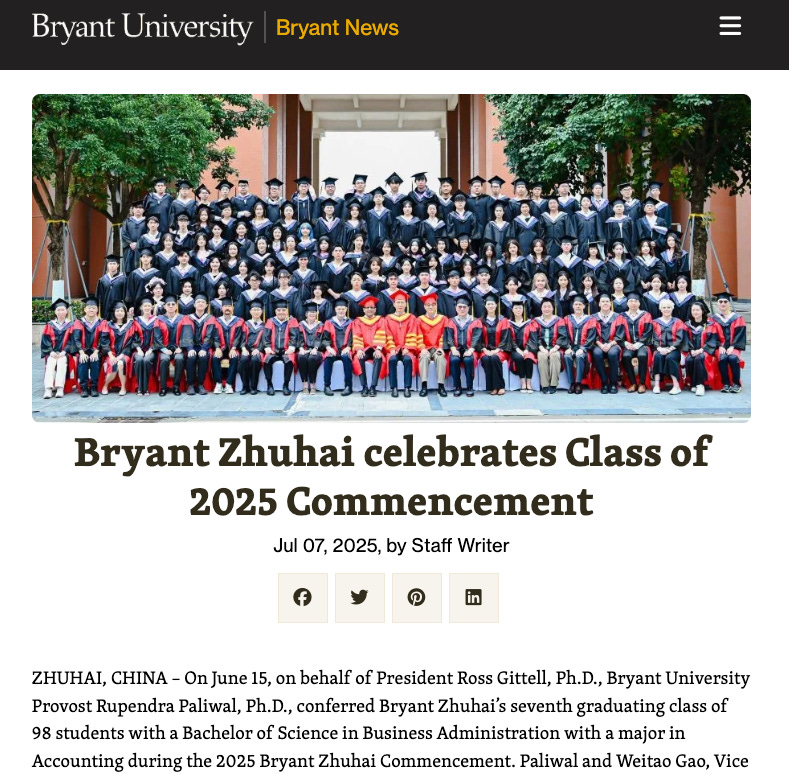
Indeed, looking at the university website, the funding was not used for programs in areas of high concern like AGI development or nanotechnology, but rather a Bachelor of Science in Business Administration with a major in Accounting. In 2015, Bryant entered a partnership with the Beijing Institute of Technology for a branch campus called Bryant Zhuhai that focuses on international business. Much of the funding in the portal comes from this joint venture, as confirmed in the spreadsheet report:
Establishes a jointly operated academic program in China that is executed in accordance with a memorandum of understanding that has a term of fifty years (subject to cancellation by either party without cause). BITZH reimburses Bryant University annually for certain expenses that Bryant University incurs with respect to the program.
This kind of branch campus can be a boon for the home country in terms of international student pools. There might be some who argue that these Chinese international students may take seats from Americans. The reality is that Bryant has an over 65% admission rate and only about 5% international undergrads. Most likely, the endeavor has been helping to fund American students in Rhode Island, yet it gets labeled nebulously as a national security risk in reports.
Insider Behind the Labels
As I was looking through the data, I stumbled upon my previous place of work, Chapman University. The portal lists Chapman as receiving $2.6 million from China, labeled as “Funding from Countries of Concern.” By happenstance, I ran the program that this funding covered. Despite the label, I was not involved in some high-flying Cold War 2 espionage; instead, it was your standard higher ed people-to-people exchange.
Chapman’s partnership for this funding was through Shanghai Normal University from 2018 to 2024. The over two million in funding covered two cohorts of doctoral students in education with an emphasis on leadership studies. There were 13 students in the first and another 10 in the second. The total funding included tuition, fees, housing, extracurricular activities, and even some travel. My faculty line there was also directly funded through this program.
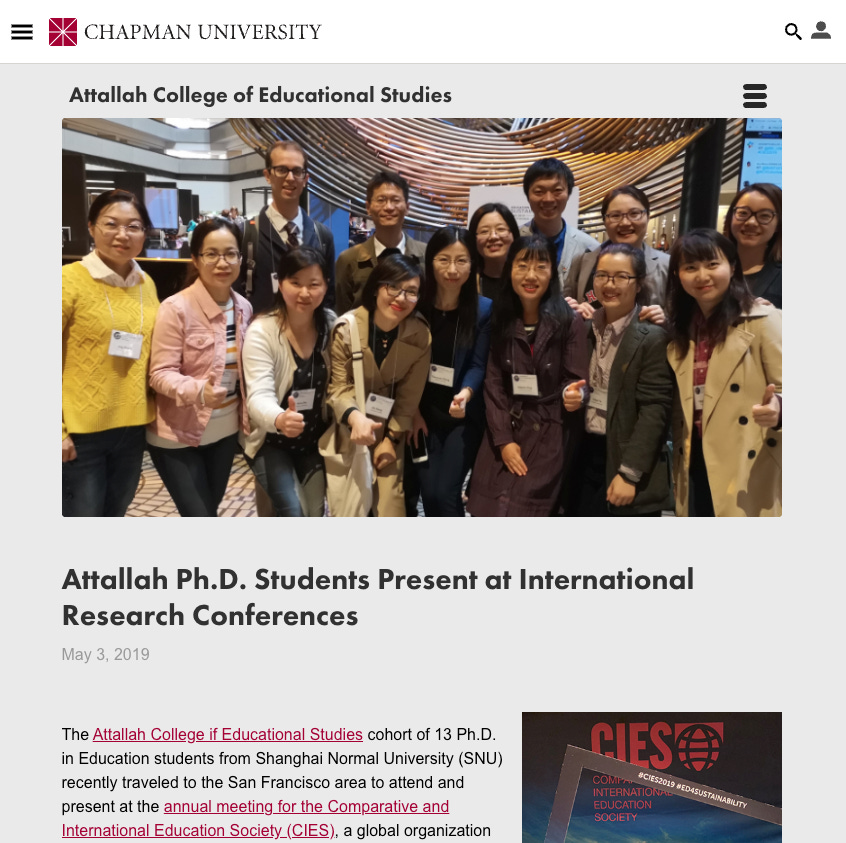
The students in the program were all instructors at private universities and colleges in Shanghai. Shanghai Normal University was helping the Shanghai municipal government boost the standing of the city’s private institutions. So the doctoral students came to the US to learn about pedagogy, leadership, and research methods in education.
The students went back to China to teach ESL, Global Business, or Museum Studies. I am very proud of what they accomplished, especially considering COVID derailed much of the planned programming. Clicking through the contextless data makes it seem like there was some sort of nefarious program happening. Instead, the Shanghai Normal program has helped fund scholarships for domestic PhD students at Chapman. It was also a job creation program for Americans. Well, at least one American: me.
Poor Governance Fuels Conspiracy
Never attribute to malice that which is adequately explained by stupidity. -Hanlon’s Razor
I do not have a problem with a policy to have universities list their funders—I would actually love to see all of them beyond just the foreign transactions. But I want this kind of program that works well and doesn’t confuse people further. Through this recent iteration, because the government had been doing a poor job of managing this data, the framing insists that universities were concealing sources.
Trump and his allies have repeatedly made the claim that the sector was hiding foreign influence and funding. On the contrary, universities publicize these partnerships. While being called a “secret” and “hidden”, the universities have announced these partnerships on their websites, posted about them on social media, advertised them in magazines, and held public events with them. It seems more likely that the lack of data was the fault of the US government not creating a system in the first place. And the new system has overpromised indictments against US higher education.
If the concern over this funding is real, then we should want better data and transparency, not worse. There is some useful data available; it’s just not on the dashboard. I found the actual spreadsheets with the data reported to the US government in prior years. The information is broken down by contract, with the years active included, going back to the late 2000s.
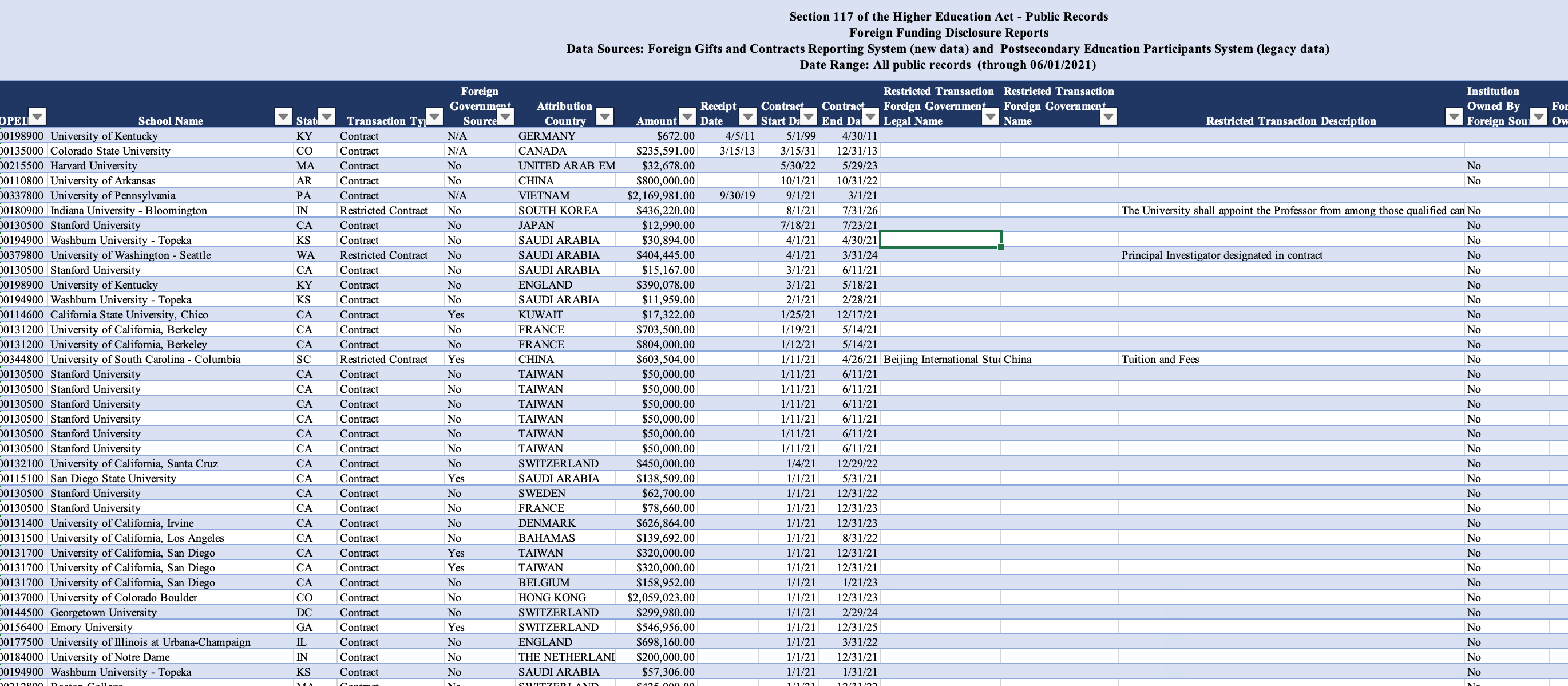
I was thinking that the data discrepancy likely indicated that the data simply had not been collected until 2020, basically the final year of Trump’s first presidency. I could not find the data before then, but I did stumble on records of a FOIA request by journalist Mitchell Bard that cited the data from then:
The Foreign Gift and Contract report currently available covers the years 2012-2018. I am interested in obtaining a report that begins with the earliest recorded data. I believe it goes back to 1986 so I would like a spreadsheet from 1986-2018.
Given the request, it seems likely that the older, pre-2012 data were never available or badly mismanaged. It also appears, though, that some data had been available via a searchable spreadsheet. However, I could not 100% verify because the Trump administration has deleted those pages from the DoE website. It was available throughout Biden’s administration, as per the Internet Archive. The current available spreadsheets start in 2020, but they are still a mess, with multiple years, duplicate labels, and mislabeled dates.
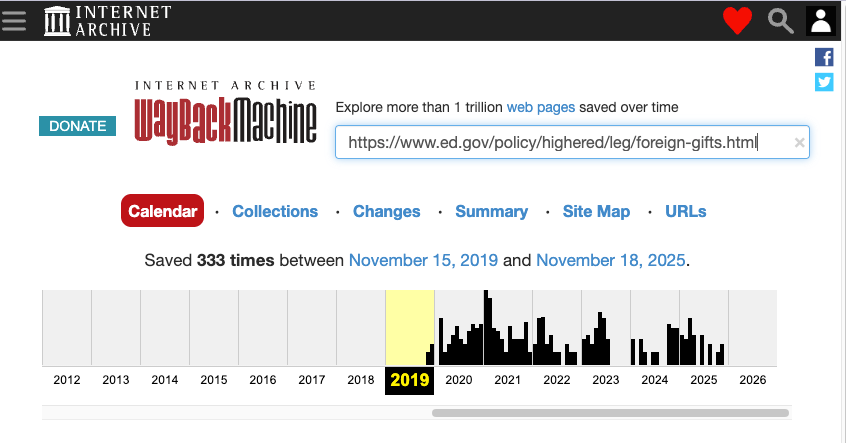
Real transparency is the government cleaning the data that it has and releasing it in a way that makes sense. The messy dashboard and deleted data are emblematic of the administration’s earlier DOGE disaster. Elon Musk was tasked with cleaning up government waste, but his efforts mostly just broke things through blind cuts, which later had to be amended. In a government geared towards efficiency, building a proper reporting mechanism, dashboard, and data repository would have been easy.
If there is a concern with foreign influence, why not tie foreign funding reporting to accreditation? Co-opt these agencies and systems we already have. So many decisions are made in higher ed in the name of compliance with the accreditors already. Instead, Trump has been actively antagonistic to these entities. What is going to happen is that next time a Democrat is in office, this foreign reporting effort will fall by the wayside again because it has not been incorporated.
International Ed is an American Success Story
There might very well be cause for concern over foreign funding. Intelligence agencies have made these claims for years. While some of the targeting has been false, there have been documented cases of Chinese espionage in highly specialized technical programs. We should want our intelligence working smarter to understand and manage these risks. That does not mean lazily categorizing everything under a “concern” label.
Of the $67 billion reported, gifts made up 25%. Gifts versus contracts are two very different things. I could more understand the scrutiny of straight gifts. That’s what Bard was researching when he filed his FOIA request that I cited above. Gifts bring with them an air of quid pro quo or other kinds of questions around influence. There has certainly been meddling by domestic donors at US campuses.
On the other hand, the 75% from the contracts seems overstated. These are services of trade—one of the few areas with a trade surplus for the US. Much of these contracts listed on the spreadsheet are paying for tuition and fees, considered a US export under the World Trade Organization's General Agreement on Trade in Services (GATS). One of Trump’s primary goals in his second term has been to improve trade rates with countries. But cutting these programs only makes it worse.
For those arguing that we don’t want foreign interference in our institutions, then at the same time, the US is also trying to make the entire economy more dependent on foreign markets. This is why the Chinese targeted chicken feet imports, as there was little else to choose from. International students must also be vetted by USCIS before they arrive and heavily tracked once they get here, more so than those on visas for business.
Here are the Chinese importing accounting degrees and education PhDs, just as Trump wants them to do with our shoddy cars. These specific education exports have brought with them millions of dollars to the local Rhode Island and Orange County economies, allowing scholarships for more American students to attend college. Multiply similar programs across the entire country—this should be labeled an American success story. Instead, they get labeled as a security concern by a lazy and overpromised bureaucracy.
Since programs like those at Chapman or Bryant are far, far removed from actual concern, it puts the entire reporting endeavor into question. The overpromise here should be a concern to those who are actually worried about foreign influence. We need better, targeted initiatives, not blindly swinging a hammer.