


Studying abroad was a central node in the trajectory of my life. It allowed me to see a wider world beyond my little slice of life in Oklahoma. Living in Italy for that semester, and later again in South Korea, shaped my worldview and conceptions of what was possible, especially in terms of urbanism (see my previous article below). But the experience is actually not all that common for young American males.
American male college students have lower study abroad rates than their female counterparts. It has long been a tough sell to get them to go. Even when I went back on my life-changing study abroad trip in college, I went alone because I could not convince any of my friends to join. That disinterest can be extrapolated across the entire country.
What Studying Abroad Did For Me

Note: I am traveling this week, so I am leaving you with an excerpt from one of my recent publications. It is a short essay talking about some of the inspirations I took from studying abroad in Italy as an undergraduate, and later in life. It is from the edited book volume entitled
There has been some coverage of the disparities between men and women studying abroad. Major outlets like Inside Higher Ed (2008), The Washington Post (2015), and The Atlantic (2019) have covered the story through the years, but none provided any real solutions. The global travel and study abroad company Terra Dotta recently released a study entitled “Getting More Males to Study Abroad.” Most of the recommendations were focused on more students, male or female, to study abroad rather than just on the group with disparity.
While I agree that young Americans of all varieties should get a chance to study abroad, given how impactful my experience was, it saddens me that other young men do not take the same chance. In this article, I set out to understand the differences and consider reasons why American males are not studying abroad.

Study Abroad Numbers
The first thing to note is that there is indeed a disparity between American men and women when it comes to study abroad. I have heard some online commentary brushing aside these disparities as an artifact of overall higher education enrollment numbers. Indeed, women have long outnumbered men in American universities, but this does not actually explain the differences in study abroad.
According to the Women’s College Coalition, women began to outnumber men in higher education enrollment way back in the 1970s. The numbers have only increased since then, with women now accounting for roughly 58% of all students enrolled in American colleges and universities, according to National Center for Education Statistics (NCES) data on the graph below. These numbers have been fairly consistent over the last 25 years, yet have been slowly ticking up since 2018.
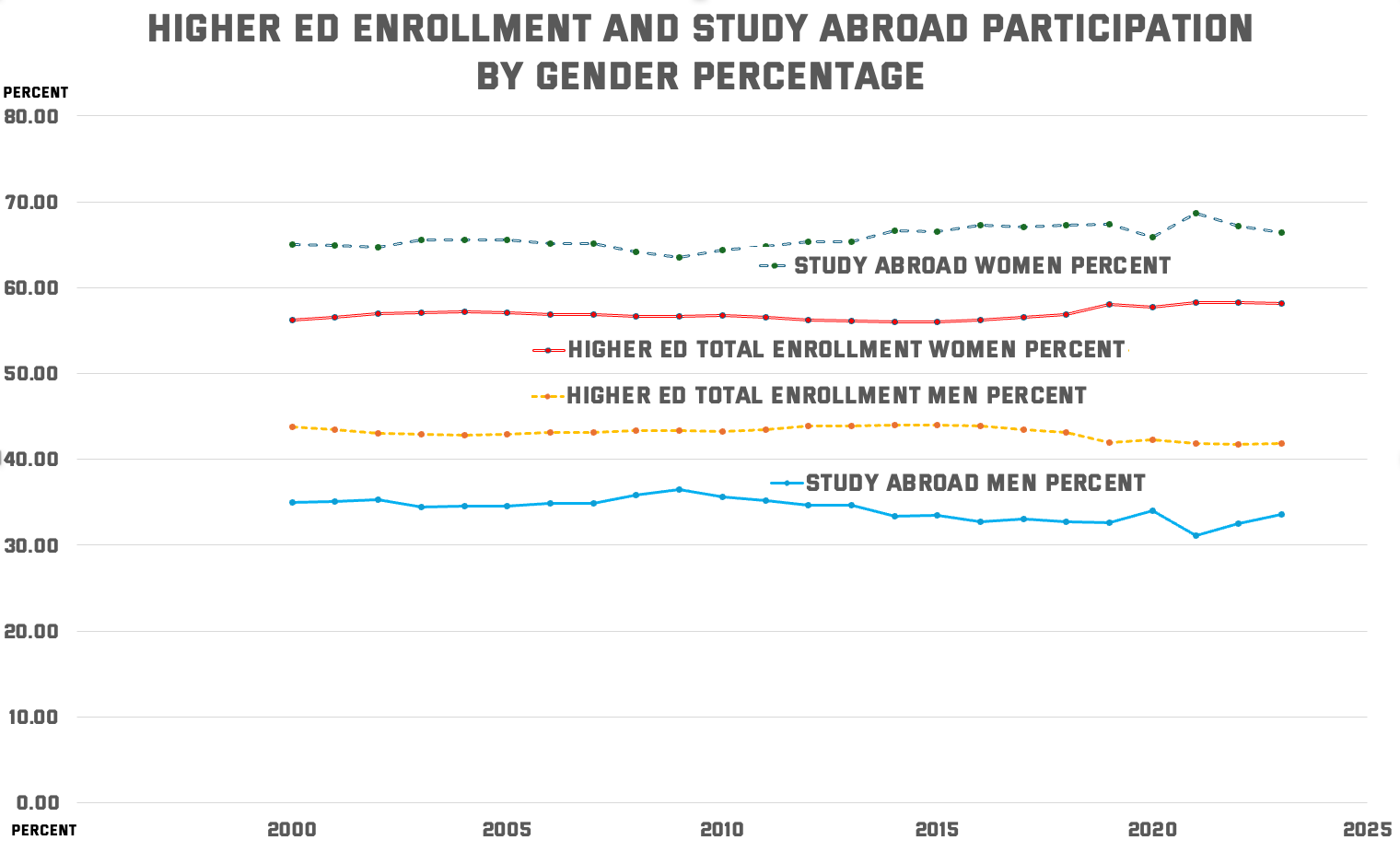
Using study abroad numbers from the Institute of International Education (IIE), the chief data-gathering organization for American international education, reports that 66.4% of American students who study abroad are women, with only 33.6% men. These numbers have remained stable over the last 25 years. This means that the disparity in study abroad is actually greater than the total higher education enrollment gender gap.
Interestingly enough, the gap between men vs. women in terms of study abroad is basically the same as the White vs. other racial groups. White students make up about 66% of all those who study abroad, compared to 34% of other racial groups. These numbers have drastically changed over the last few decades, moving from 84% White vs. 15% other groups back in 2000.
These racial group differences reflect the changing demographics of the country. Certainly, some barriers remain, but the overall changes can also reflect a focus by the higher education sector to diversify the study abroad participants. These efforts have worked!
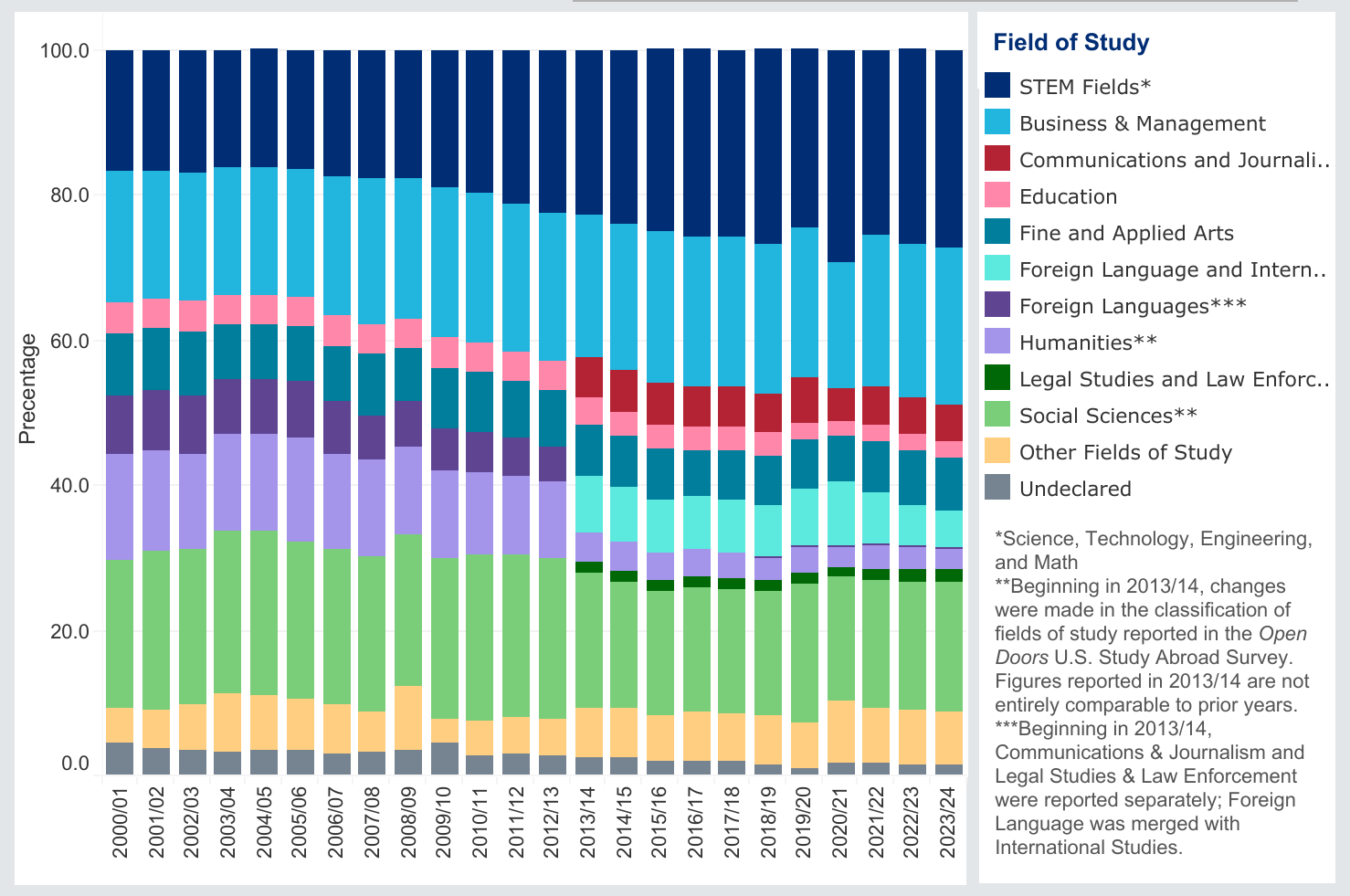
Overall, more people of all kinds have studied abroad. Yet, the gender differences remain. I was even thinking that perhaps major plays a part. But IIE’s field breakdown shows male-dominated fields like STEM have the highest participation rates in study abroad (and still growing). So the disparity points to something else.
Funding Study Abroad
In general, data suggests that most students choose not to study abroad because of finances. At the same time, American students are already drowning in debt to pay for college. Men also seem to be more concerned about student loan debt, borrowing less than women on average. Research has posited that men are more likely to favor “getting internships and making money” than studying abroad.
Given the importance of finances, there needs to be funding available to students if we want them to study abroad. There are certainly general scholarships and fellowships that target experiences abroad. Flagship government programs like the various Fulbrights, Boren Awards, or the Critical Language Scholarship (CLS) Program are available to all American youngsters. Likewise, individual schools may offer their students financial assistance, such as the University of Southern California’s (USC) Leonard Shoninger Endowed Scholarship.
At the same time, given the mentioned efforts to diversify study abroad, there are also scholarships geared directly at underrepresented groups, which do not include men as a ,group as far as I can tell. Another flagship program from the U.S. Department of State’s Gilman Program has the goal of providing opportunity to students who would not typically study abroad. According to the program in 2021 under Diversity of Background and Experience, the Selection Criteria prioritized the following student groups:
first-generation college students, students in STEM fields, racial and ethnic minority students, students with disabilities, students attending minority-serving institutions and community colleges, and students from U.S. states and institutions with lower study abroad participation, and more.
Of course, men may be included in these groups, though not explicitly. However, given the Trump administration’s fight against ethnic and gender prioritization, the Gilman website has scrubbed any mentions of student group diversity other than military.
Many of the other private study abroad funding sources also seem to have similar underrepresentation missions, without any explicit mention of men. Here are a few:
The Fund for Education Abroad (FEA) targeted “students of color, community college, and first-generation college students.”
The American Institute for Foreign Study Access (AIFS) reserved funding for “Inclusion, Diversity & Equity.”
SIT Study Abroad had “Hispanic-serving Scholarships” and “HBCU Scholarships.”
University Studies Abroad Consortium (USAC) has Access Scholarships that target: “Ethnically/Racially diverse, LGBTQIA+, Religiously diverse, Students with disabilities, Non-traditional age students (25+).”
CET Academic Programs had a Diversity & Inclusion Scholarship for “students from racial/ethnic minority groups.”
Semester at Sea has an Inclusive Engagement Scholarship that stipulates: “Preference will be given to students from underrepresented identities (Race/Ethnic Minorities, Students with Disabilities, First Generation, Low-Income, LGBTQIA+, Religions, Veterans).”
The Institute for Study Abroad (IFSA) had “Diversity Scholarships.”
Diversity Abroad’s Overseas Ambassador program stated: “Students from the following backgrounds are strongly encouraged to apply: economically disadvantaged, ethnic & racially diverse, first-generation, LGBTQ+, students with disabilities, students of faith.”
The Diverse International Women of Color Study Abroad Scholarship is explicitly for “women of color.”
My point is not to say we should get rid of these programs. Although many (FEA, AIFS, CET, and SIT) have already appeared to remove DEI-like descriptions recently. Diversity Abroad has even completely rebranded as BeGlobali, but it has kept some of its previous priorities.
Instead, I am highlighting that there seems to be little direct effort to recruit men through funding, despite their clear underrepresentation. In my search, I could not find any funding programs that made explicit efforts to target men as a group. The closest thing I could find was those scholarships at all-male colleges like Wabash. I was even able to find a couple of funding sources explicitly targeted at women: The Jenna Ness Memorial Scholarship and the Corinne Jeannine Schillings Foundation (albeit both are smaller).
There just seems to be a lack of interest in including young men in these kinds of efforts. Gender disparities in study abroad are merely taken for granted. The result is young men lose out.
Becoming Gendered
I do not believe there is discrimination happening against men in study abroad. Instead, it is more about messaging and perceptions, along with the mentioned funding issues.
It seems, in the mind of college boys, study abroad is something that girls do. Even the Inside Higher Ed article back in 2008 wondered if study abroad has become a “A Female Thing.” One study reported that a male who was going abroad got made fun of for being a “weirdo.” I can certainly relate; many of my friends thought I was pretty weird for moving to Italy and Korea. That same study suggested that there needs to be “intentional” efforts to “‘defeminize’ study abroad programs in the eyes of male college students.”
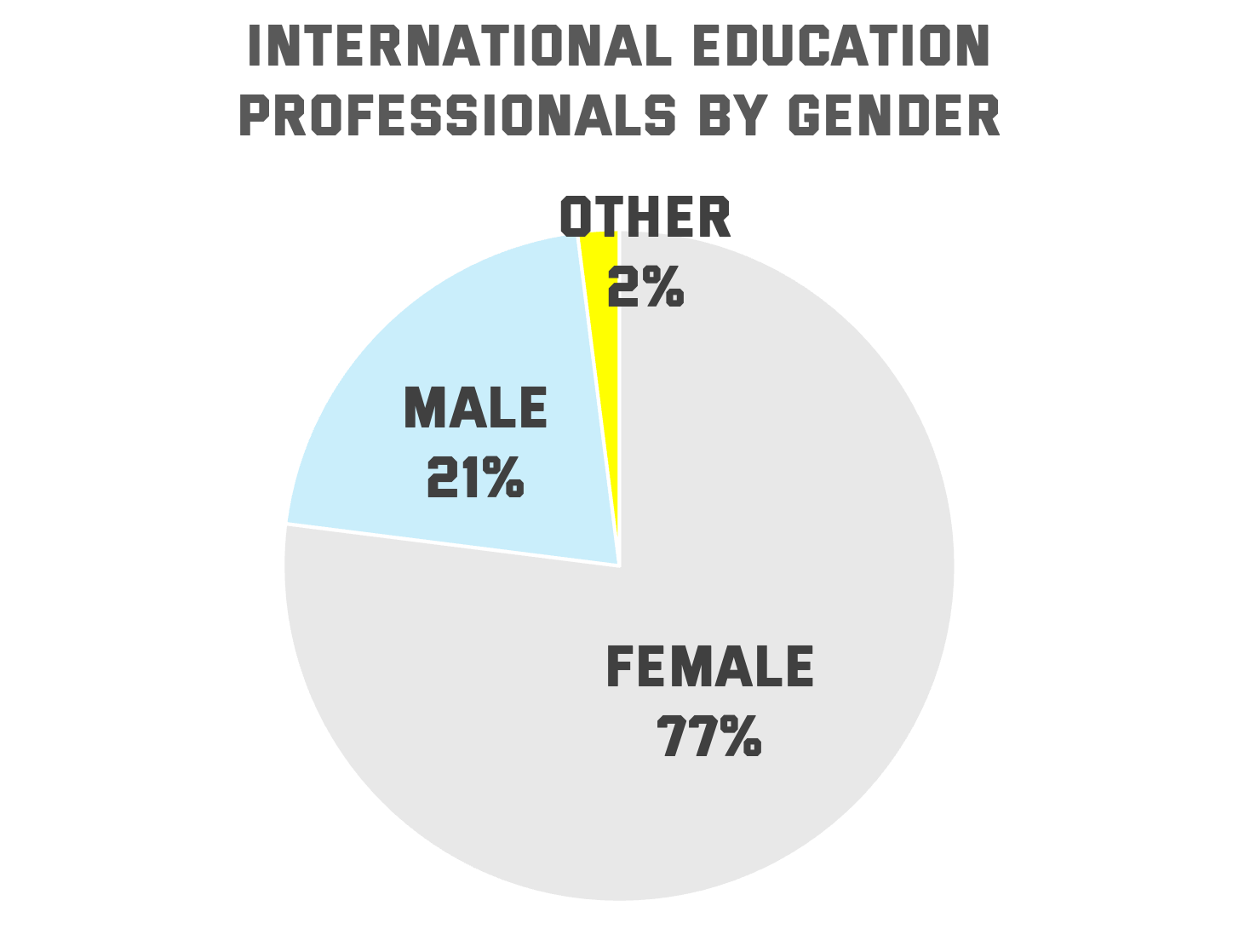
Women are more likely to be higher education professionals than men (60% of the sector’s workforce). A report in the Chronicle of Higher Ed highlighted how men in general are starting to feel like college isn’t for them. Likewise, those who work in study abroad are similarly overwhelmingly female, perhaps more so than the general numbers. In a sample of its members, the Forum on Education Abroad reported that 77% of international education professionals were women.
In the general workforce, researchers have found that once a profession becomes highly gendered towards women, men start dropping out of that specific line of work. The study concludes, “men’s avoidance of work in feminizing occupations is a credible mechanism for explaining swings in sex composition of various occupations.” These same effects may help explain why boys are missing out on study abroad.
I have even seen rumblings that travel itself has become gendered. One travel agency estimates that 64% of all global travelers are women. The same report found that women overwhelmingly make travel decisions and discretionary budgets. The ladies are simply leaving the men at home on the couch.
One recent viral screed illustrated this phenomenon. eigenrobot, an X account with over 201.2K followers, declared:
"travel" is fake
no one except lord myles has "adventures" when they travel
you are staying at a hotel, paying large sums of money to have a far worse experience than you could have in your own home and a far softer experience than you could have by spending a weekend in jail
Other commentators have started wondering about these new gendered travel dynamics. Paul Skallas, aka LindyMan, argues that “since mass travel became normalized, women became independent and got their own money we see travel is mostly a female hobby now.” VB Knives, a popular commenter on X, calls the change “the great inversion.” Building from this concept, A.M. Hickman of Hickman’s Hinterlands describes this trend as “women are now by and large more adventurous than men.”
These differences in higher education broadly and travel generally mean that the boys just aren’t going to study abroad in high numbers. It will take convincing them to break through. We should make the effort.

Inspiring the Boys
Going back to the anti-travel take, the original poster explicitly questions the “adventure” notion of travel. I do think this perception can help us understand men’s modern aversion to study abroad. The experience needs to be understood as a journey, something that is adventurous, a kind of quest.
My own experience as a dumb 20-year-old abroad was full of adventure. One time my roommate and I hitchhiked back to our campus after missing the bus home. Another time, I was forced to sleep outside the bus station in Barcelona when I turned up without a hotel, and every hotel in the city seemed to be booked up. Luckily, I met a group of Polish guys doing the same thing. There are countless other stories from my time abroad.
I think promotional materials for study abroad should tap into the adventures to be had while gone from home. Posters and other inspirations can signal to young men that this is for them. I have an affinity for the old travel posters myself. We should key on these designs.


Another angle is through sports. One reason I also think that many college boys do not study abroad is fear of missing sports. Sports are central to so many American men. They would not dare miss a single college football Saturday or NFL Sunday. I don’t really have a solution for this other than studying abroad in the off season, like in the summer. I will also add that watching football abroad with your fellow Americans builds a kind of fellowship.
It’s not just watching sports, but also playing sports that might scare away college males from studying abroad. More males participate in intramurals or other college sports. For some students, sports are the main reason why they are even at the college in the first place. We need to reiterate that sports do not go away when studying abroad.
Most study abroad programs still have intramurals. Our American team got destroyed by the Italians in soccer when I was studying abroad. And in Korea, one of the funniest weekends was always the sports festival between my university (Yonsei) and our rival (Korea U). I also found a pick-up basketball crew during both sojourns.
The message for studying abroad should be that it gives more sports opportunities. This includes attending professional matches. The rise in popularity of soccer in the US should make studying abroad in Europe more attractive than ever. Why wait to see washed-up stars in the MLS when you can see them in their prime in the EPL or La Liga? Japan’s growing baseball dominance should excite a young American studying in Tokyo. When are you going to get a chance to see Yomiuri Giants vs. Hanshin Tigers?

The human connection is also important in studying abroad. The real treasure was the friends we made along the way, the cheesy line is right. I have to admit, I did meet my wife while studying abroad (we were both international students in Korea). While the Eat, Pray, Love mantra might be targeted at women going abroad, I don’t think we should simply let go of the appeal of human connection that might be attractive to men, too.
One relevant growing phenomenon comes from so-called Passport Bros. The Economist describes Passport Bros as “young Western men who travel abroad in search of better dating prospects.” Critics believe that this transgressive lifestyle choice takes advantage of power dynamics in less affluent countries.
I’m not here to debate the concept of Passport Bros nor to tell universities to start advertising the concept. Instead, I am highlighting that in other avenues, men have seen interest rise in going abroad. While very specific, I think meeting people should be something that is attractive about studying abroad.
What Young Men Miss Not Studying Abroad
This conversation around study abroad is emblematic of a larger, changing culture in American boys. There have been growing concerns that young men are becoming disillusioned in this country. They drop out of the workforce, live with their parents, rarely leave the house, sit on the couch all day, and play video games until the sun comes up. Sometimes they are called NEETs, a derisive acronym that stands for “Not in Education, Employment, or Training.”
These growing concerns about arrested development have sparked more interest in recent years. The Young Men’s Conference is an upcoming conference targeting solidarity and support for young men. Speakers include both Democratic and Republican elected officials, researchers, and other thinkers. The American Institute for Boys and Men is “the first national organization committed to objective research and policy development to enhance the wellbeing of boys and men. Likewise, Jonathan Haidt, the well-known New York University (NYU) psychologist, has raised the alarm bells over anxiety or loneliness in today’s boys.
I am not going to pretend that studying abroad will heal every pathology that ills society. Instead, lessons learned and experiences gained during study abroad can be powerful tools for success. Being abroad builds resilience by necessity. We get forced to leave our comfort zone, try new things, and take on new responsibilities. There is a kind of independence gained abroad when untethered from what is familiar.
One way that young men do already get experiences abroad is through military service. There are around 221,000 American troops stationed abroad in a given year, which are overwhelmingly male. While being in the military and studying abroad are certainly different, the experiences can have similar effects.
I know just being in the military offers a certain kind of transformation. Troubled or lazy young boys become respectable and responsible men through service (I saw it in many friends who joined). Part of that transformation is moving, sometimes abroad. Mottos like Join the U.S. Navy, see the world are popular draws in recruitment.


The 1953 book When We Get Back Home from Japan by Bill Hume and John Annarino lampooned American servicemen returning to the US after being stationed abroad. From shoes to bedding to other cultural changes, the book highlights the transformation that we go through after living outside of the US.
In the classic movie Stripes (1981), Bill Murray’s character (Winger) tries to convince Harold Ramis (Ziskey) to join the Army. Funny enough, Ziskey was an ESL teacher, which is already a good way to get paid to travel via teaching abroad (this is what initially took me to Korea):
-They give you money.
-Who?
-The GI Bill. Borrow all the money you want.
-Will you shut up about the Army?
-You borrow the money, you buy a Winnebago. They ship it anywhere you want. You get lots of travel. Kathmandu, guaranteed.
-Yeah, dysentery guaranteed.
Granted, in the movie, the pair end up regretting their decision to join after a miserable experience in basic training. Eventually, they grow up and save the day. A mini version of this transformation happens when students study abroad. Both experiences can help young men avert becoming a NEET.
Become Bourdain
One of my idols growing up was Anthony Bourdain. His travel show really got me thinking seriously about visiting or living in the far reaches of the world. He advocated for moving, whether abroad or just somewhere else, to better yourself:
If I’m an advocate for anything, it’s to move. As far as you can, as much as you can. Across the ocean, or simply across the river. The extent to which you can walk in someone else’s shoes or at least eat their food, it’s a plus for everybody. Open your mind, get up off the couch, move.
The tragic end of Bourdain's life may not bring reassurance for his advice. Perhaps a lesson is that if one is too rootless, travel doesn’t fill the void of unhappiness. But the advantage of studying abroad is that people can try a different life while keeping their world at home. It is just a chance for a given period, a year, semester, or even just a few weeks. It’s the expat lifestyle lite, although studying abroad is certainly a gateway to real expat living.
There are growing movements of people taking Bourdain’s advice by escaping the US, finding work and lives abroad. Digital nomads have remote jobs in the US while living in other countries. Interestingly, data suggests that there are more male digital nomads than female counterparts (56% vs. 43%). This may factor into the aforementioned Passport Bro phenomenon. The point is, men seem to eventually want experiences abroad, but time and opportunity are limited.
In the end, I hope younger generations just have the same agency and opportunities that I had. They deserve to go on their personal hero’s journey, facing trials and tribulations and overcoming anxieties and hangups. So much of the toxic monosphere, like Andrew Tate, is just young men looking for advice and encouragement to improve themselves. Studying abroad is a healthy way to do just that.


Seeing the world through a new lens, beyond just travel, may even reaffirm their love for the US (missing football, big trucks, and free refills). But it may also help them see what is possible beyond the confines of this country (walking to the grocery store, taking public transit, eating bizarre foods). Both were true for me.
For all of these reasons, we cannot forget about the young men. They need our support, funding, and attention. Give them their adventure. We must find a way to get the boys to study abroad.
Reminds me of the tradition of a Grand Tour for young men in the 17th-18th century - exposure to foreign culture (European) was considered a capstone of an elite education. An aristocratic practice, but even on a smaller scale there’s a tradition of sending young men abroad as a rite of passage.
I almost studied abroad. I had applied for two scholarships to pay for a semester (or year) in Istanbul, but they didn’t come through. My grandma and dad offered to finance it, but I had too much pride, and I didn’t want a large handout from family.
I eventually did get to Istanbul, with my own money, after college.