


Note: Around the College Towns is my weekly links roundup article on urbanism and education. These posts mostly cover news that may have fallen through the cracks rather than the big events.
Palm Trees, Scam or Icon?
The organization Streets For All, an advocacy group focusing on better urbanism, recently released a video entitled ‘Are Palm Trees in Los Angeles a scam?’ It drew a wave of opinions, some positive, some negative. The take seemed to have wide support in the urbanist community. Max Dubler of California YIMBY posted, “Palm trees are bad. Chop them down and give Los Angeles some shade.”
Conversely, the take drew ire from others. LA in a Minute defended the palm tree in the city he covers:
The palm tree is the consummate symbol of Los Angeles; vertical symbols of relentless optimism everywhere throughout our horizontal city. And, like many people in L.A., they thrive even though they’re not native.
The online right, in particular, seemed annoyed at the video, decrying “progressives” or “YIMBYs” for the take. The California Post used the moment to take a potshot at a local candidate they don’t like (Nithya Raman, who is popular in urbanist circles).
For me, I actually don’t think a love or hatred of palm trees needs to be divided along political lines. This is not a left or right issue, even though that is what the internet is trying to make us believe. The debate is yet another display of how issues in urbanism do not neatly align with our culture wars.
In this case, I disagree with my fellow urbanist on this one. I like palm trees.
There are a lot of urbanists who seem to really emphasise function over form. It is somewhat of a divide within the movement when talking about building housing that actually looks good. A large portion of urbanists believe this issue isn’t that important. For them, these aesthetic arguments are just a NIMBY obstruction tactics. While I agree that this justification is often used to block housing, I also think that aesthetics do matter. You can see me railing against ugly dorms every week here (see links below).
In the case of the palm tree, the function-over-form urbanists see them as useless at best (they don’t provide much shade) and dangerous at worst (fire and debris hazards). I get these arguments; I would usually prefer to walk under a tree-covered canopy street (see my old Tweet below). Palm trees just do not create that kind of coverage.


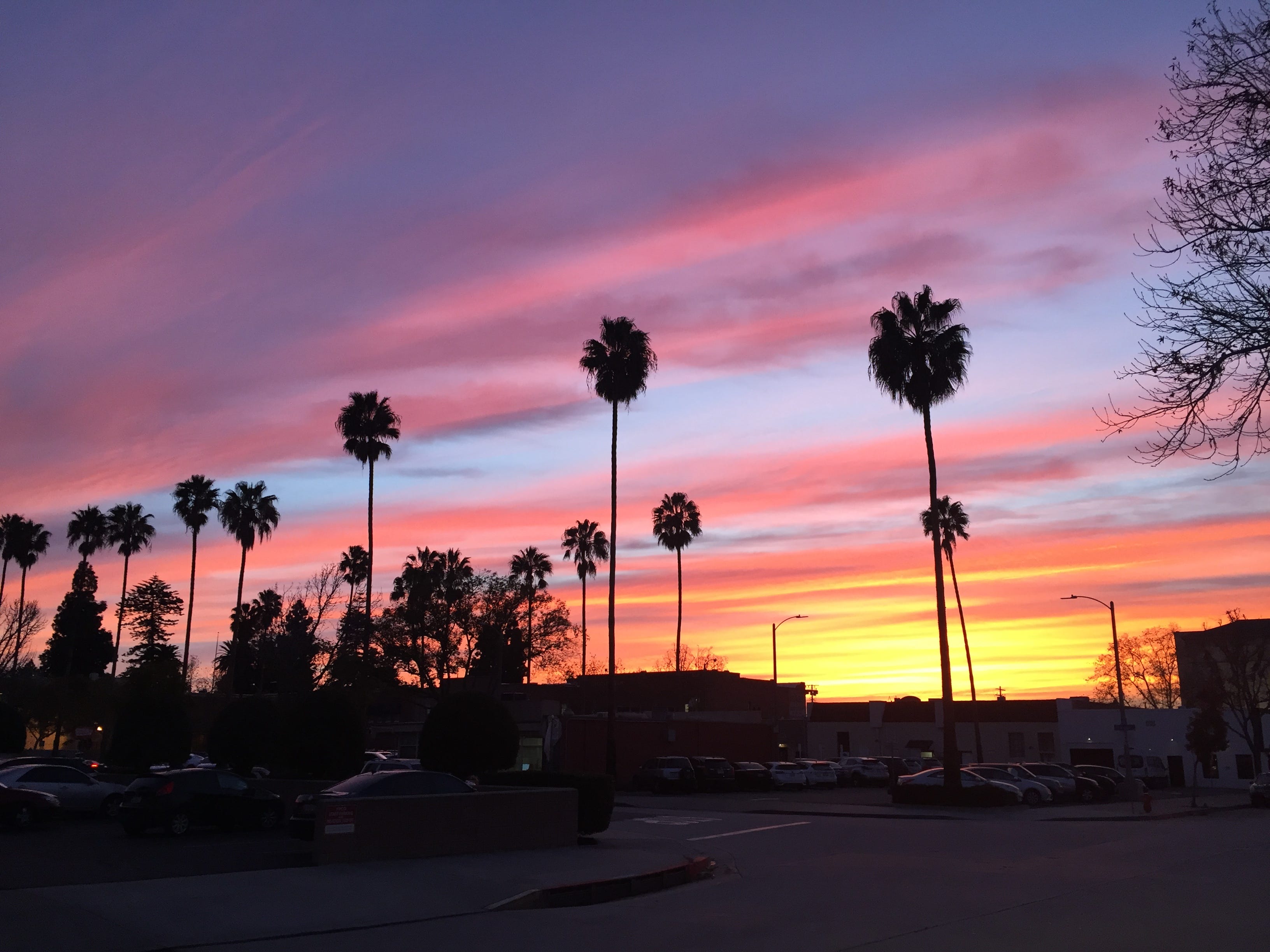
At the same time, the vibes that palm trees give off are crucial to the identity of the area. Sun, surf, sand, and palm trees. Iconic. They look amazing under the sunset, providing a calming reminder of relaxation. Even if they were imported 100 years ago, they have grown to become icons for all of Southern California. Aesthetics matter. Palm trees are now part of what it means to be LA.
I’m not saying Southern California should only plant palm trees, just that we should not remove them nor consider them scams. One thing I do agree with the anti-palm tree crowd is that we need more Jacaranda trees. These native trees have beautiful purple blooms in the Spring. My former neighborhood, Old Towne Orange, is full of them, and I loved walking past the purple petals on my way to work.
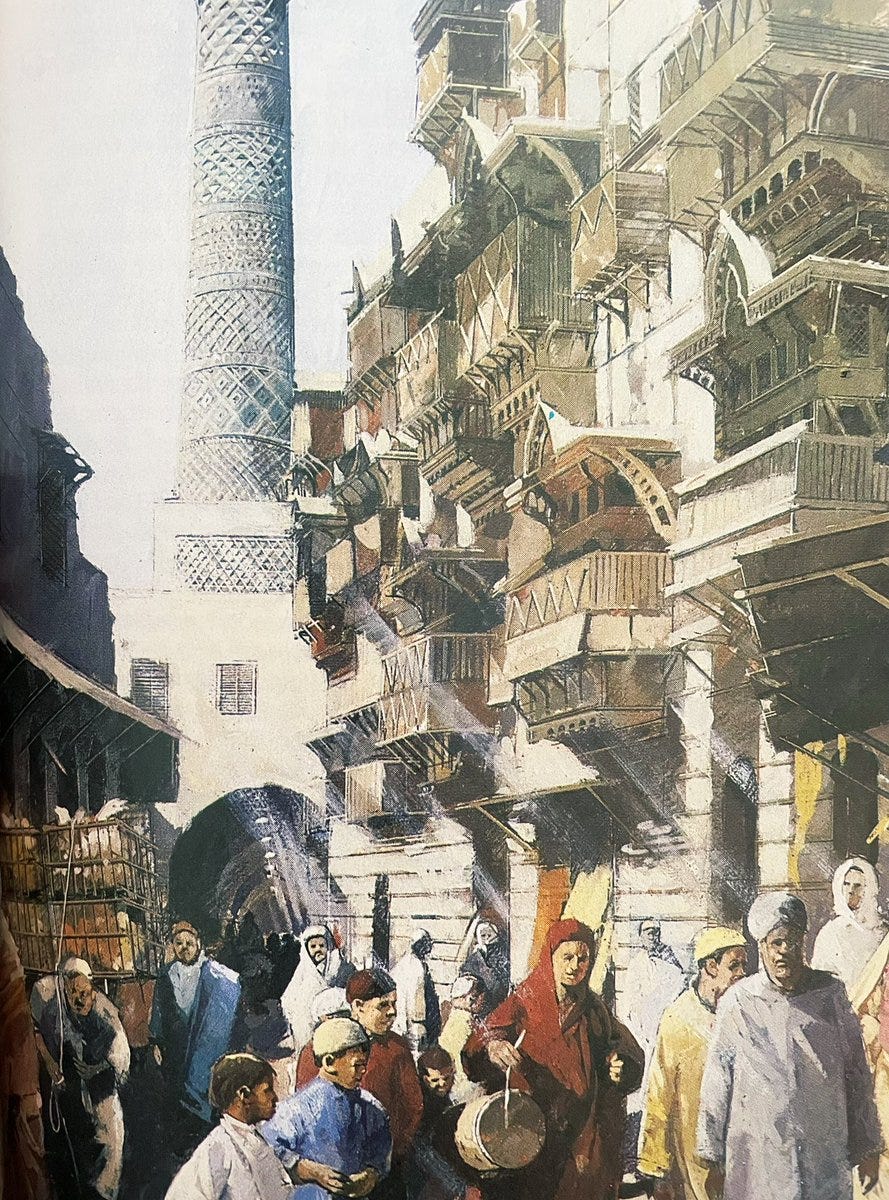
The real problem with LA, and the entire state of California, is not the trees. We have stopped building with traditional designs that take into account the climate. Rather than just copy-n-pasting suburban sprawl, with wide lanes, far setbacks, and concrete parking lots, we should be building our society with the sun in mind. We can look at how ancient civilizations have long dealt with their own climate: narrow lanes, verandas, canopies, four-story buildings that cast shadows.
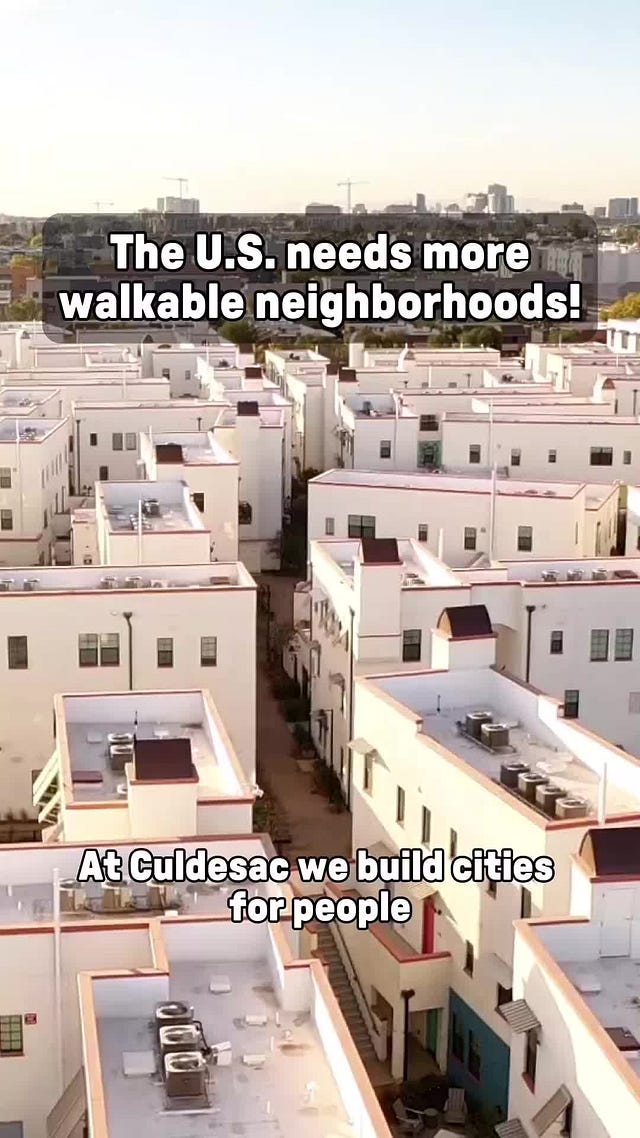
And if we want to look at something a bit closer, then consider the principles of Culdesac Tempe in the next state over in Arizona. It takes a lot of the old design aesthetics and funnels them into a modern American society, getting rave reviews from the urbanist community (I hope to visit one day for a future article). The building structures and layout design are what really matter. Trees are the dressing on top.
So, yes, let’s plant more trees. But no, palm trees aren’t a scam. They are form over function. Aesthetics matter.
 Tiktok failed to load.
Enable 3rd party cookies or use another browser
Links I’m Reading This Week
Education
Students are hacking online degrees to earn degrees in less than a year. This is a massive problem with online education today in the face of AI. This kind of thing just makes a mockery out of higher ed.
In more ethical, shorter-degree news, ASU London offers three-year degrees in the UK. The Age of Conquest knows no bounds!
NPR has a list of colleges that are a suck on the American tax dollar. They are mostly dumpy for-profit schools. I will have a future article on this topic.
Switching to student housing, California spent hundreds of thousands of dollars per bed in efforts to tackle the student housing crisis across the state. It’s great we are getting more housing, but it is insane at the cost of doing anything literally here. Very frustrating place.
Potentially, one issue with costs in California comes from entities trying to grease their palms. That seems to be the case with a canceled dorm project at Los Angeles Community College District due to improprieties in the bidding process.
Sacramento State is trying to shed its commuter school label by making students live on campus for the first two years. The strategy is also likely a good revenue generator for the institution.
On the opposite end, Pitt is now no longer guaranteeing on-campus housing for juniors. This change is part of the university’s growth strategy.
In Wisconsin, they have an explicit program for students to live in senior housing while they study. Interesting initiative. I think we will need to see more of this with the aging of our population.
University of Virginia is building on-campus housing for its MBA program. More apartment-like and aesthetically pleasing, this is what the future of student housing should look like.
Likewise, Columbia’s newest dorm is certainly a beaut. Basically, it’s a gut renovation of an old, run-down dorm from the Union Theological Seminary. This is what student housing should look like.
Juxtapose these with what we are getting down here in Southern California at UC Irvine. Not the ugliest dorm I’ve ever seen, but certainly not great. That distinction goes to…
Evangel University, a tiny Christian college in Missouri, opened a new dorm that is one of the ugliest I have ever seen. I guess it does look exactly like the rendering. Hideous.


Urbanism
Airbnb has gotten into the housing development game. I don’t hate this. I see what they are proposing as a way to make better use of our spaces and as part of the ADU boom.
Waymo is entering the Japanese market. I will be interested in seeing adoption there, as it is already transit-rich. A lot of urbanists are afraid of what self-driving cars mean for public transit. If Japan can successfully navigate the tech, then I would be hopeful.
Malls might be making a comeback. I think we can continue saving malls if we build more housing around them rather than relying on everyone to drive in.
Consultants misappropriated funds for the California high-speed rail project. I’m glad we found this out now, but with billions spent and years wasted, everything about this project is turning out rotten.
Mark R. Brown, AICP, CNU of Car Free America makes the case that city planning has too much public engagement. I 100% agree.

Adaptive Reuse Corner
We are back with yet another edition of Adaptive Reuse Corner. Last week’s winner came from the old mill in rural Virginia. That was the one I chose, too. Great craftsmanship. No one wanted those rough commercial units. I get it.
Starting out for the week, we have a pair of lighthouses. One comes from Northwestern Pennsylvania, sitting right along the Allegheny River (A), for $1.3 million. The other comes from central South Dakota along the Missouri River (B), a beautiful part of the country I just visited when I went to Deadwood. That one is less than $250K! A deal.
Next, I have two schools. One is an entire campus of a former boarding school in the Berkshires area of Massachusetts (C). At $3 million, not a bad price considering what you would be getting. You can live out your Charles Xavier X-Men fantasies; just be forewarned about the upkeep of shuttered campuses. The other is a one-room schoolhouse in Fort Wayne, Indiana (D), with nice-looking additions for almost $700K. The owner even hopped on r/centuryhomes to lament having to sell.


I also found a couple old commercial properties. The first is a gorgeous brick bank in a small town in Nebraska (E). At just $85K, it probably needs a lot of work, but the insides do not actually look horrible. The other might be a bit of cheating; it’s an office in small town Illinois, with a residence on the second floor for $100K (F). These kinds of live-work units used to be very common across the country, not so much now. I wish we could bring them back.
The last selection comes from a church in the middle-of-nowhere Iowa (G). It hasn’t been converted to a residence, with the pews and altars still standing. For just over $100K, you can start your own cult religious revival!


Which do you choose? Look for the Adaptive Reuse Corner poll next week.
Closing Time… Budget Your Own College
Andrew Piper is an AI and storytelling researcher at McGill University (whatever that means). He does seem to be doing some interesting work there. His vibe-coded The Socratic College Ledger is a small, experimental app that lets players budget their own college. The app promises:
A bare-bones humanities institute: professors, students, rooms, and nothing else you can avoid. Every dial below moves the tuition. The one that moves it most is the seminar cap.
I spotted Piper’s post over on X, where he said he was hoping to “mock-up… no frills humanities institute with just profs and students.” The design would not be about “big facilities,” dorms, libraries, or gyms. “Just the place where ideas and learning happen.” Laudable.
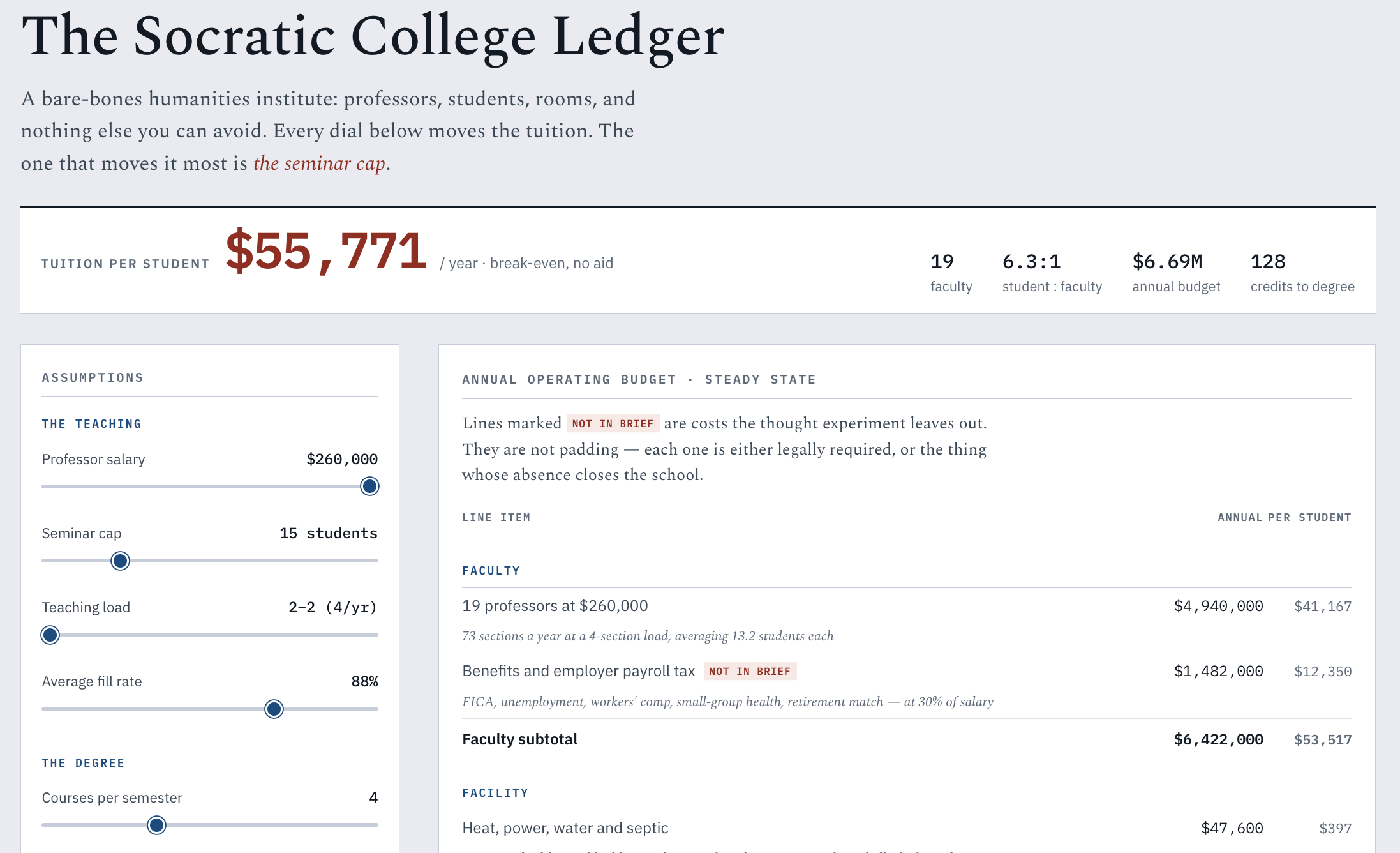
In the end, Piper realized a “brutal truth” for this vision: “the math doesn't work.” He just could not get the budget from ballooning for a college he envisioned. At least he tested his hypothesis, only to discover it’s not so hard to run a university! This might be a future university president training game.
Try it yourself. Were you able to create the college of your dreams within a reasonable budget? I also came up short, though my dream college is one with dorms, libraries, and gyms, so perhaps our visions just do not align on this one.