


Editorial Note: This is the first guest post in the “Summer School at College Towns” series. If you are interested in writing for College Towns, feel free to reach out to me on Substack or at ryanmallen555@gmail.com.
Today’s guest post comes from Nico Hohman, who runs the Plans & Principles Substack. He is also the Executive Director of Operations at Capitol Campus and is working on his Master’s in Urban & Regional Planning at Georgetown University. Enjoy. -Ryan
I wear two hats at Georgetown University. The first is as a staff member. My role as the Executive Director of Operations of the Capitol Campus gives me the opportunity to interact with just about every group on campus, from facilities to housing to student affairs to the provost’s office and everyone in between. My other hat is that of a graduate student. I will complete my master’s in Urban & Regional Planning in the spring of 2027.
It is through this dual-role lens that I discovered something interesting happening with graduate students: they are getting younger. What’s more, today’s graduate students aren’t just younger versions of previous cohorts. They behave differently too.
This discovery first started as a conversation with my colleagues. We were commenting that it looked like this cohort of graduate students appeared younger than previous groups. And as a current graduate student, I noticed the same thing in my classes. Though I’m far from being old (I’m only 37), it definitely felt like I was the old guy in class.
So I did what any good graduate student would do: I did some research. To the library!
Grad Students Really Are Getting Younger
As it turns out, our observations about these graduate students were correct. According to numbers from the Integrated Postsecondary Education Data System (IPEDS), graduate students have been getting younger over the last 25 years. (Note: IPEDS data is a great source because institutions that receive federal funding for students are required to report data back to the federal government.)
Below is a graph showing the total enrollment of all graduate students across the United States since 2003, broken down into age-specific categories.
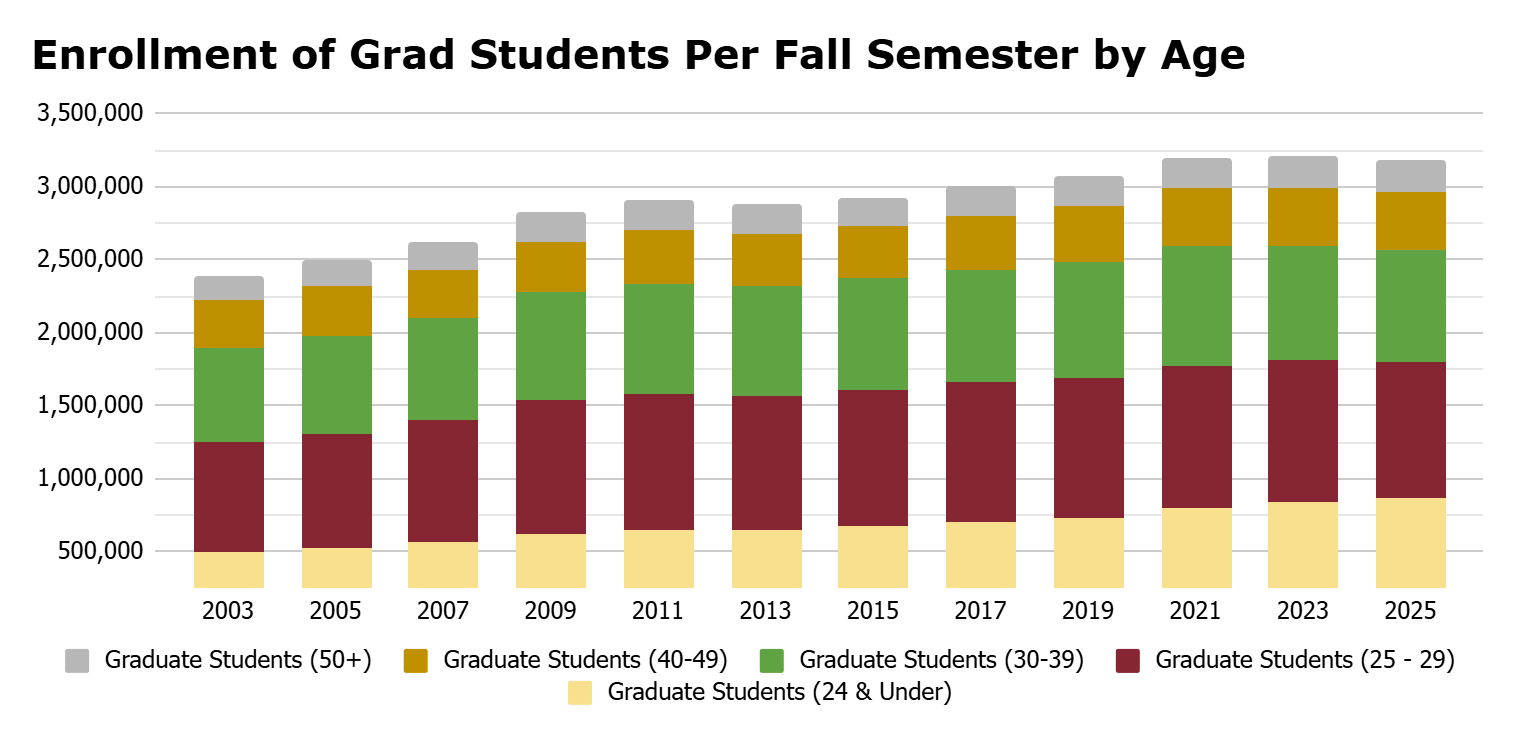
The topline number is obvious. Total graduate enrollment has grown by over 500,000 students in the last two decades. Lots of factors play into why graduate enrollment has increased, including more universities offering more graduate programs; more 4+1 dual enrollment programs like at the University of South Carolina, the University of Texas, Worcester Polytechnic Institute, and many more; as well as economic cycles that favor graduate school enrollment when the economic outlook looks rough.
What is less obvious from the IPEDS data is how that growth is segmented by age. To better capture this growth among the youngest graduate students, I break down that growth by share. Below is a chart showing the share of graduate students over the last 25 years, categorized by three distinct age cohorts: 24-and-under, 25-to-29 year-olds, and those students over 30 years old. The oldest cohort, those 30 and older, has seen a decline in enrollment since the start of the new millennium, while the share of graduate students in the youngest cohort has grown by nearly 50%.
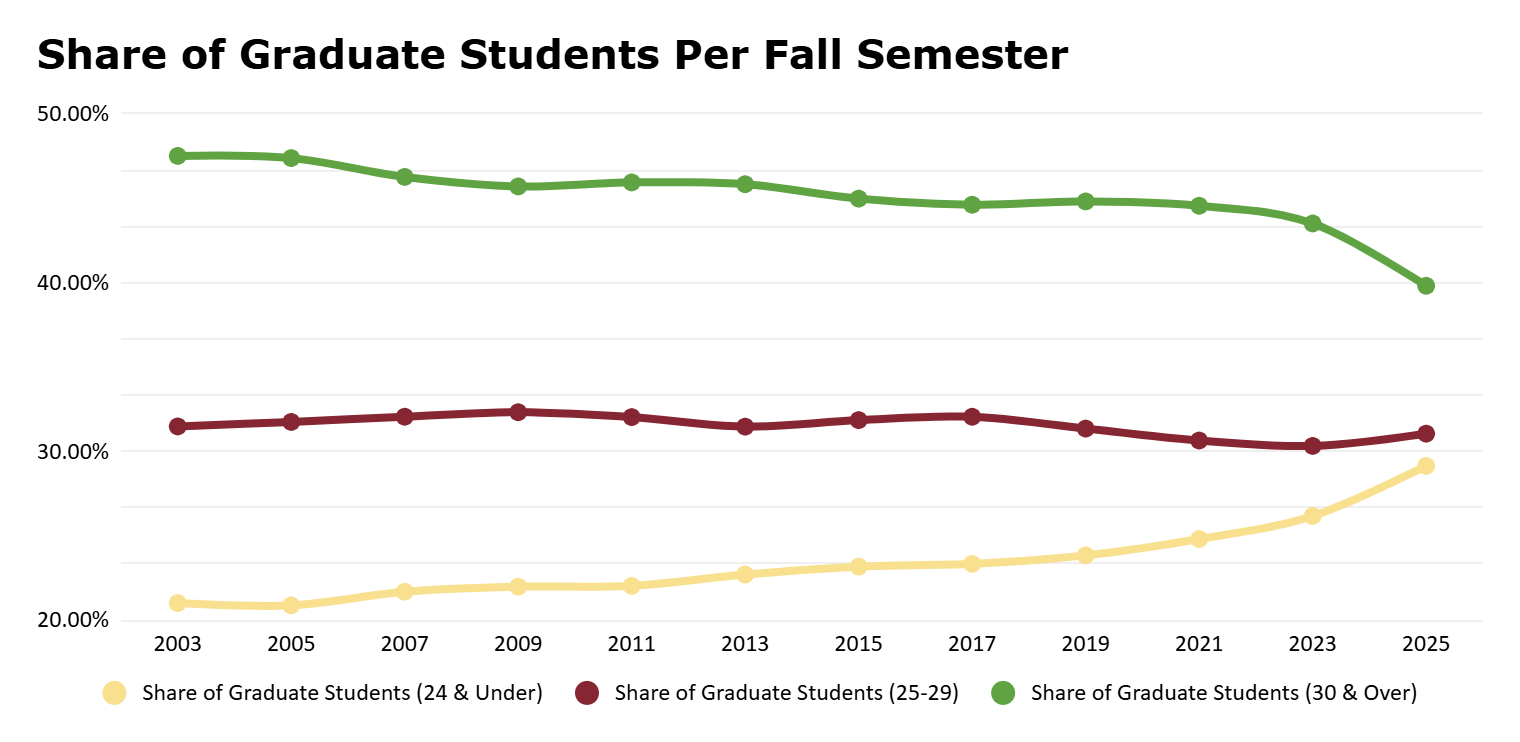
These three age cohorts were selected because it is assumed that the youngest cohort is moving directly from undergraduate to graduate studies. The middle cohort is assumed to have some experience in their originally selected fields and may be looking to obtain different credentials to pursue a different field of study. While this may also be true for the oldest cohort, it is more often assumed they are obtaining additional credentials to advance their current positions in the workforce.
Introducing the Graduate Youth Index
To better highlight these trends, in the chart below I introduce the Graduate Youth Index. This index tracks the growth (or contraction) of these three specific age cohorts against their respective baseline shares in 2003. These three cohorts started with an Index score of 100, and each subsequent year their indices increased or decreased based on the enrollment of that age cohort. In the fall of 2025, the Index for graduate students 24-and-under was 138.7, the highest ever recorded. For graduate students 30-and-older that same semester, the Index was 83.8, the lowest ever recorded. Grad students in the middle cohort decreased their most recent Index score to 98.6.
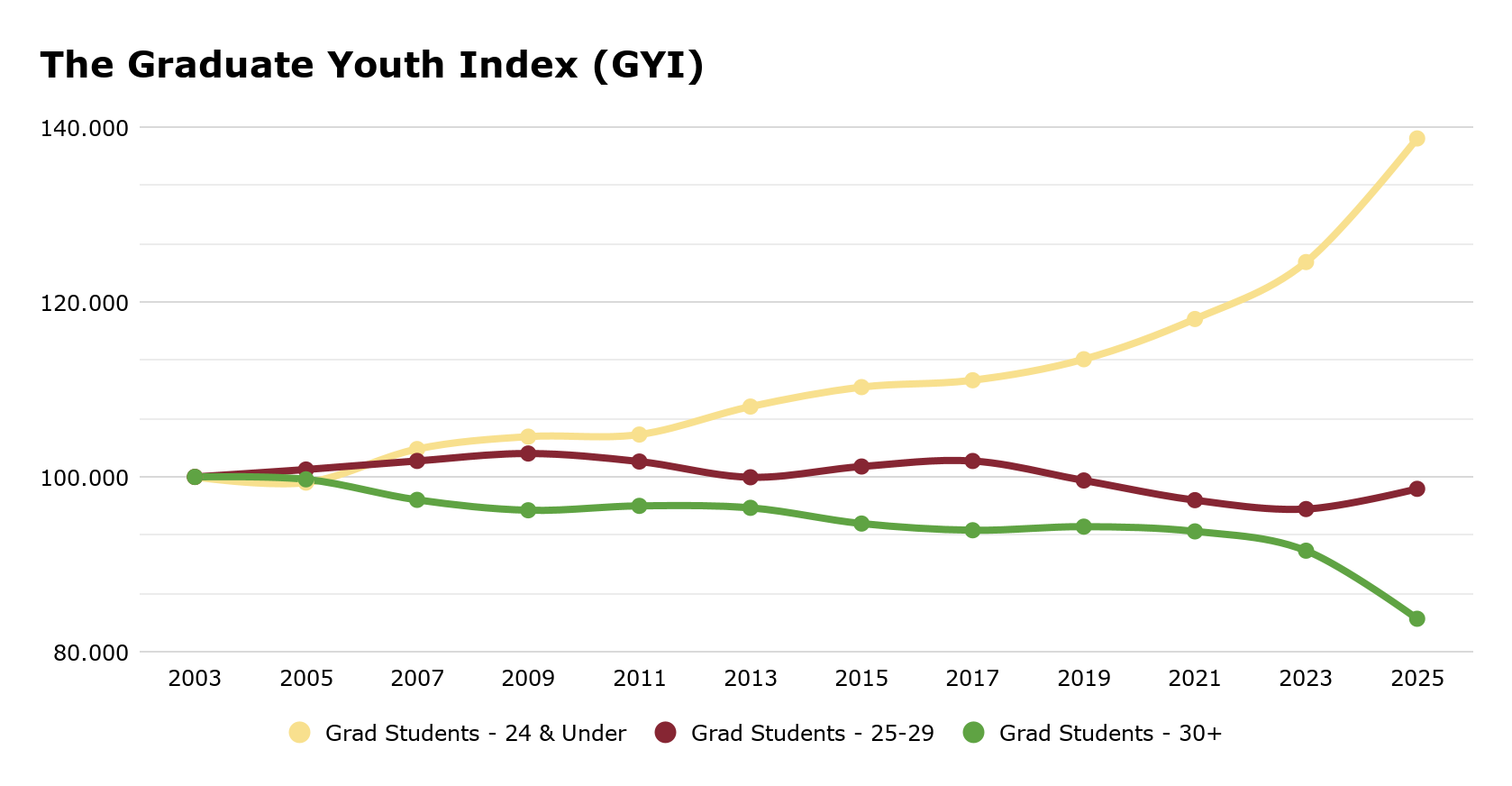
The fact that universities have increased the number of graduate programs or that major economic disruptions have increased the desire to obtain additional credentials should be relevant to all age cohorts, and not just the youngest ones. So why are we only seeing growth in the youngest age cohorts? I have four theories.
First, the COVID-19 pandemic was not only an economic disruption but also a disruption to everyday life. For any student who graduated from high school in 2016 or later, they had some sort of high school or college experience impacted by the pandemic. A return to graduate school may be a way for them to experience a “normal” school life when so many other areas of their lives were overrun by COVID.
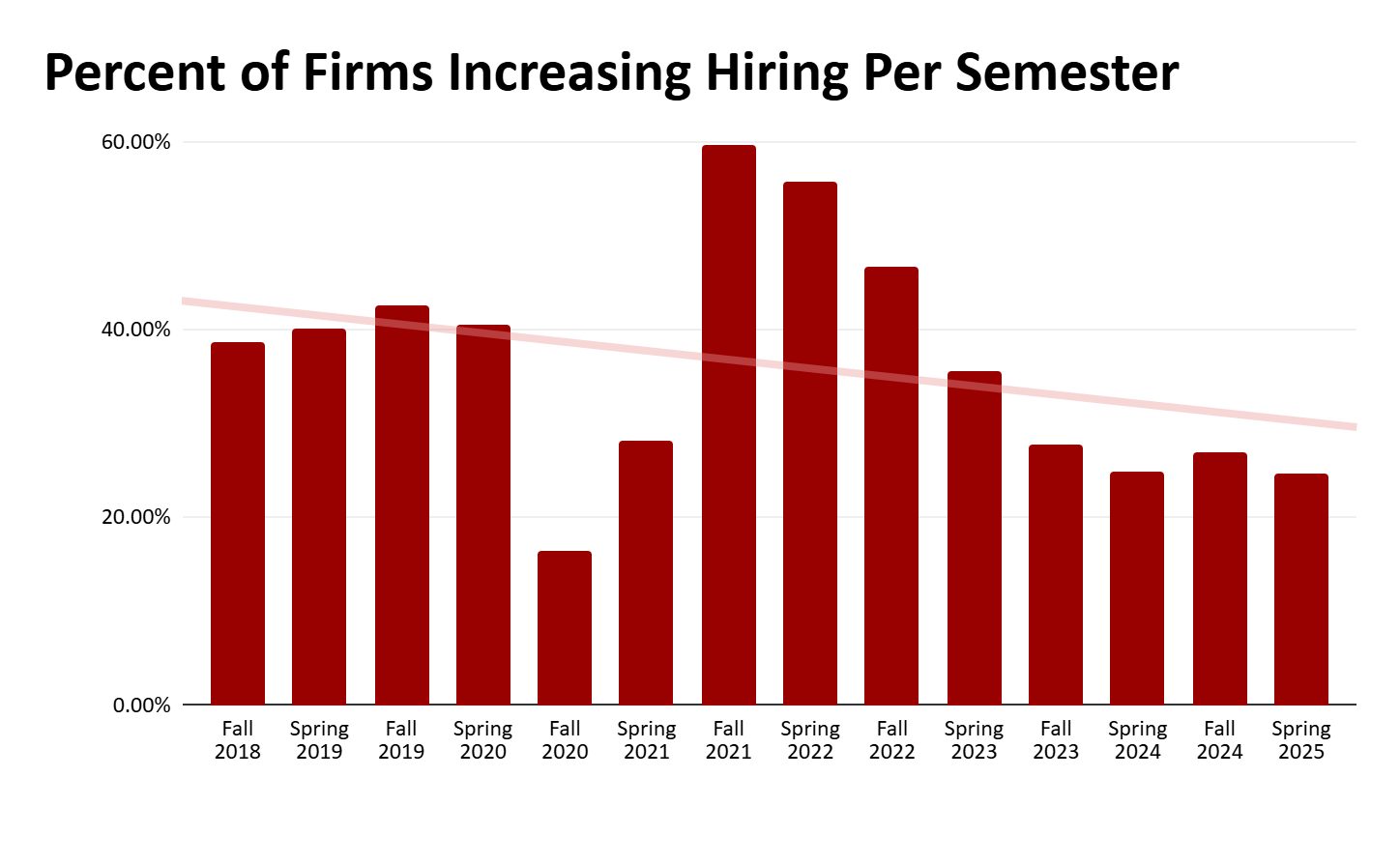
Another theory is that the market for hiring recent college undergraduates has shrunk. According to data in the chart below from the National Association of Colleges and Employers (NACE), the pace at which firms are hiring undergraduates for entry-level roles has slowed. Reasons for this are varied, but for our purposes we can assume that a tighter hiring climate for younger workers specifically gives them reasons to pursue additional degrees to remain competitive in the marketplace.
A third theory is what Jean Twenge referred to as delayed adulthood or slow-life theory. The premise here is that today’s graduate students (yesterday’s high school seniors) are passing through certain developmental life stages (like drinking alcohol, dating, or obtaining a driver’s license) later in life than their grandparents, parents, or even their older siblings. For example, in 1979, over 90% of high school seniors had tried alcohol. In 2016, only 67% of seniors had tried alcohol. In 1984, only 13% of seniors had never been on a date. By 2016, 36% of seniors had never been on a date. In 1989, 86% of high school seniors had their driver’s license, while only 73% of high school seniors in 2016 had their driver’s license.
Previous generations looked at high school as a way to grow up while undergraduate school was their way to learn a specific career skill. Perhaps today’s graduate students are looking at their undergraduate careers as a way to learn how to become an adult while graduate school now becomes the place they learn a specific trade skill.
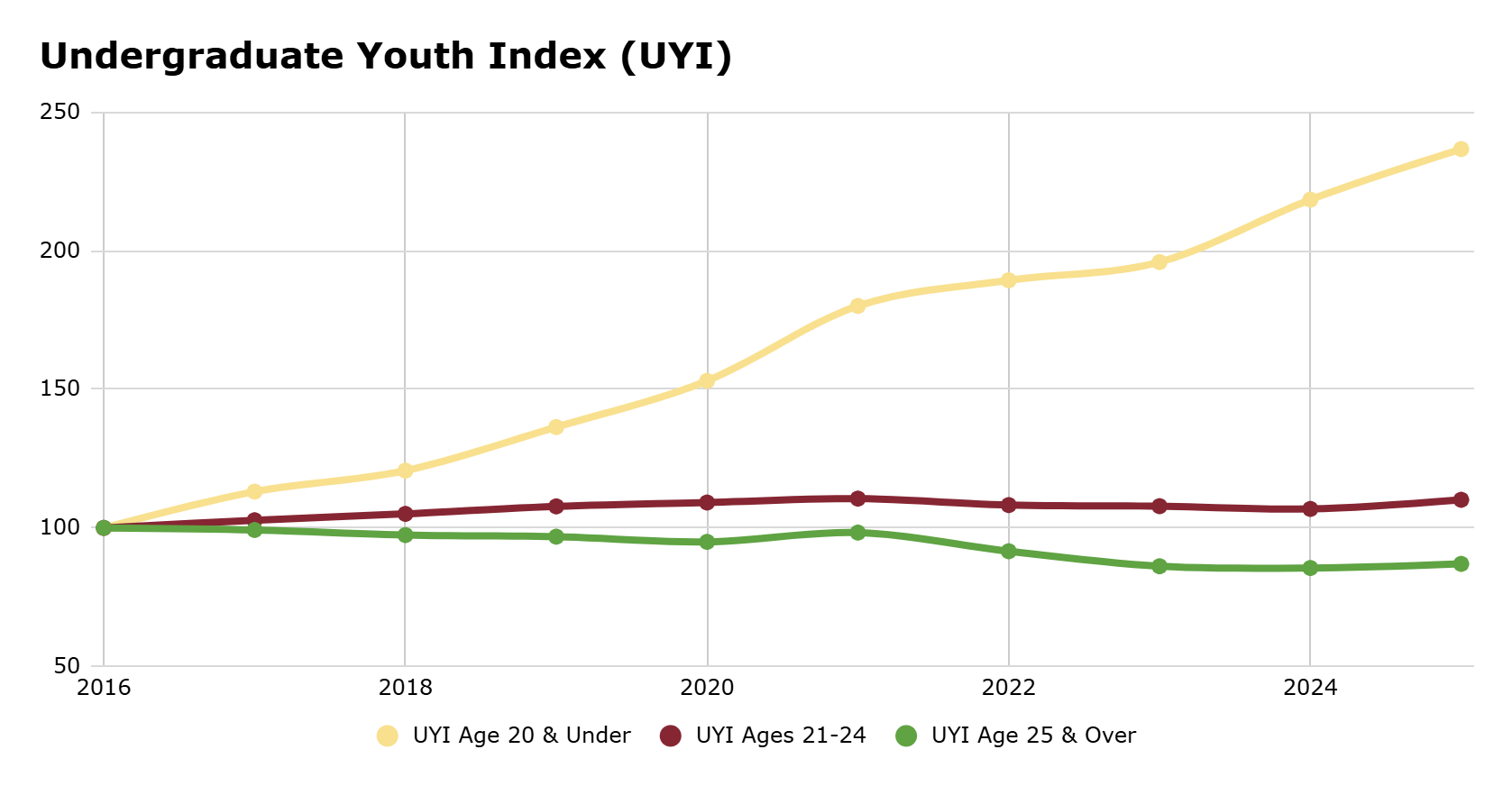
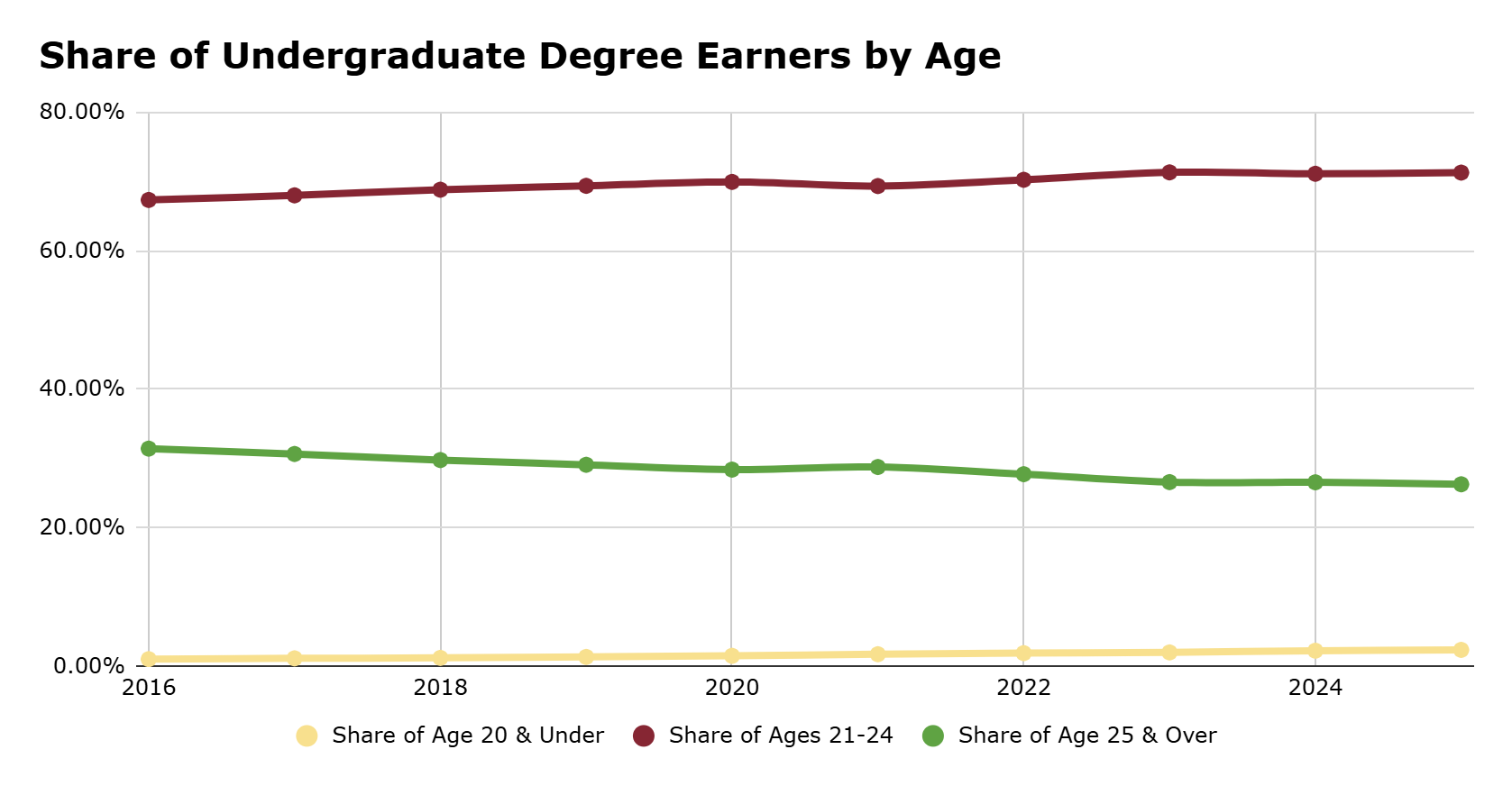
The last theory about why graduate students are getting younger is simply because undergraduate students are getting younger too. This trend is not nearly as pronounced at the undergraduate level as it is at the graduate level, but undergraduates are also becoming younger. This is primarily due to high school seniors taking dual enrollment courses while still in high school. As a high school student, obtaining more college credits prior to enrolling in undergraduate studies allows them to graduate faster.
Below is the data from the National Student Clearinghouse regarding the age cohorts of undergraduate students. While the change in the share of younger undergraduates has dramatically increased, the overall proportion of younger undergraduate students still remains small.
Editorial note: If you have your own theories on the graduate student youngening trend, give us a comment on your thinking below.
The Changes to Campus Life
We know that graduate students are getting younger. We also have some reasons to explain this trend. Next is the most important question: so what? Why should universities care that their graduate students are getting younger?
For private universities where tuition dollars are the primary drivers of revenue, it is often the graduate tuition dollars that make up the majority of this revenue stream. Therefore, if universities view themselves as in the business of providing education to their customers (i.e., their graduate students), then they would be wise to adapt to the changing demographics and needs of their customers. Today’s graduate students aren’t just younger versions of previous cohorts. They are a new type of consumer: the undergraduate-plus student.
The traditional graduate student was not a heavy user of campus facilities. Typically, they were students in their late-twenties or early-thirties. They lived off campus and had their own transportation. They may have had a spouse and might even have had children. They often had full-time careers and were coming to campus once or twice a week, usually in the evenings, to take three-hour lecture or seminar courses. They came to campus, took their class, and then they left. With these more traditional graduate students, the town-gown dynamics were easier to manage. The “studentification” impacts in the immediate neighborhood around campuses were less strenuous. There needed to be fewer purpose-built student housing complexes, fewer concerns over disruptive student behavior, and generally better property upkeep. In essence, the traditional graduate student was both a part of the town and the gown, and therefore wanted to maximize their positive impacts in both arenas.
Today’s undergraduate-plus students are much heavier utilizers of campus. Many of them treat graduate school as their full-time job. And without them having as much full-time or real-world experiences, many of today’s graduate students are coming straight from undergraduate school, where they are used to their undergraduate routines. These often include on-campus housing, on-campus dining, on-campus health and wellness services, and active learning classrooms.
Today’s younger graduate students want the convenience of on-campus amenities without the association of undergraduate life. They want housing, but prefer apartment-style suites instead of communal dorms. They want grab-and-go food services instead of traditional dining halls and meal plans. And they want their classrooms to be flexible and tech-capable with natural light and moveable furniture.
Demographics are Destiny
For decades, institutions have planned around broad categories like undergraduate or graduate students. Those categories were useful because they generally reflected meaningful differences in how students lived, learned, and interacted with campus. Today, those distinctions are blurred as graduate students spend more time on campus, seek stronger connections to university life, and expect a wider range of services and amenities than previous generations of graduate students.
Demographic change arrives gradually enough to go unnoticed until the evidence becomes impossible to ignore. Universities that continue to plan around the graduate student of 25 years ago risk operating academic programs, student services, and building facilities for a population that no longer exists. Worse, universities that do not adapt to their changing student populations risk closing entirely. While fewer students enrolled overall at an institution can certainly lead to its death spiral, having the wrong products and services for the right population (or vice versa) will also lead to a university’s demise.
Graduate students are changing. The question is whether the campus will change with them.

It would be very interesting to see the numbers separated by gender, and to see how numbers have changed based on university funding. In the last decade or two, universities have needed more funding through graduate students. It would be interesting to see how that has changed the demographic.