

Editorial Note: This is the second guest post in the “Summer School at College Towns” series.
This guest post comes from Loredana Carson, is an Orange County educator whose experience has focused on combining her teaching of English as a Second Language background with other academic studies, including public policy and higher education research.
College Towns has previously posted about international students being targeted by the Trump administration. Building from these and the recent policy to limit visas to just four years, Carson explores how losing international students is detrimental to local economies. Enjoy. -Ryan
International students have quietly shored up the budgets not only for the schools they attend but also for the municipalities in which they reside. As an instructor at multiple institutions in Southern California, I wondered if the absence of international students was causing any measurable issues for local economies. I did what all academics do when faced with a research question; I began searching for data. What I found is that a quiet economic siphon is deeply impacting the neighborhoods surrounding local universities.
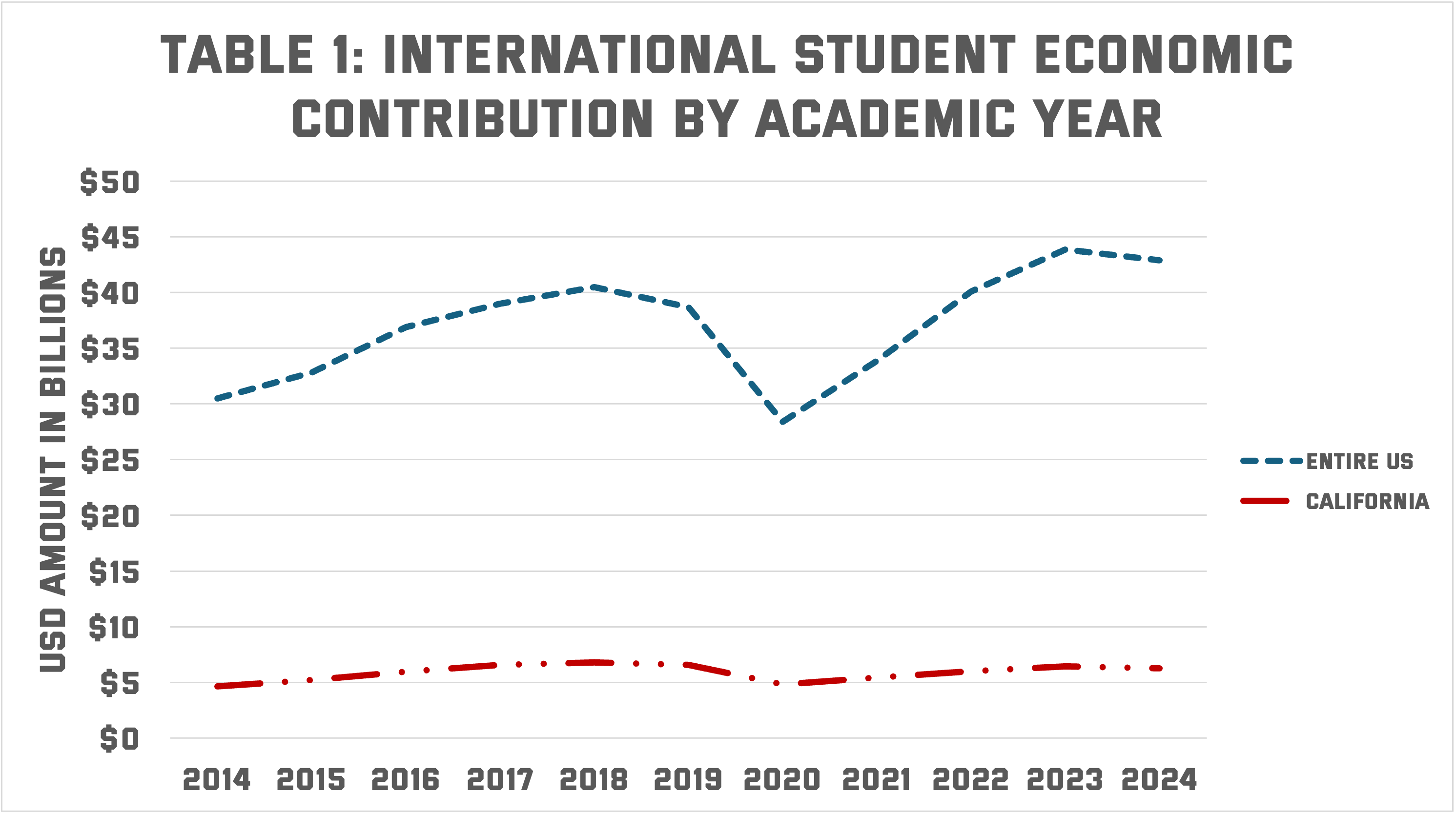
NAFSA’s most recent economic report from 2025 tells us that international students contributed $42.89 billion to the national economy in 2024-2025. This figure reflects the loss of $1.1 billion over the prior year. Federal laws restricting visas for international students have become increasingly stringent and show no sign of letting up under the present administration. Table 1 below shows how those numbers have changed over time.
Readers will be familiar with the litany of complaints levied against international students. Claims range from: international students take seats from Americans, international students are spies, international students steal American jobs. This framing of international students as bad actors is offered without context or proof. Such statements are designed to destabilize higher ed at a time when the system is already under attack and being forced to adapt to regulatory interference. The recent ruling from the Trump administration limiting visas to only four years has only added to these unwarranted attacks on this student population.
How Does This Economic Hit Land at the Local Level?
Anecdotally, I know from the institutions I teach for that it hurts programs, and the decrease in students has resulted in fewer classes being offered. Some might view this as a problem solely for higher ed to sort out, but research reveals that international students contribute dollars not only to tuition but also to home rentals, food, commerce, car purchases, tourist dollars, and sales tax.
To even secure an F-1 student visa, these applicants must demonstrate absolute financial solvency by providing liquid bank statements proving they can cover a minimum cost of attendance that typically ranges from $40,000 to over $75,000 per year, depending on the campus and degree program. Because they are legally barred from working off-campus, this entire sum represents a guaranteed, upfront injection of outside capital directly into the neighborhoods surrounding our universities.
Losing international students isn’t just an issue of empty seats in a classroom. Student reduction means empty apartments, fewer customers at neighborhood grocery stores, and fewer dollars flowing into local sales taxes that fund city parks and roads. The impact is much larger than is currently being portrayed.
While multiple examples exist of this local economic impact, I selected two cases from my state of California to demonstrate the order of importance this issue presents to local communities. California provides a microcosm of the entire country, as illustrated in Table 1. I selected public institutions for ease of finding verifiable information, but this does not mean that private institutions are not impacted in the same way.
Foul Weather in San Diego
The economic liabilities of tightening immigration policies are acutely evident at San Diego State University (SDSU), a major public institution facing unexpected international enrollment contractions. While SDSU administrators initially projected an expansion of international enrollment based on strong admission activity, thousands of accepted students were ultimately unable to enroll due to severe visa appointment backlogs and a national F-1 visa refusal rate that spiked to a decade-high of 35%.
This administrative gridlock has been severely compounded by an aggressive federal vetting climate. Formal updates from the SDSU International Student Center document instances of sudden visa status terminations and active student visas being revoked mid-semester without warning.
When a major metropolitan campus like SDSU loses substantial international enrollment to systemic visa denials, the fiscal damage spills immediately into the surrounding San Diego municipality. According to NAFSA, every three international students historically support a local service job; a contraction of 400 international students at a major hub like SDSU places roughly 133 local San Diego service, hospitality, and retail jobs at immediate risk or eliminates them entirely.
The economic ripple effect of losing international enrollment can be painful. Based on the latest economic value analysis by NAFSA, international students in California contribute an average of nearly $45,000 each to the economy through a combination of tuition, housing, and local commerce. Applying this baseline to SDSU, losing a cohort of just 400 international students represents a combined loss of roughly $18 million in direct campus revenue and local San Diego business spending, which doesn’t even account for the parallel losses hitting neighboring universities.
In case you are thinking that SDSU can just replace these international students with domestic students and avoid the problem entirely, the issue is more complex. According to data compiled by the Public Policy Institute of California (PPIC), non-resident undergraduate students pay significantly more than California residents. At California State Universities (including SDSU), non-residents pay the base tuition plus an additional supplemental tuition fee, bringing their total to roughly double what an in-state resident pays. The same is true for graduate students, except that international students make up more of the student population, especially in STEM programs.
The extra tuition from international and out-of-state students directly helps offset state revenue shortfalls and heavily subsidizes the education, financial aid, and resources available to local California residents.
If any California State University campus reduces its international student body and replaces them with in-state students, the university brings in far less revenue. This forces the campus to look for budget cuts, which can mean fewer course offerings, larger class sizes, or fewer campus jobs—all of which harm the local campus economy. This is in addition to the problems faced in the local off-campus economic community.
(Un)Welcome to the OC
These shifting dynamics of federal visa approvals and immigration backlogs have left a clear mark on California’s public university infrastructure, with California State University, Fullerton (CSUF) serving as a primary regional indicator in Orange County. For years, CSUF operated as a major cultural and economic hub for international students, maintaining a historical baseline of well over 2,400 to 3,100 foreign-born students annually, according to historical records reported in College Factual institutional tracking data. However, as federal screening measures tightened and visa backlogs mounted, recent aggregate profiles indicate that CSUF’s unique international footprint has contracted significantly, sliding to a baseline of roughly 1,500 to 1,790 active students.
This almost 50% downturn mirrors a wider macro trend given that the California State University (CSU) system has experienced a stark contraction in its global student body, culminating in a recent drop to just 12,122 international students, as reported by CalMatters. The downturn represents the tail end of a multi-year decline accelerated by the pandemic. In 2019, the system boasted a robust international enrollment hovering between 18,000 and 20,000 students. However, a perfect storm of pandemic-era travel restrictions, prolonged visa backlogs, and fluctuating federal immigration policies ultimately drained more than 5,800 international students from the system, deeply reshaping the cultural and financial landscape of California’s state campuses.
Applying economic framework formulas established by NAFSA, a contraction of this magnitude at CSUF means that an estimated $30 million to $45 million in annual, non-tuition discretionary spending has vanished from the local Fullerton and Orange County ecosystem. Based on NAFSA’s regional employment multiplier, erasing up to 1,600 international scholars from the local economy places roughly 533 local hospitality, retail, and off-campus housing jobs at immediate risk. Furthermore, this contraction simultaneously starves the public university of approximately $24 million in annual out-of-state tuition premiums traditionally used to subsidize campus operations and domestic enrollment.
How Long Will We Continue to Shoot Ourselves in the Foot?
The international visa crisis is not a temporary administrative headache; it is an unintended, self-inflicted economic sanction on America and our college towns. While university press releases may project a stable front, local landlords, small business owners, and service workers are quietly paying the multi-million-dollar price for federal policy gridlock. National Foundation for American Policy (NFAP) data shows that 59% of America’s billion-dollar “unicorn” startups have immigrant founders, and one in four began as an international student visa holder. Blocking international student participation harms local metropolitan ecosystems.
In addition to the economic woes inflicted by the visa restrictions, there are multiple other unintended consequences of limiting the number of international students in both undergraduate and graduate programs. As an instructor, I truly value the international perspective these students bring to the classroom. Their contributions offer the domestic students an opportunity to hear perspectives other than their own and offer a chance to form friendships and learn about other cultures, even if they are not able or interested in participating in study abroad situations. It is not possible or practical for every student to leave their home campus, and for some, this is as close as they will get to an international experience.
Another issue is the loss of potential employees with the skills many employers report as difficult to find, including science and math expertise and/or multilingual employees capable of working fluently in more than one language. The Peterson Institute for International Economics recently produced a report that details the impact of international student exclusion on U.S. economic growth.
The US is not alone in this movement. England, Australia, and Canada have all also attempted to reduce the number of international students. However, they are also discovering that shutting out all international students may not be the best way forward. If you follow the money, the true economic beneficiaries of America’s hostile visa climate are America’s geopolitical competitors, including China, whose “internationalization at home” strategy successfully retains billions in domestic family capital that used to be liquidated into U.S. college towns.
China Will Gladly Take Our International Students, Bad Gen Z Survey, & More

Note: Around the College Towns is my weekly links roundup article on urbanism and education. These posts mostly cover news that may have fallen through the cracks rather than the big events.
Overall, research led me to more clearly link the loss of students to a reduction of both city revenues and jobs. This important issue demands additional research and consideration. The interest groups lobbying Congress for a remedy are doing so from the standpoint of the institutions themselves, but clearly there needs to be input from local, state, and federal government officials to highlight the economic imperative revealed in the research.
Editorial note: If you are interested in writing for College Towns, feel free to reach out to me on Substack or at ryanmallen555@gmail.com.
Great thoughts, Dr. Carson - so sorry you have to write them, and more sorry that I don't hold a lot of hope for the folks making these decisions to care much about local, national, or global impacts ...
Great post, will be sharing
Hope to see more from this author in the future