


This article is the second installment of my United States Semiquincentennial Series. This series is a celebration of the country, its history, and the American people. It also offers direction moving forward to the next 250 years of our country. See the previous edition on the Space Race here.
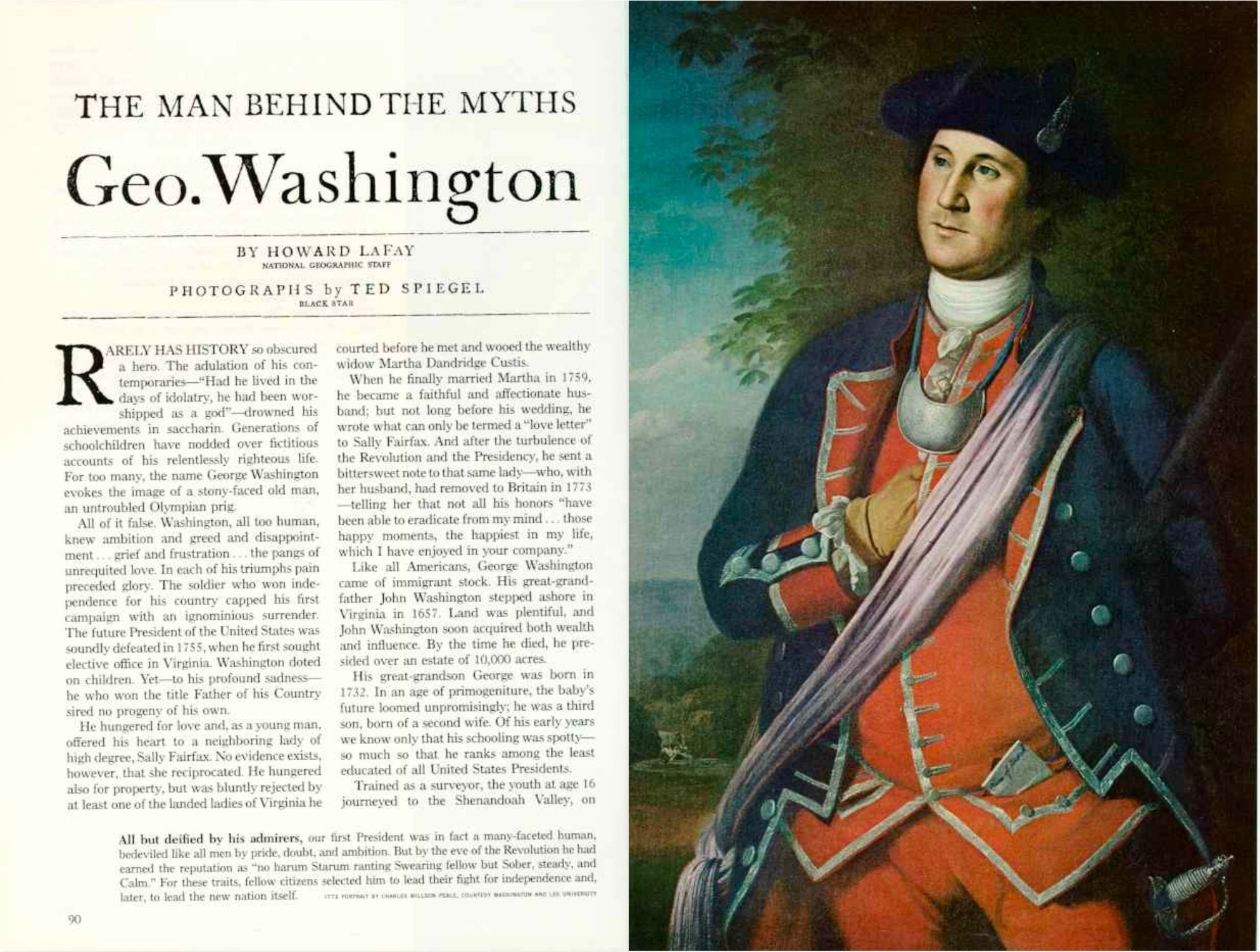
The July 1976 issue of National Geographic was a celebration of America. It was the time of the US Bicentennial, which captivated the country in the mid-1970s. While much of the issue looks backwards with exposés on George Washington or the country’s changing physical landscape, one article looks forward to the future.
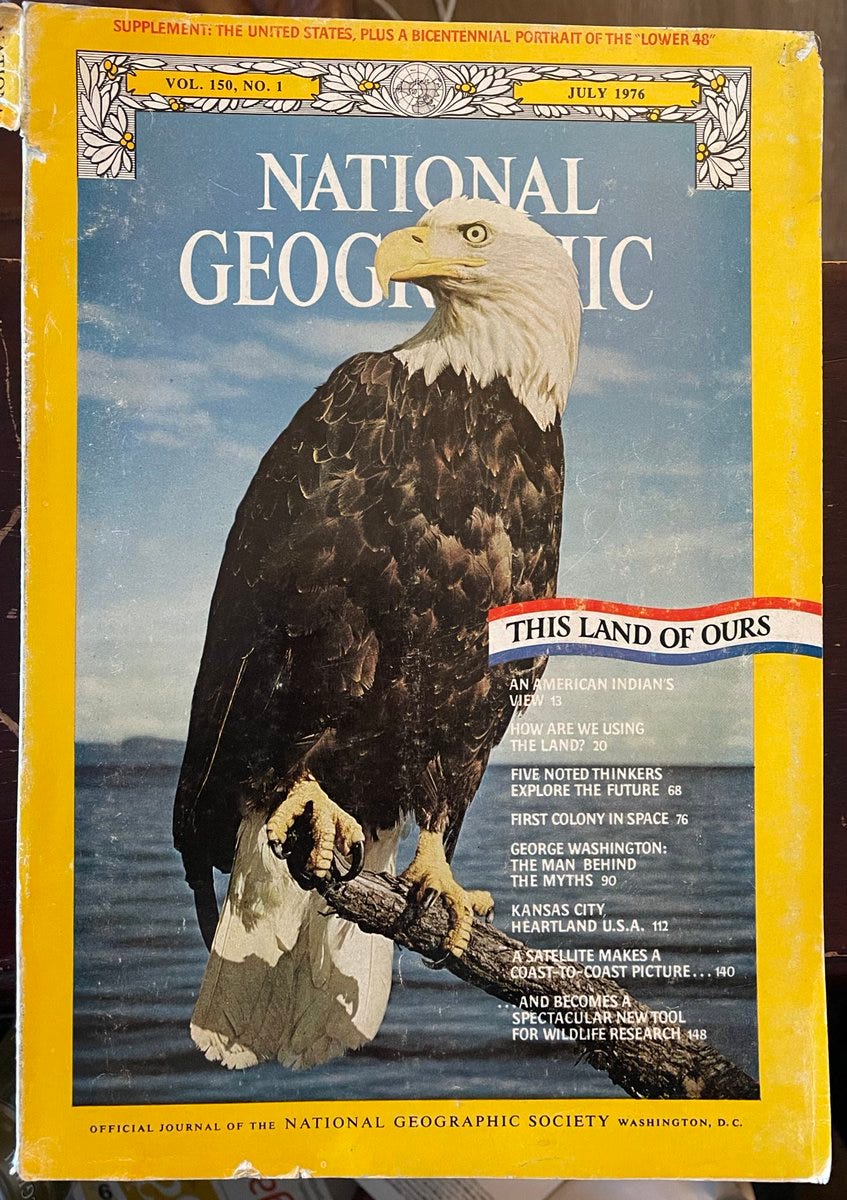
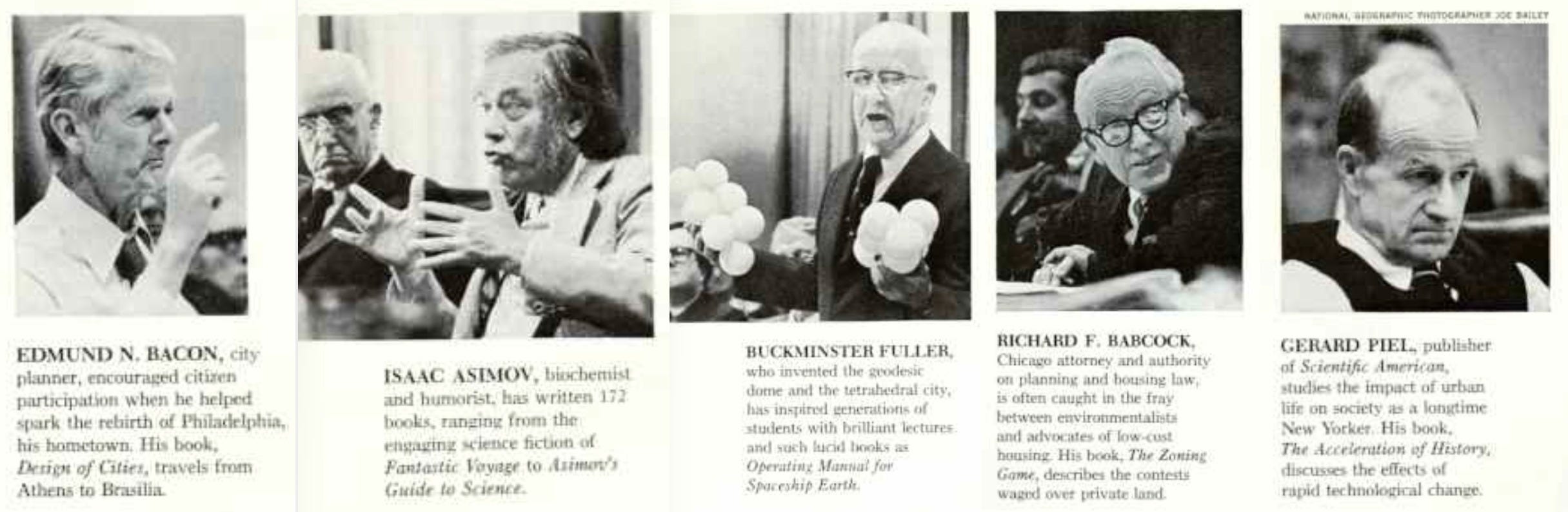
Titled Five Notable Thinkers Explore the Future, the article outlines a meeting between intellectuals and writers of the day, as they prognosticated on what life has in store for Americans in the future. We are now 50 years out from the US Bicentennial and these predictions. With the upcoming Semiquincentennial, it is a good time to see how they did. Thinkers included in the piece:
Gerard Piel - publisher of Scientific American.
Richard F. Babcock - Lawyer and housing advocate.
Isaac Asimov - Famed sci-fi and non-fiction writer.
Buckminster Fuller - Architect, author, designer, and inventor.
Edmund N. Bacon - City planner and urbanist.
So how did these illustrious thinkers do? Let’s dive in.
Wait, It’s All Zoning? Always Has Been
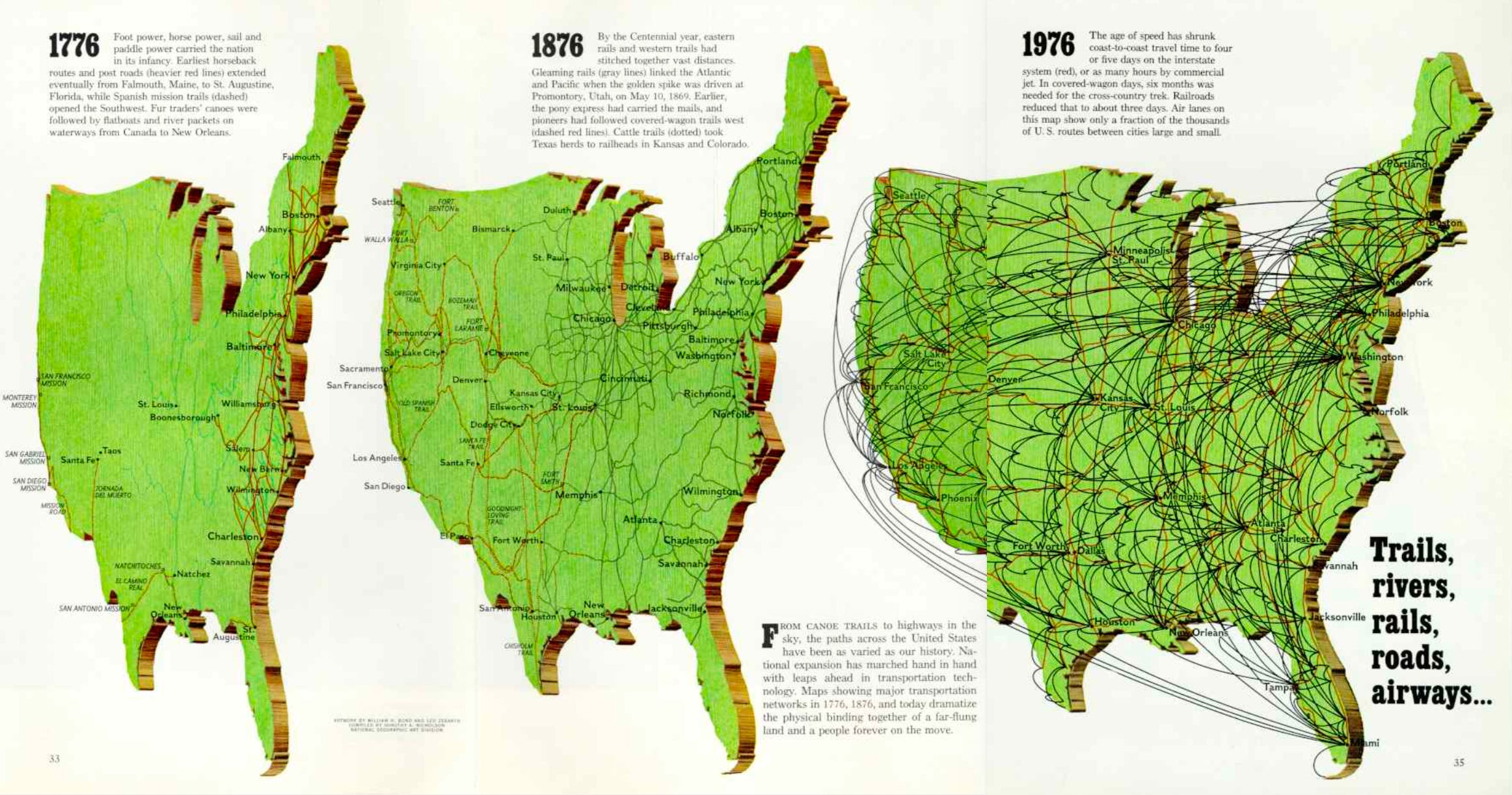
One thing that immediately jumped out to me was how much focus there was on the urban form, cities, and our inhabitation. They dissected the ills of zoning, in particular, along with the criticisms of post-war urbanism. I was not expecting there to be so much to be about land use!
But the urbanism focus makes sense in retrospect. The 1970s were a time of the "urban crisis." Cities were struggling, hollowed out by suburban sprawl, and, in some cases, literally burning (see the Bronx). When this issue was released, the country was still a quarter-century out from the eventual urban Renaissance defined by the Millennial-Hipster-Bespoke Revolution of the 2000s.
Surprisingly, the thinkers were actually predicting these leaps in urbanism. “We’re going to see the American people resettle in the city,” said Piel. Bacon echoes the point: “It means that the center, which we think of at the moment as decaying and being abandoned, will have a resurgence and will again become the focal point.” Even in the midst of a chaotic era, they could still see the power and potential of cities and, likewise, the drawbacks of suburban development, including racial segregation.
By the year 2076, unless we achieve a racially integrated society, you are going to see our big cities substantially all white. In the next 20 years at the longest, the suburbs, where the jobs are already moving, will be open to blue-collar blacks. -Babcock.
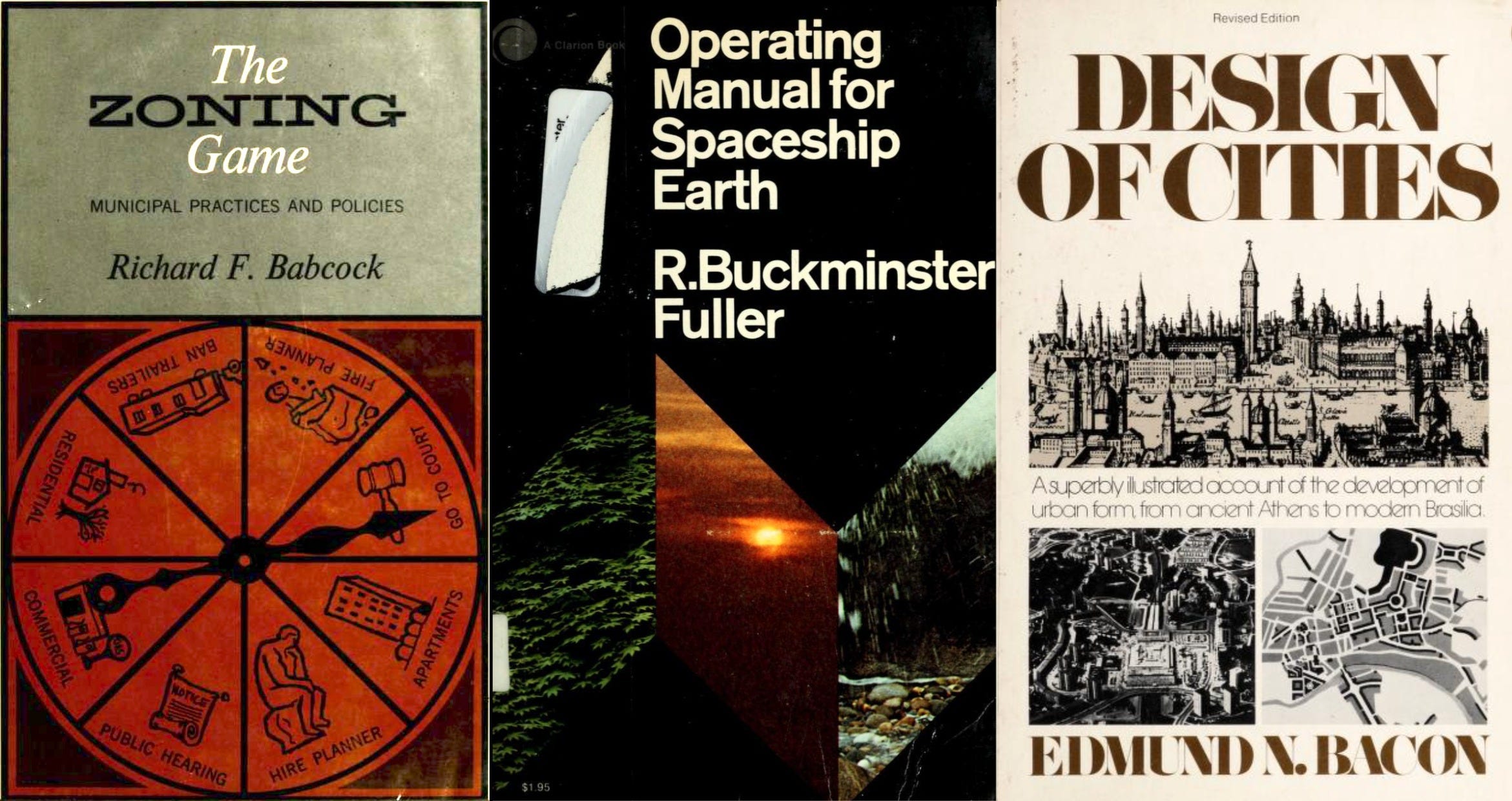
Babcock, who is sometimes labeled “The Dean of American Planning Law,” published The Zoning Game way back in 1966. In it, he argued that American zoning laws were political endeavors rather than scientific or rational, especially that of the growing suburbanization trend. The conceptions of land use in the article almost sound like M. Nolan Gray’s Arbitrary Line (2022), published a half-century later.
On the question of land use, I think it is perfectly clear that we’re going to see the end of suburbia. The suburban dwelling is the most wasteful of resources and of energy. All of the public investment in highways, sewers, and all the rest that makes this system possible is accomplished for the more fortunate at the expense of the less fortunate. -Piel
The great illusion of the suburban experience was that man can experience nature by owning pieces of it. And that is fundamentally incorrect. Nature eludes ownership. Becoming more urban and less suburban will also reverse the rhythm of life, to our great benefit. -Bacon
In critiquing the “Low density of the suburbs,” Bacon foresaw the helicopter parenting that defines American childhood today. “They should not have to depend upon their mothers being chauffeurs in order to make contact with friends,” he wrote. Indeed, since the 1970s, children have been walking less and being chauffeured more, leading to the dreaded school car pickup lines.
The School Car Pickup Line Is a National Embarrassment

I teach a lot of international students about the US education system and our schools. Whenever they go into our schools for the first time, one of the things that always shocks them is the school car pickup traffic lines. These lines are ugly, annoying, dirty, and they have become a common mainstay in American schooling.
Babcock even correctly identified state YIMBY movements. “I believe that by the year 2000 the states will have a significant voice in land-use policy,” he said. “The states will take back significant parts of the power they granted to municipalities.” While it took another two decades, the 2020s are certainly defined by states giving property rights back to owners, which were clipped away by obstructionists.

Although not everyone foresaw the battle lines that zoning had drawn. “New perceptions of land are going to make for a situation where private property versus control doesn’t become the main conflict,” exclaimed Bacon. If you’ve ever gone to a community meeting on a proposed apartment complex, you know these battles rage fiercely.
The urbanists were also shortsighted on the suburban experiment. There was a sense that it would eventually fail, with the rest of the country realizing the folly that they had already diagnosed in land use. “Are the suburbs dead?” posed the magazine. Yes, some have certainly failed, which is a central thesis to Charles Marohn’s suburban Ponzi scheme concept from Strong Towns. Yet, the country has not abandoned the overwhelming suburban form, to the chagrin of urbanists today.
Peak Everything
This period of American history seemed to elicit thoughts on peaks and excesses. In 1968, Paul R. Ehrlich published the devastating book The Population Bomb. The central thesis was that the world’s growing population could not be supported by the food supply. His calamities never came to be. But his theory was influential. To the credit of the thinkers in this National Geographic piece, they went the other direction from Ehrlich’s alarmism.
Despite the imperfections of our society, however, we see in our vital statistics, and in those of every other industrial nation, the impact of industrial abundance. All the industrial nations are approaching zero population growth. First their death rates came down. Then, with surviving offspring assured, they reduced their birthrates. We have every reason to believe the same will happen in the developing countries, as they achieve economic expansion. -Piel
Piel was mostly discussing this population slowdown in terms of expected economic growth, or that we should not expect to see infinite growth in the future. His prediction is exactly the issue many countries are grappling with today, too few babies, not too many, as Ehrlich errantly predicted.
They were, though, concerned about aspects of energy use. The memories of the OPEC oil crisis and fallout were clearly fresh in their minds. Likewise, the notions of Peak Oil or running out of resources were starting to take shape during the era.
We are assisted considerably in facing up to the problems of urban settlement by the fact that the petroleum of the world is rapidly becoming exhausted. We are going to have to move from a petroleum-base mobility to an electric-base mobility. We’ve got to quit using petroleum for our basic way of getting around. -Bacon
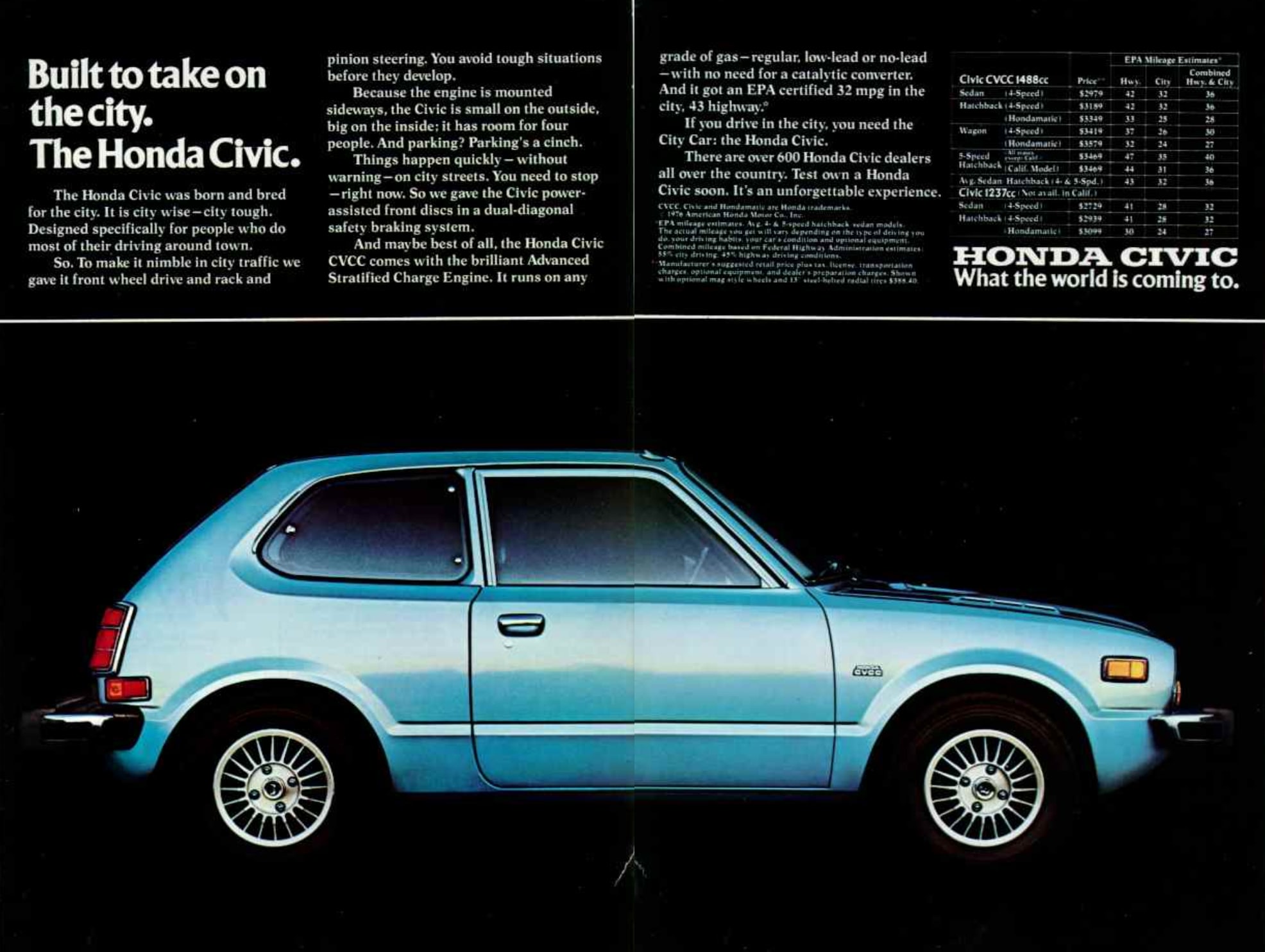
His colleague Piel added, “It’s quite apparent we will be living in the post-petroleum age.” Obviously, the autocentric approach that inundated post-war America was seen as unsustainable. Bacon asserted, “The only reason for a vehicle will be to bring a baby home from the hospital or to take a casket out.” While we are certainly not anywhere close to car-free America, we are certainly on a rapid collision course with change through electric cars, self-driving improvements, better battery technology, and other renewables.
Even though the world was facing energy competition, Fuller foresaw a future of global cooperation in this area. He believed that somehow the world’s powers (US, China, USSR) would join forces for a global “intercontinental” power grid. He was obsessed with the wasted energy in the technology of the day. “I know it is highly feasible to take care of all humanity at higher standards than anyone has known,” he encouraged. Alas, we have not yet reached this peaceful Star Trek-like world unification.
Isaac Asimov is Out of This World
While much of the guesses in the piece were rooted in some practical policy and societal questions. This is actually one aspect that I was slightly disappointed with the thinkers; there were so few fantastical sci-fi predictions. Of course, Isaac Asimov was the one exception.
“I have written about the world or global village, tied together electronically, with every citizen able to communicate instantly with every other,” said Asimov, who predicted the modern world of the internet and smartphone by then through his fantastical sci-fi stories. By 1976, he was already blending science fiction with science fact.
We will have to have a steady-state society, in which all innovations will be looked closely for possible evil side effects, because the big slogan of the 21st century will be: No More 20th Centuries! -Asimov
His concern that Americans will be apprehensive of new technologies was apt. The country has a kind of distrust for new innovations. We saw this with the rise of credit card transactions, the internet, smartphones, and now AI. The current rising opposition to data centers mirrors Asimov’s prediction.
At the same time, Asimov also made some bold predictions that never really came to fruition, not yet at least. In one, he posited that the human race would stop building up via skyscrapers, and instead drill down to subterranean cities.
We can live all year round in an equable temperature at all latitudes: We can have transportation not affected at all by inclement weather. We can establish our night and day the world over to suit ourselves and thus remove a great deal of what separates us. -Asimov
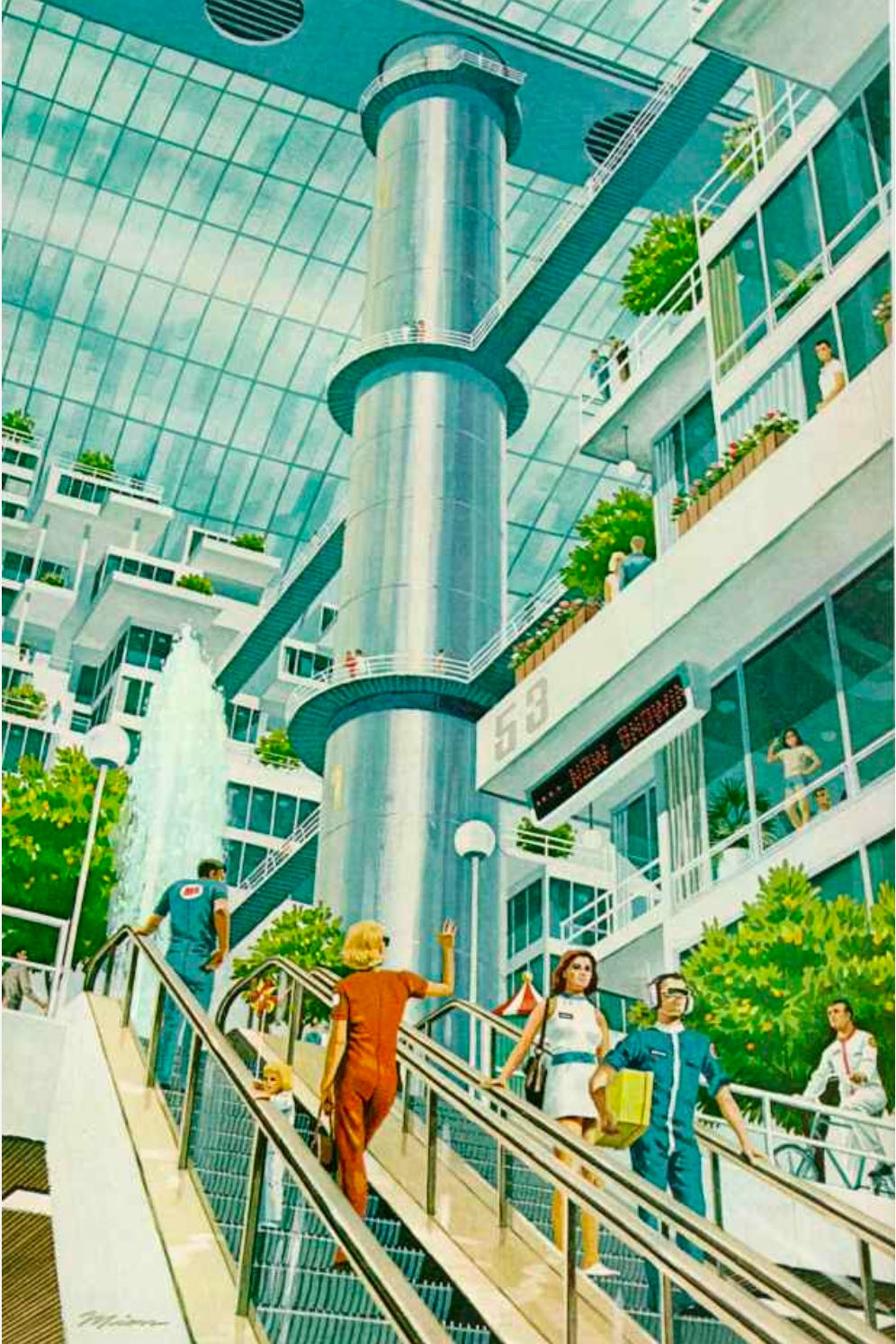
Challenging this subterranean point, he ended up arguing with himself, adding that the human race may much rather prefer going up. Not in high-rises, though, but to outer space. Of course, just standing pat terrestrially was not a listed option.
Going up, however, is perhaps the more attractive direction and the one that mankind is more likely to take. Our concept of land use now may include not only the land on the surface of the earth. We can colonize the moon or build space colonies. -Asimov
National Geographic seemed so intrigued by what the sci-fi writer was predicting that they gave him his own article in the same issue. Entitled “The Next Frontier?,” Asimov described what space life would be like for future Americans. I must say that it includes otherworldly illustrations by Pierre Mion. I love the optimism in post-war retrofuturism.
Colonies, whether they are on the moon or in near space, would fulfill functions that are now fulfilled by the cities on the surface of earth Properly handled, the earth may become a rather parklike world, a rather low-density world, with most of humanity living in space communities. And then, someday; there will undoubtedly be a panel talking about the future of space use. -Asimov
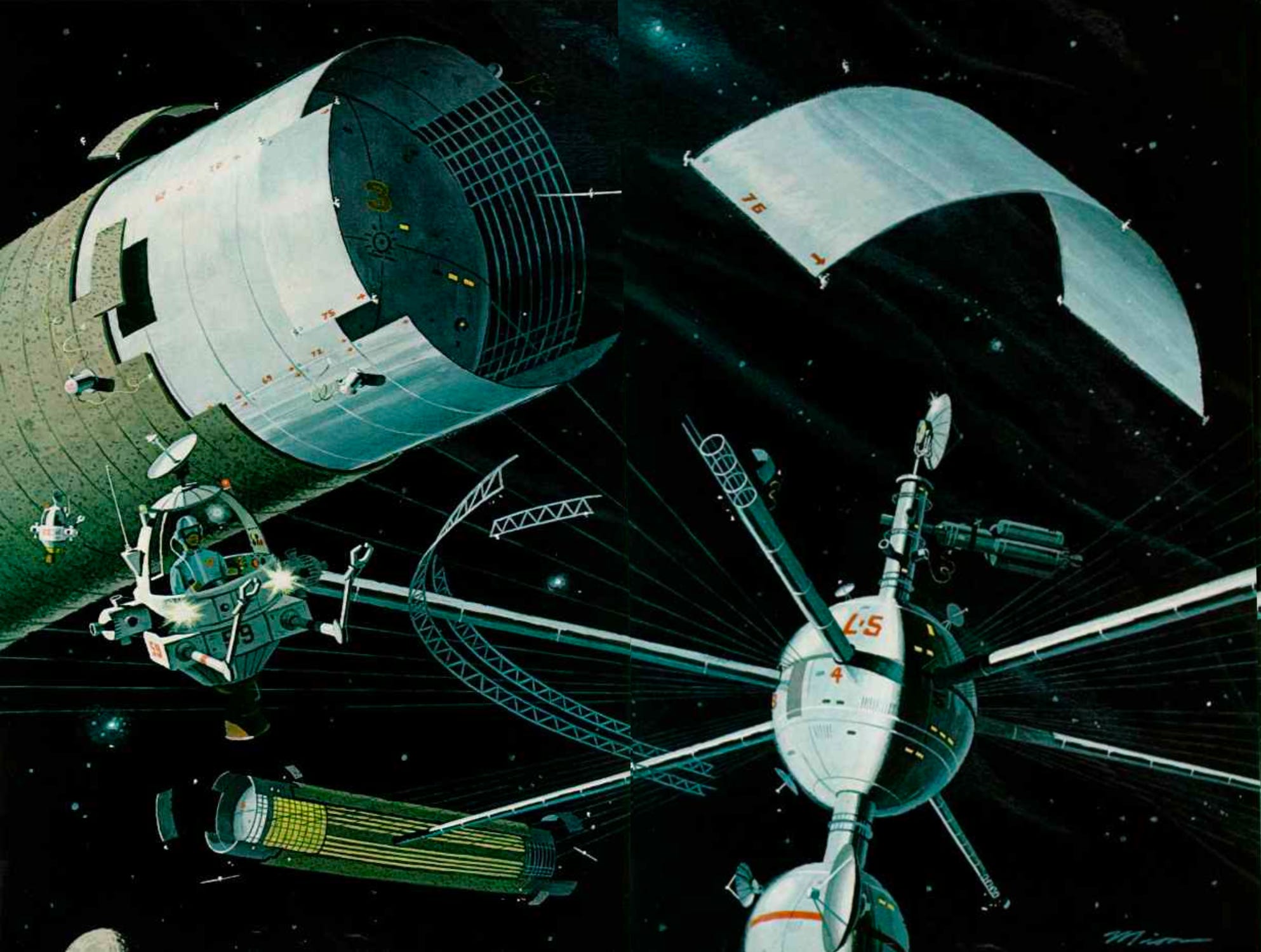
In the end, we did not reach these heights, even with the renewed interest in space exploration. He did make some astute predictions, such as the rise of the internet, but he would be disappointed at the advancements we haven’t really made in interplanetary exploration. We still seem very far from a Moon colony.
The US Needs a New Space Race

This article is the first installment of my United States Semiquincentennial Series. This series is a celebration of the country, its history, and the American people. It also offers direction moving forward to the next 250 years of our country.
My Blurb for America in 2076
This has been fun to go back and see what the smartest people predicted for life today. They got some right, and a lot wrong. There were not even that many wild predictions (save Asimov). I guess it shows how serious these guys were, but it lacks imagination, even if proven correct.
Their guesses made me think of our own current expectations for the future. I see some parallels to the Peak stuff from the 1970s with the trendy term “late-stage capitalism,” basically peak capitalism, before everything comes crashing down. The futurists of today might make this kind of prediction, as did some of the thinkers then. But they could be wrong, and the system endures, despite its warts.
Some of the current discourse reminds me of the failed Population Bomb prediction of Ehrlich. Given these population concerns of yesteryear, I do wonder if our consternation over the nose-diving birthrate numbers across the world will somehow be worked out. Perhaps, like with farming, the technology will bring ease and efficiency to laborious situations, which was seemingly the innovation path that the thinkers in the piece leaned on for their predictions.
I guess the lesson from these futurists is that a lot of predictions are going to miss, while some will hit. The most pressing problems of the day may just fade into an afterthought. On the other hand, things that are salient right now may only become more so. Like Asimov with the internet, I can see similar shades of this with the rise of AI. No matter the Bicentennial of 1976, the Semiquincentennial of 2026, or the Tricentennial of 2076, the future always remains to some degree unpredictable, even by the smartest people in the room.
Thought you might enjoy this article about a commencement in Florida booing the speaker talking about AI
https://www.404media.co/ucf-ai-commencement-speaker-booed/?ref=weekly-roundup-newsletter