


Note: Around the College Town is my weekly-ish links roundup article on urbanism and education. These posts mostly cover news that may have fallen through the cracks rather than the big events. Subscribe to get these updates.
Hoppers is NOT a NIMBY Movie
Note: Spoiler-free, with only light plot points.
I will just answer the headline question up front: No, Hoppers is not a NIMBY movie. I first reported on the outrage bubbling in the YIMBY community over this new Pixar movie trailer a few months back. But I pointed out that we urbanists need to chill out since we hadn’t actually seen the film yet. I was right!
I watched Hoppers over the weekend, and it is indeed not a NIMBY movie. It’s actually an urbanist movie, albeit somewhat complicated. The main controversy is not stopping housing, but rather stopping a highway from bulldozing a vibrant neighborhood (of sorts). There is even a scene with a proposed ring highway around the city of Beaverton (a stylized version of the Oregon city by the same name).
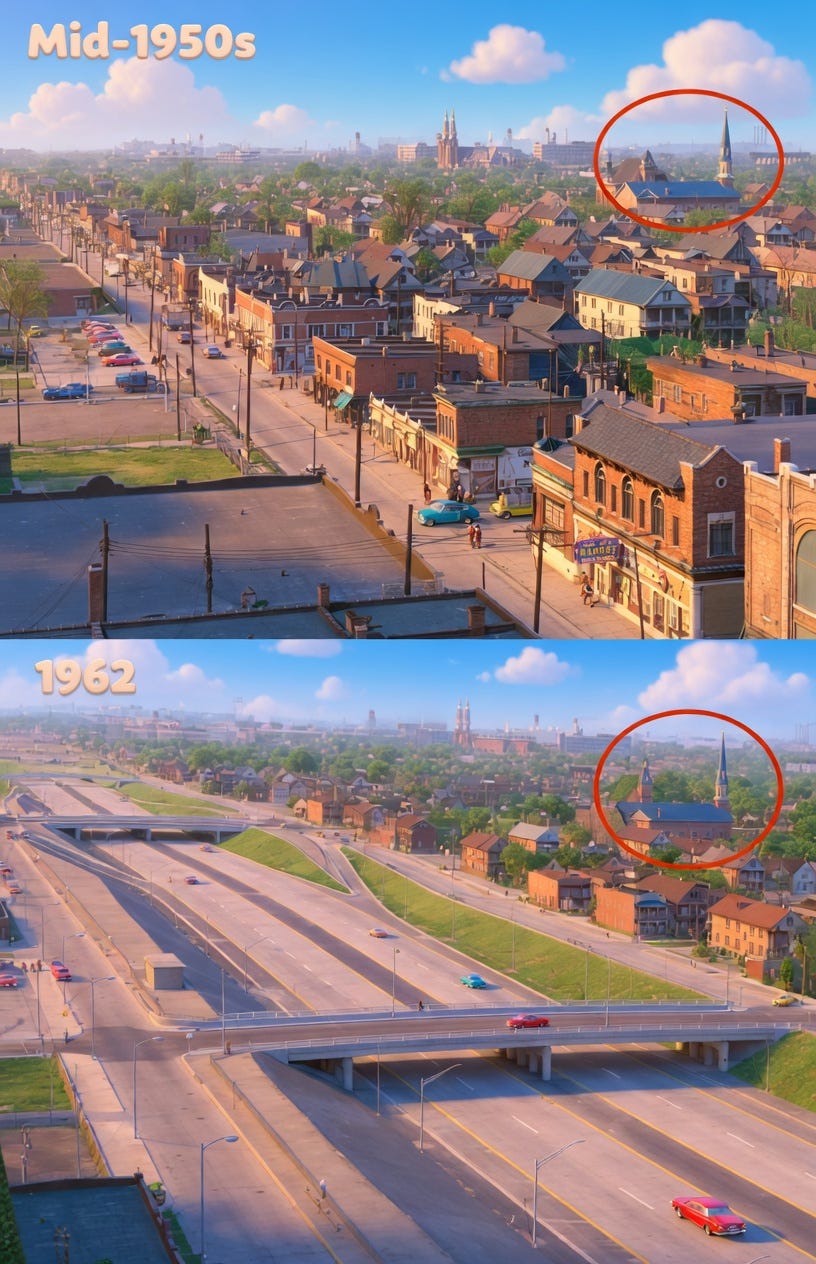
The scheming antagonist is Mayor Jerry, played by the always good Jon Hamm, who wants to build a highway through a local glade to connect the city with the white picket fence suburbs. The protagonist, Mabel, a young college student at Beaverton University, has fond memories of a pond and picks a fight against the highway plan. “Nobody even wants your stupid highways,” she yells. “Everybody wants my stupid highway. That’s why I’m going to get reelected," the mayor retorts.
I think the writers must have been sensitive to the possible NIMBY critique, so they inserted some talking points that urbanists often themselves champion. “The Beaverton Beltway, getting you where you need to go up to four minutes faster,” says the obtuse mayor, obviously lampooning the One More Lane Will Fix It meme. “People love highways. They love getting to places fast,”1 he adds, sounding like the real-life traffic engineers so lamented by urbanist communities.
I won’t get into any more specific plot details, but this basic setup shows how the film doesn’t really have a NIMBY message, even if it isn’t a YIMBY movie either. I see the film as more of Pixar’s version of the Jane Jacobs vs. Robert Moses fight, the legendary battle to save the soul of New York City. Mabel is the gadfly stand-in for Jacobs, while the Beaverton Mayor is the NYC Mayor. Although, the plot does get a lot weirder than this dynamic as the film progresses.
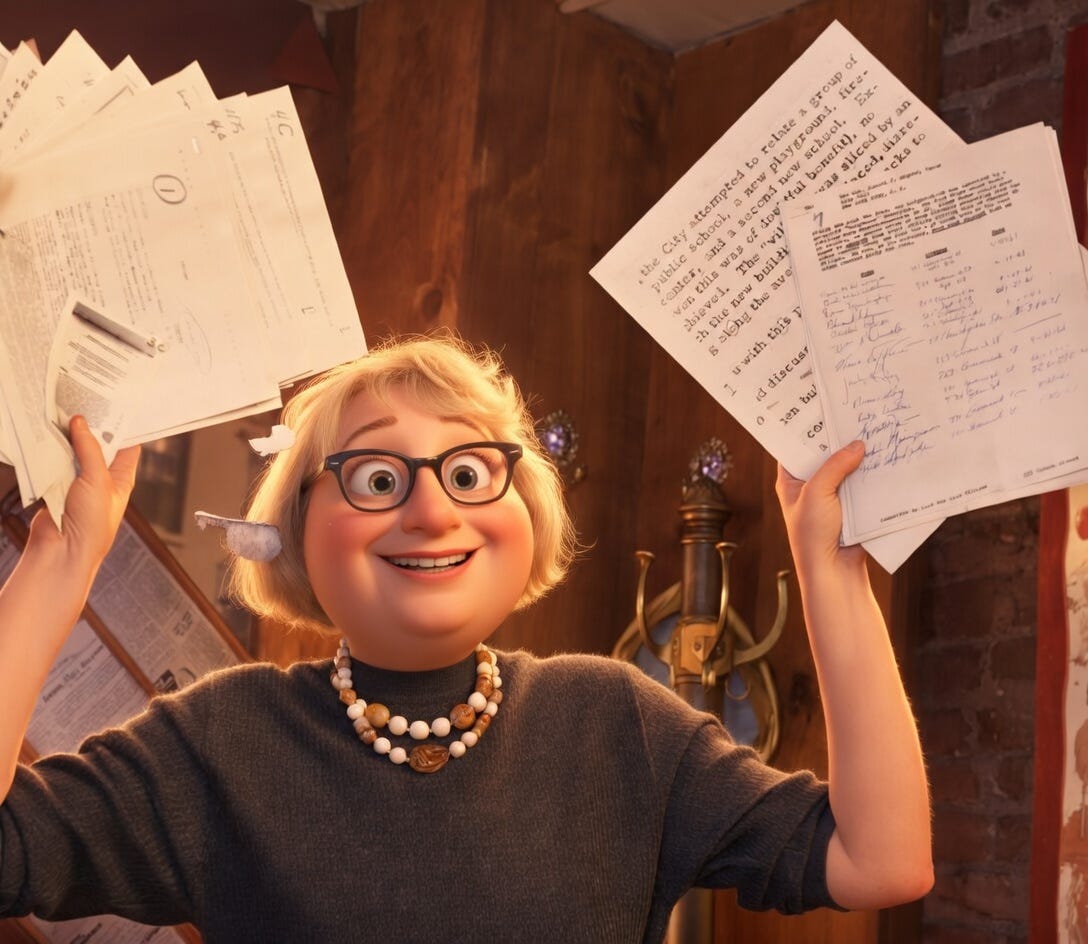
I will say Jacobs is complicated in urbanism circles. She is claimed by two different divergent sides. On one side, it is argued that she advocated against car culture and suburban sprawl. Another side says she illustrates the importance of community engagement and historical preservation. Sometimes these two sides do not get along, hence the divide in urbanist circles. So perhaps both will claim Hoppers as their own, along with environmentalists.
Finally, after confirming that Hoppers is not a NIMBY movie and, instead, labeling it as an urbanist movie, I must close with some bad news: Hoppers is just not very good. This new film is about as humdrum as they get. Very average. We are long gone from the Golden Age of Pixar. Hoppers is not going into the Urbanist Movie Hall of Fame alongside Roger Rabbit. No matter the NIMBY, YIMBY, or urbanist messages, I expect the film to be forgotten fairly quickly.
Links I’m Reading This Week
Education
Universities are landlords now, a new role that brings considerable challenge.
Losing public trust, elite universities look to pay more taxes (in the form of donations to local services).
Princeton, NJ, is battling NIMBYs; many such cases in college towns. I do know a half-empty closed college campus right in the middle of town that could make a great affordable housing spot.
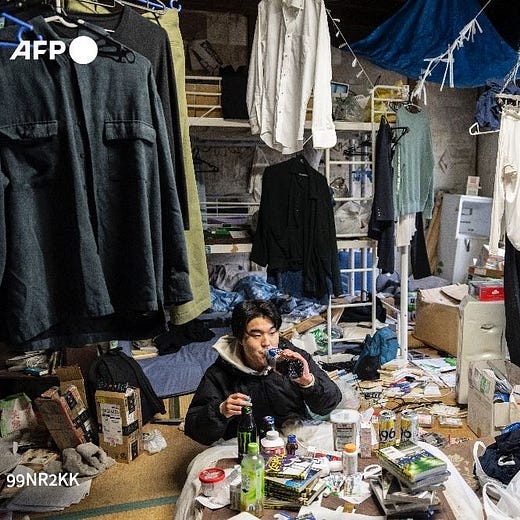
Inside Kyoto University’s chaotic and magical student-managed dorm. This looks so fun.
 Agence France-Presse@afpfr🇯🇵 Le Foyer Yoshida de la prestigieuse Université de Kyoto est autogéré par les étudiants. Malgré les signes évidents d'insalubrité, ils le chérissent comme un bastion de la libre pensée, face à la hiérarchie stricte qui domine la société japonaise. ➡️ u.afp.com/SLgi

 3:00 PM · Mar 15, 2026 · 23.6K Views7 Replies · 21 Reposts · 146 Likes
There are too many Americans studying at this Scottish university, say the Americans studying at this Scottish university.
US slips to #3 in choice of study by Chinese international students. There will be large reverberations as these student pools dry up.
The economic impact of H-1B visas has been massive for the US economy. More problems loom on the horizon as we continue our insular policies.
Airports are classic college advertisement vectors. But how about the university press? Great idea! Kudos to University of New Mexico Press for this:


Don Taylor has an interesting observation that state schools have better transfer rates, so it’s easier for college athletes to hop around and still (possibly) graduate.
Urbanism-ish
Trinity Broadcasting Network HQ torn down. Not that important, but I used to drive past this place all the time. Felt very out of place along a highway.

The private passenger rail service Brightline is booming, as customers are looking for ways to get around skyrocketing gas prices.
A driver fell asleep in a Tesla while on the highway. It’s this exact kind of irresponsible person we must get off the road immediately. Put them on the bus or a Waymo.
Cool refabricated construction development in upstate New York. These kinds of new building methods don’t have to be ugly!
A wildlife bridge in California cost $114M, almost $100 million more than comparable projects in other states. This was actually a much-needed project, but it’s frustrating that the state cannot do anything on a reasonable budget.
Closing Time… March Madness Celebration
I love March Madness. It is one of the last American monocultures that unites so many people watching one shared experience. Writing for Matthew Yglesias’ Slow Boring , Halina Bennet makes the argument that we “have a moral obligation to join an office March Madness pool to do your part to prevent the disintegration of the social fabric,” as explained in a Tweet from Yglesias. Hey, I’m doing my part by watching the games.
Beyond the basketball, though, I love March Madness because it celebrates the diversity of higher education institutions from across the spectrum. Colleges that most people have never heard of take down the giants in the sport. I first learned about universities like Gonzaga or Butler by following their Cinderella runs in the tournament as a kid. It is part of my love for colleges broadly.
This year’s Cinderella has been High Point, which upset Big Ten basketball power Wisconsin in the first round. Through the victory, audiences discovered that this rural North Carolina liberal arts college is basically a resort. Research has shown that doing well in the tournament can really boost an institution’s reputation:
Making the NCAA’s March Madness basketball tournament provides a national spotlight and advertising effect that is good for any school. Winning in the tournament is even better. But being a smaller, lesser-known private school that advances surprisingly far (winning at least two unexpected games) in the tournament is especially fruitful…
We find that making a Cinderella run in the tournament provides promotional buzz that increases freshmen enrollment by somewhere between 2.1% and 4.5% 2 years after the successful performance (Collier et al., 2020)

Sadly, High Point turned into a pumpkin a little early, losing to Arkansas in the second round. Yet the message seems to be out on the school now. The strength of US higher education is that we even have places like High Point. March Madness is a visceral and fun reminder of how great and diverse our sector can be.
There is no public script, so I tried my best to get the quote correct.