

Note: Around the College Town is my weekly links roundup article on urbanism and education. These posts mostly cover news that may have fallen through the cracks rather than the big events.
Graduating Into and With AI
It’s graduation season! Congrats to all those recent grads ready for a new adventure. This week, a lot of talk has happened around this graduating class having to grapple with AI. The job world for recent grads is indeed in massive flux due to the wide adoption of the technology.
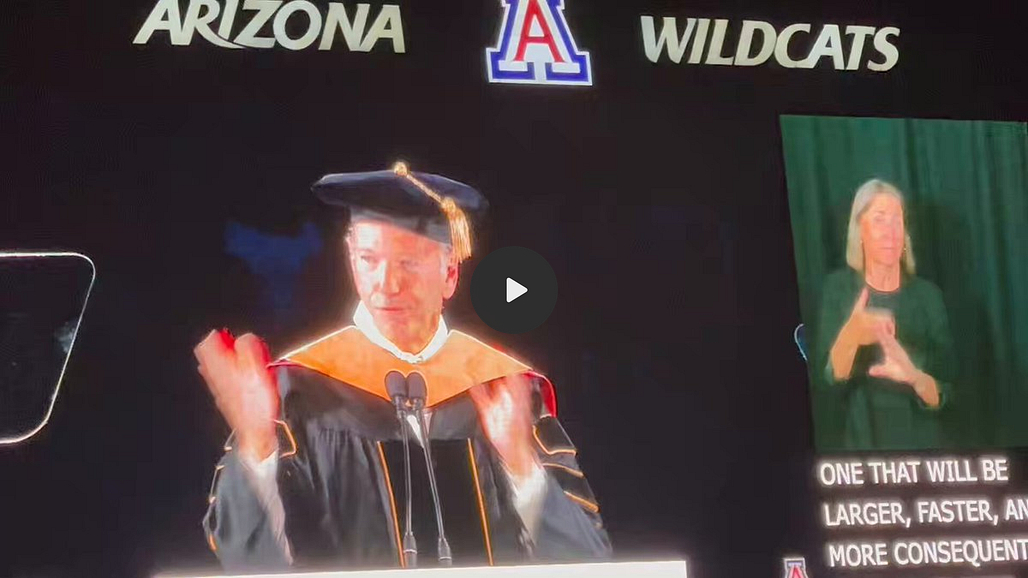
Given the concerns over AI, it should not be surprising that students recently booed commencement speeches by speakers lauding AI. This happened at the University of Central Florida (thanks to Ray Berger for flagging this one) and the University of Arizona. Not even former Google guru Eric Schmidt could convince the students of the tech’s merits.

At the same time, there were a few high-profile op-eds from students on their cohort’s adoption of AI. Basically, most of them cheated, according to these writers.
“We are the first college class of the A.I. era — ChatGPT arrived on campus about two months after we did,” wrote Stanford graduate Theo Baker in a New York Times op-ed. “When we graduate next month, this technology will have altered our lives in very different ways.”
Indeed, these students were guinea pigs in the lab of AI higher education experimentation. The experiment has gone awry, and the test subjects know it. The ease and temptation to use AI to cheat have simply been too great. Baker wrote:
Cheating has become omnipresent. I don’t know a single person who hasn’t used A.I. to get through some assignment in college, yet the school was at first slow to realize how widespread this would become.
Given this one was in the New York Times, it received a lot of attention. But another newspaper with a lower profile echoed these same claims. The piece chronicles cheating at Western University, London, Ontario, Canada. One anonymous student admitted:
In certain situations people just want to do well, students, and I fall into this category, that knows cheating is not right, you just go along with it because the robot is going to be better at wording of a professional essay.
Both stories are especially concerning. Stanford is supposed to be a place for our best and brightest, an engine of innovation. The author does bring up the dubious ethics by past alumni, with several high-profile alumni in jail, such as Elizabeth Holmes. Further, the story from Western was regarding a health class. Look, I’m all for using AI to improve diagnoses, but I’d like my medical practitioners to have some competencies without the tech.
Over at the r/professor Subreddit, my fellow colleagues were lambasting these students and their cohort. Cheating with AI has been the bane of this group since the rollout of ChatGPT four years ago. It changed the profession forever, even if some professors refuse to believe it. Some harsh responses:
The message I got from this article is that while some students resort to booing commencement speakers at the mere mention of AI, they are quite happy to use AI during their education, even at hallowed institutions like Stanford.
Bingo-- they don't like the "we might have no jobs when we graduate" part… they sure love the "let me just use AI to do these assignments so that I don't have to learn anything" part. It's kind of a double-edged sword but both edges cut in a way that renders them unemployed.
Grim, maybe, but not much we haven't been chewing over in here for years. I think the hardest part for me is accepting that it's a whole culture of lying and thievery these days and that I can't trust even my best students. That if I get excited about anyone's work at all, there's a 50/50 chance I'm being played for a fool. At best, it's a waste of energy to care any more.

Tough quotes. But they represent very real frustrations from the faculty. Some have suggested we go back to older models of assessment: Blue Books, oral exams, and in-person proctoring, etc. Yet, there is pushback to these efforts.
At Stanford, professors are banned to “proctor in-person exams.” Baker wrote that some considered this practice to be a “nuclear option.” At Western, one professor said handwritten exams were not feasible. “A written exam by hand tests, first and foremost, a student’s handwriting skills which, in this generation, (are) almost absent,” he told The London Free Press. “It also means deciphering handwritten answers.”
Despite these barriers, universities (and professors) are realizing that the same ways of doing things can no longer remain. Hollis Robbins, a fellow educational Substacker who has been on this AI-higher ed beat for a long time, outlines some possible rules for institutions on Anecdotal Value. Universities need to get real and help these students help themselves.
The graduating class is right to be concerned with AI threatening their careers, even if many of them were using the tech to cheat. Universities should realize these temptations are too great, even for the best students. Our sector must adapt, or the boos at graduation will only continue.
Links I’m Reading This Week
Education
Comedian Nate Bargatze is giving a student athlete a role in the next film to sign with Vanderbilt U. College football really is in the Wild West era right now. Anything seems possible.
Oklahoma City U’s golf team won their division’s national championship, despite the school announcing the closure of the program. All too common in higher ed these days. Good quality and importance don’t always translate to survivability.
In more closure news, Oakland City U, not to be confused with similar-sounding named institutions in the Bay Area and Michigan, but in Indiana, flip-flops on its closure. The school will remain open… for now. From my experience, reversing these kinds of closing messages cannot easily be put back in the bottle.
Princeton gets around the endowment tax by giving students more money. Seems like the ideal way to incentivize.
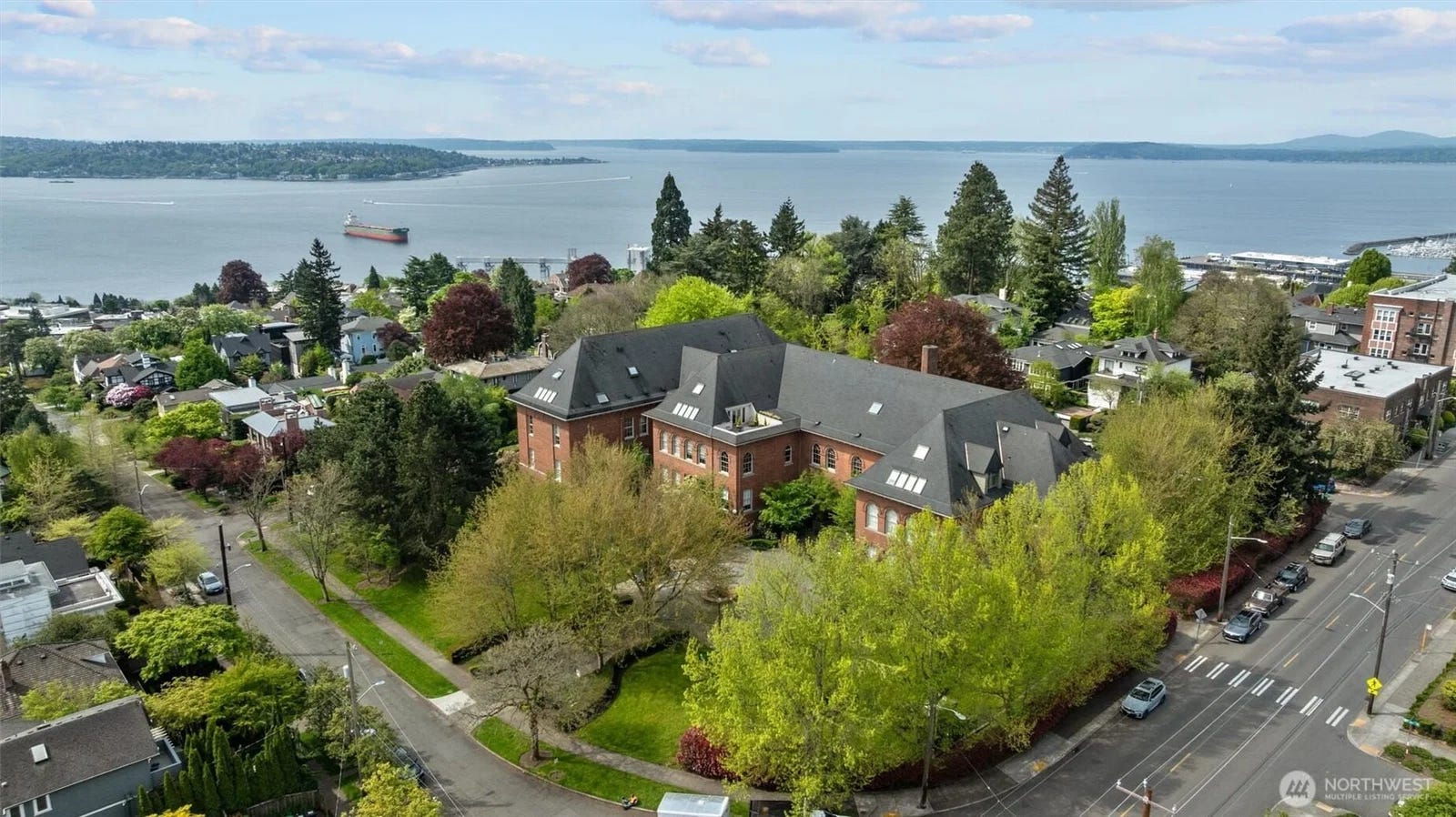
Would you want to live in an old school? Maybe this one in Seattle! But it does cost a million dollars, with another $2K per month for HoA. Ouch. Still cool adaptive reuse.
California may loosen regulations on public university student housing. It seems absurd that private universities already have these privileges when the UCs, Cal-States, and CCs do not.
In more housing news, Gainesville mourns dumpy abandoned gas station to be turned into student housing. Reading through the Facebook comments, I see so many locals harbor contempt for the University of Florida and its students. Sad.

Is it time to end peer review? Some fellow researchers believe AI has rendered the old academic journal publishing system unsustainable. It is a convincing argument.
Over in the UK, King’s College London and Cranfield University announced a merger. The vision for the merger is to create a “global university” brand. The Age of Conquest goes global.

Urbanism
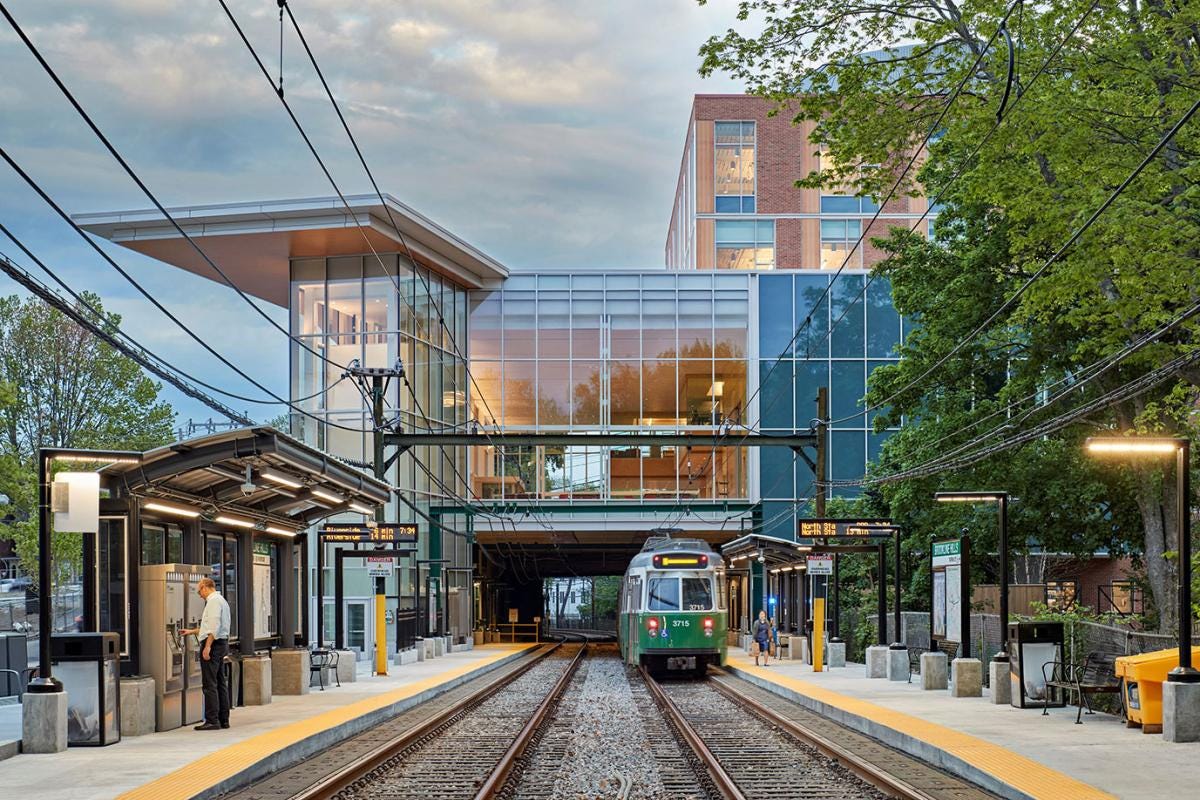
Brookline, Mass., has an amazing high school that sits over a light rail line station. I love this kind of integrated design. Too few schools these days have good urbanism.
New data on childhood immobilities in the US. Kids can’t do anything by themselves.
Ebike company locks out customers from their bikes. Another example of all this “smart” tech making things worse.
Giant novelty statues have been a fading tradition, despite their importance in Americana. But this lost art is making a comeback.

ABC News has removed the entire archive of the election prediction site FiveThirtyEight. This kind of thing is becoming more and more common. Good reminder that we must protect the Internet Archive at all costs.
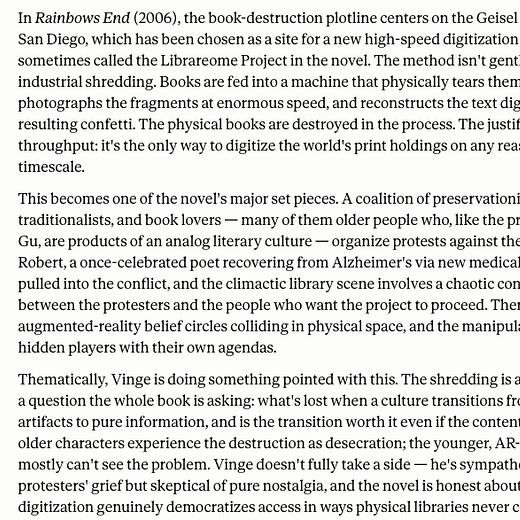
Likewise, AI training means destroying old books. What a bummer to find out.
 Sivori@sivoriAnthropic is buying millions of rare books, scanning and destroying them because legally destruction is the safest option. This was a plot element in the Vernor Vinge novel, "The Rainbow's End", which I read 20 years ago.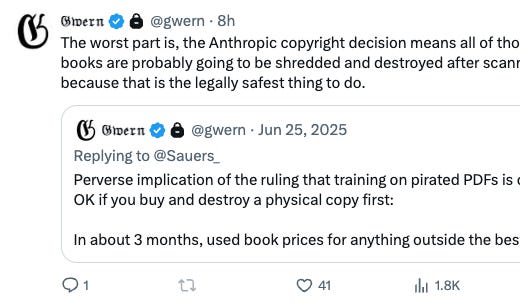
 1:52 AM · May 8, 2026 · 1.39K Views4 Replies · 7 Reposts · 44 Likes
In some California news, LA residents are angry at a proposed public restroom in a popular park. They think installing restrooms will attract more visitors so they would rather have none at all. Insane logic.
But it’s not all annoyance here. LA’s new D-line subway is a game-changer for the city. Heading in the right direction!
Brightline West, the high-speed rail line connecting LA to Las Vegas, is facing opposition from… Texas? Apparently, it is a lobbying group of angry farmers who hate trains (seriously).




Closing Time… No One Can Escape My Research. Not Even Me.
This past week, Middlebury College released a plan to sell the Middlebury Institute of International Studies (MIIS) at Monterey to the Soka University of America. Hey, wait, that’s my university where I work!
I have been researching closing colleges for three years now, along with a decade of research on higher education broadly. I guess you cannot work in US higher ed these days without going through either some kind of institutional closure or expansion. I even covered the closure of MIIS here on College Towns when it was announced in August last year.
As someone who researches college closures, I am happy to hear MIIS will survive. It is an interesting and unique institution. In my own field, they have long done great work in international education (although they ended the MA in International Education Management in 2025). So I am glad that the institution will remain open.
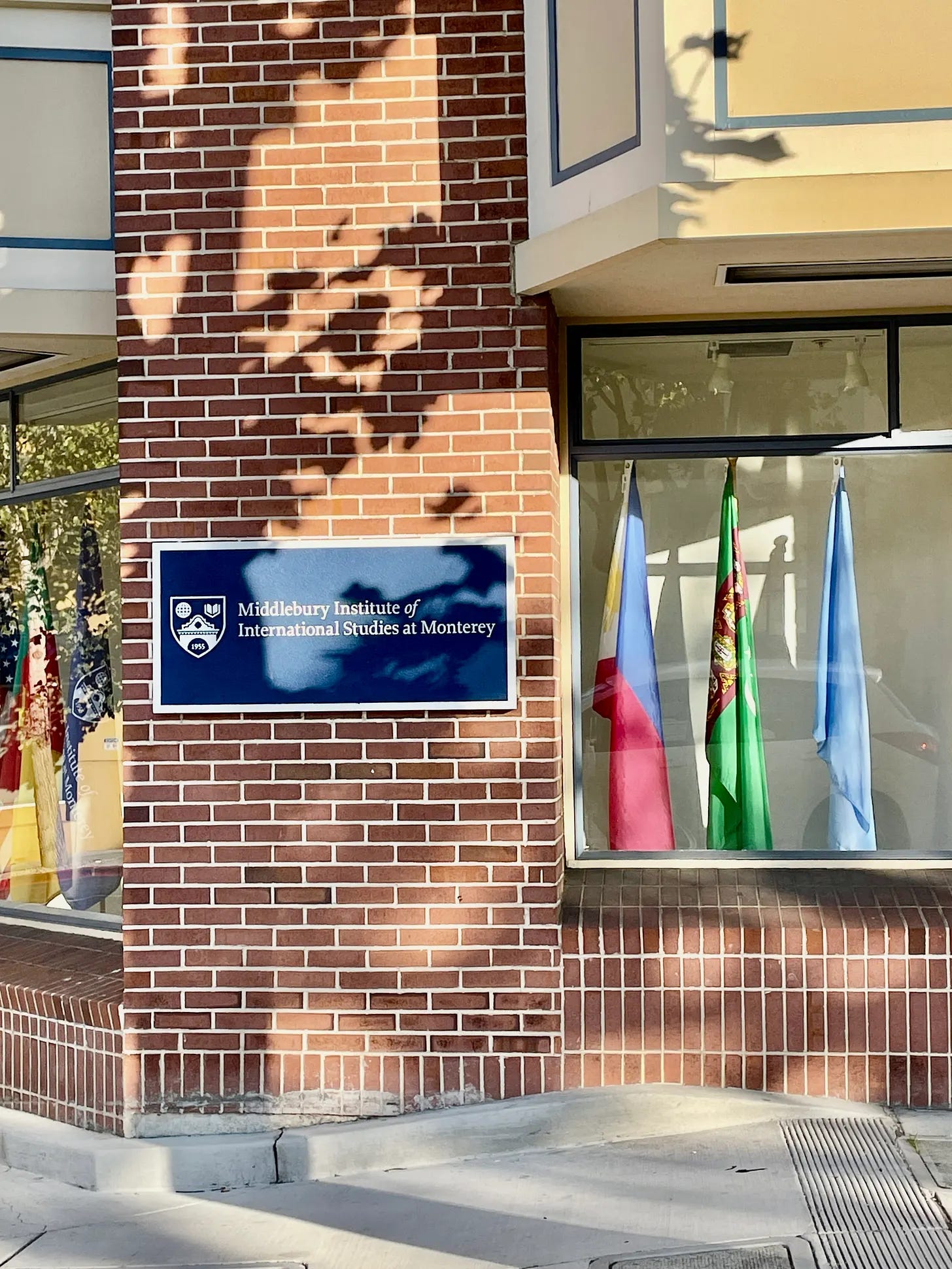
As a faculty member here, it is also interesting that I am now within an institution grappling with closure/ merger. There are certainly questions that I have that are both professional and research-related, like How is this going to work? Since the announcement was just for these preliminary stages, there is still a lot to work out. The deal will not even be completed until the end of the 2026-2027 academic year.
For now, I am excited to learn that a great institution has been saved, even if not every program will make it. I am also excited to meet my new colleagues, even if I still have questions around the merger. C'est la vie in this Age of Conquest of US higher ed.