


Note: Around the College Towns is my weekly links roundup article on urbanism and education. These posts mostly cover news that may have fallen through the cracks rather than the big events.
The Trend in Universities Cutting Child Care
In the last few weeks, three major universities have announced cuts to their on-campus childcare services. The University of Kansas announced the closure of Hilltop Child Development Center, while UCLA is ending the Early Care and Education program at the end of the academic year—both announcements have sent their community of parents scrambling to find replacements. Furthermore, Virginia Tech will no longer support childcare for its graduate students.
The 74 first brought up these trends in April of this year in an expose. Apparently, it is not just a trend in higher ed:
The child care closure at UNO is reflective of a concerning trend: Across the country, universities, school districts and hospitals are shutting down affiliated child care programs at an alarming rate as the cracks in America’s child care system begin to widen into fissures.
While the wider cuts are concerning, I think there are specific reasons within higher education that help to explain the trend in the sector. Just in the last couple of years, I counted 18 institutions that have shuttered their on-campus childcare facilities. The table below does not even include cutting childcare benefits like at Virginia Tech, and I’m sure there are others that I missed.
I see the shuttering of campus childcare as an erosion of the multiuniversity. Clark Kerr, the mastermind behind the tiered higher education system in California, coined the term in The Uses of the University (1963):
The multiversity is an inconsistent institution. It is not one community but several--the community of the undergraduate and the community of the graduate; the community of the humanist, the community of the social scientist, and the community of the scientist; the communities of the professional schools; the community of all the nonacademic personnel; the community of the administrators. Its edges are fuzzy it reaches out to alumni, legislators, farmers, businessmen, who are all related to one or more of these internal communities (pp. 18-19).
Universities and colleges operate as kinds of little cities. People live and work on campus, walking to class, for food, or other services. They have all kinds of services, from gyms, restaurants, barber shops, and child care. Many institutions even have their own police force. This bundle that looks more like a city came along as universities turned into multiuniversities.
The closures in childcare facilities signal an erosion of the do-everything university model. A lot of recent criticism of higher ed argues that universities have strayed from their core mission of educating students. One of the loudest complaints comes from the idea of over-administration. Just this week, The Chronicle of Higher Education ran an article titled, “Has Administrative Bloat Reached a Breaking Point?”
As a multiuniversity, the university is supposed to do everything, including child care. The expectation can help explain the rise of administrators or support staff over the last few decades. But with the hits to higher ed, it seems that institutions are retreating from some of these duties, hence the cuts to child care.
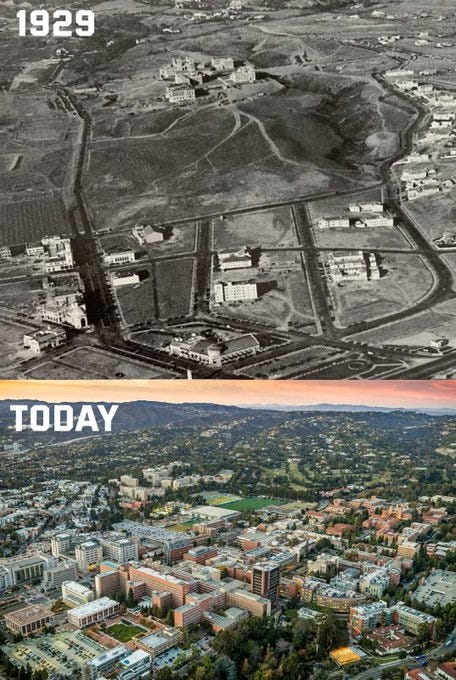
I have long believed that universities should do more to make life easier for parents. I appreciate places like the University of Virginia expanding family housing on campus. Given the concerns about birth rates, these issues should only be more salient, not less. Even if our universities are no longer multiversities, I think they should care about child care for their communities.
The low birth rate itself is likely playing a role in these cuts. There are just fewer (little) kids running around college campuses, as recent cohorts are having fewer children and also waiting until later. But the cuts to child care will only make parenting more difficult for both students and employees, adding fuel to the demographic cliff. It is a downward spiral. These are part of broader societal issues we are seeing due to fewer kids (I will have a piece on this soon).
Links I’m Reading This Week
Education
Some colleges are slashing prices, including the university where I work, Soka University of America, offering free tuition for families earning under $200K. I think these are overall good trends. Our sector has far too long saddled young people with too much debt.
Columbia Journalism School is pausing admissions into its MA. My guess is the student loan caps were a strong reason, since this degree can cost students $120K.


More Age of Conquest moves: Carnegie Mellon University to build a new campus in Miami. This one is funded by another billionaire, a trend I have written about in the past.
In more billionaire higher-ed news, an oil heir was given a professorship at a British university (Newcastle University). There is predictably a backlash!
Harvard removes homeless camps from property. There was a debate on the college subreddit, with one side arguing it's callous and the other that it’s necessary.
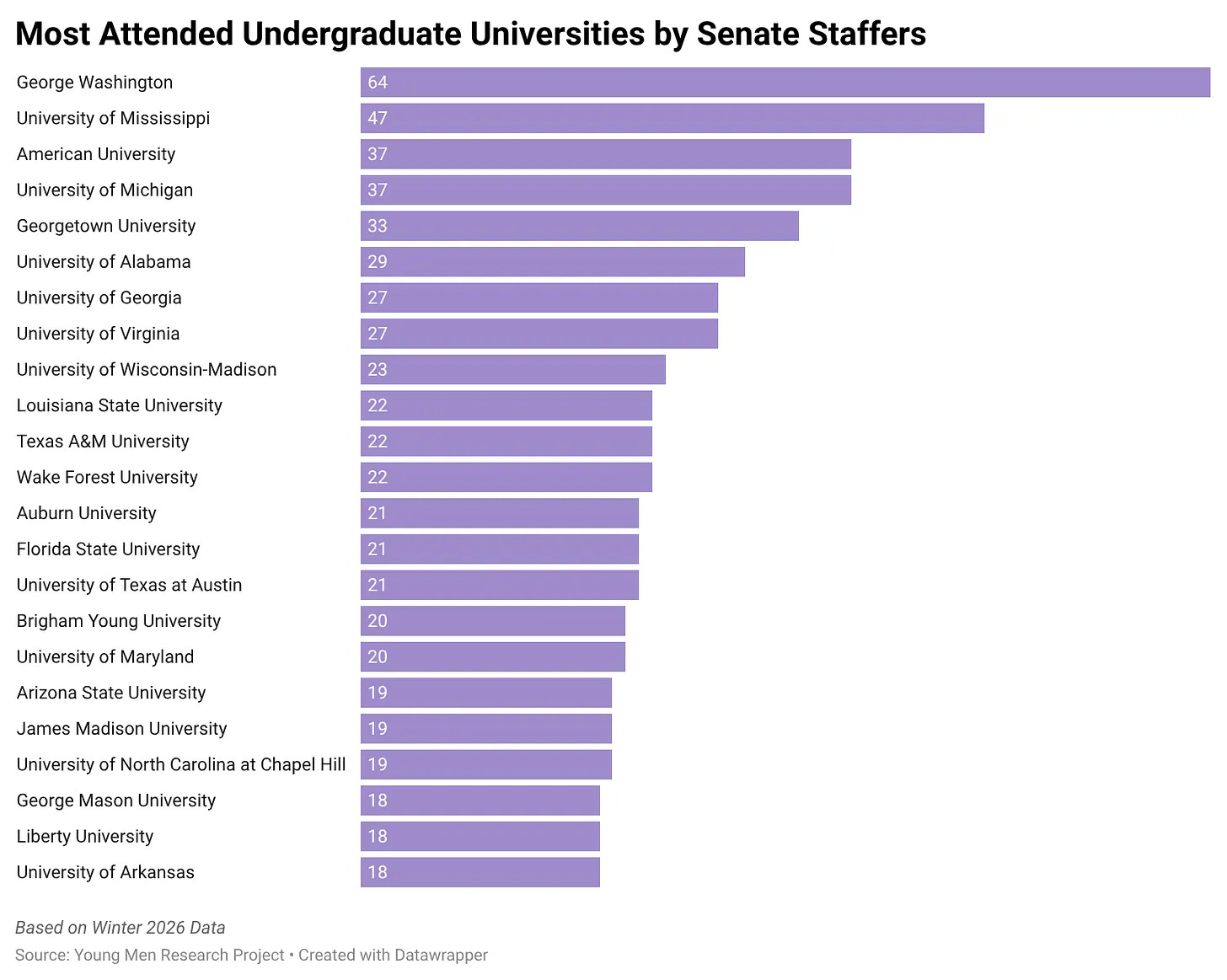
Here is data on where Senate staffers went to college via Naisha Roy and Charlie Sabgir at the Young Men Research Project. It is interesting to see so many state flagships from across the country rather than a handful of Ivies. But I guess this makes sense given the makeup of the Senate.
Stanford (allegedly) uses AI to race-swap a student in promotional material. Almost funnier, they used it to make the other kids prettier. So weird.
Nolan Monaghan Declares: Liberal Arts Education is Not a Scam. Hear, hear! Agreed.

Urbanism-ish
California high-speed rail delayed due to yet another lawsuit. What a disaster…
LA may have to cut our connection to San Diego by rail. What a disaster... again…
The Wall Street Journal did a video exposé on the terrible design of LAX. What an ongoing disaster!
I have also complained about LA’s new transit center in my review of the billion-dollar project. Some thought I was being too harsh, but the delays are proving me correct:
That’s the major problem with the LAX/Metro Transit Center: it’s surrounded by LA. The transit hub is not just going to fix a city, county, and region that has made 50 years’ worth of bad decisions around urbanism.
I cannot help but compare our progress to that of China. The country recently opened four new high-speed rail lines. Very jealous.


And if you want to go ride these trains for yourself, China is making it easier for foreigners to travel within the country with online registration.
Staying in East Asia, The Financial Times asks, Is Seoul the New Paris? As someone who lived there almost 20 years ago, I am quite intrigued. It’s a great city.
Now to head back home: OKC is getting the city’s first high school in its downtown. You can really feel the city revitalization in my hometown, where I’ll be next week for the Western Conference of the Association for Asian Studies.
In other parts of the country, where are all the good-paying blue-collar jobs? In Alaska. Go north!
And it is not all doom and gloom in the US transit world; Atlanta may get a light rail running next to its Beltline Loop. I reviewed a doc on these projects and came away quite impressed with Atlanta’s version.


Adaptive Reuse Corner
I’m back with another edition of Adaptive Reuse Corner. Last week’s winner came from the School/ Campus combo. While I voted for the Live-work unit, I would be partial to having a full basketball court in my house—just be wary of the upkeep!
The first two entries this week are both churches, one from Brookline, Massachusetts (A) and the other from Saginaw, Michigan (B). The one in Mass. is an absolute stunner of a conversion, but also a condo, meaning you only get part of the church for $1.2 million. The other in Michigan is cool for less than $249K, but basically has not been converted at all, meaning a lot more money.


The next comes in the form of two live-work units. The first is a bar-combo in Pittsburgh (C). If you have 2.3 million, live out your dreams of becoming Sam Malone from Cheers. Likewise, the other live-work unit from Colorado (D) sits in what was “once part of Deer Trail’s original downtown.” Nicely done for under $350K and only an hour from Denver, but the town itself looks to have seen better days. Do you have the courage to be part of its revival?


The next two are a bit cheating in Adaptive Reuse Corner, as they have houses within the wildcard properties. The first is a grain silo in southern Illinois (E), although it also includes a house on the lot. Only 40K! The realtor promises, “this recognizable Taylor Springs landmark offers a rare opportunity for a buyer with the vision to imagine what it could become next.” The other is a cave and wildlife park in central Pennsylvania (F). Penn’s Cave is a 1,400+ acre tourist attraction with farms, animals, picnic areas, a hotel, and a housing unit. Oh, and a massive cave. All this can be yours for only $34 million! Two extremes grouped together this week.


Finally, the last comes from a cool yet challenging conversion in the form of an old Masonic Temple in northern Indiana (G). Steep at just under $650K, there does not appear to be any conversion yet, as all the secret society’s interior remains, meeting room and all. The old downtown actually looks pretty cool, too. Hey, only 45 minutes to South Bend, so any Notre Dame professors out there have a look.
So which do you choose? Look for the Adaptive Reuse Corner poll next week.
Closing Time… New Free Game for Urbanists
A new game might interest urbanists: Cityblock, a city builder game about one single street. The game seems to have some DNA with SimCity or Cities: Skylines, where players try to make improvements to the street with limited resources that grow with progression. Standard stuff for this genre of game.
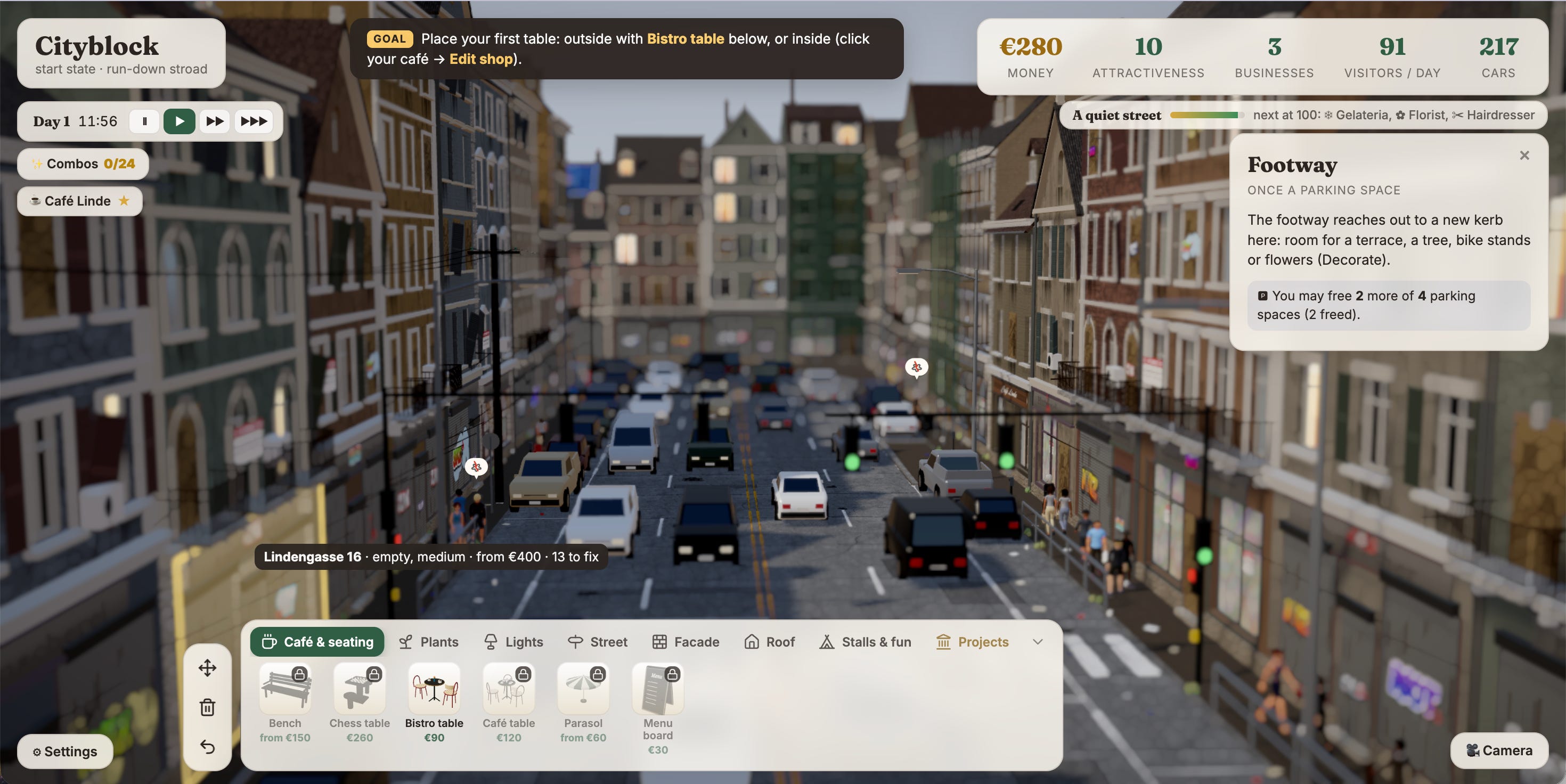
The creator even came onto the r/Suburbanhell to discuss his game. It was not received well. It seems that a lot of the game was vibecoded. While the controls are a little janky, the game itself is free, so I don’t know what most people are complaining about (I actually think that subreddit is pretty toxic in general). Something like this is exactly the promise of AI.
It is not perfect, but I can always appreciate games that can double as learning tools. Classes that relate to urbanism can hop on this free game and put the students in the mind of city builders. It’s pretty simple to pick up. Give it a try and let me know what you think.