

Note: Around the College Towns is my weekly links roundup article on urbanism and education. These posts mostly cover news that may have fallen through the cracks rather than the big events.
Last week, I wrote about Indiana University’s historic run to the National Championship in college football through the 1979 film Breaking Away. I figured I would be just one of many higher education-related outlets to cover the storybook season. I was wrong.
The day after the game, I noticed that none of the mainstream higher education outlets (Inside Higher Ed, The Chronicle of Higher Education, and Higher Ed Dive) covered the event. The Chronicle had a good article on university ads during bowl season the week before from Karin Fischer. But it was just more general rather than specific to the game and feat by Indiana. Inside Higher Ed eventually posted a commentary by University of Southern California professor and IU alum Shaun Harper, but it was buried at the bottom of the front page.

This is not a critique of these outlets—they often do fantastic and important work for the sector, and I’ve provided quotes or even full articles to them in the past. Rather, I want to make a point about differing cultural tastes and audiences for these mainstream outlets vis-à-vis a place like College Towns.
The difference can be understood through the concept of High Culture and Low Culture. High Culture is that of the “writers, artists,” and the “highly educated people of upper and upper-middle class status, employed mainly in academic and professional occupations,” according to sociologist Herbert Gans; while Low Culture is “nonacademic,” everything else for the masses—pop culture.
College football is Low Culture wrapped in a High Culture institution. Places like The Chronicle or Inside Higher Ed are more geared to an audience plugged into that High Culture. For me here at College Towns, I’m not just doing Low Culture. I don’t want this place to turn into Stephen A yelling at Skip Bayless. Instead, I more see my value as a kind of bridge, connecting High and Low together.
Chuck Klosterman, an author I also admire for bridging these cultural divides, was on Pablo Torre’s podcast recently to discuss his new book on football. The entire conversation is worth a listen, but I was particularly taken by this exchange on the importance of football to American society:
Torre: This is why football is also this thing that people should be fluent in. It’s our language, just the practical and political and sociological motive of like, this is a passport to talk to the largest number of people available in our country. And if you abdicate that… then you’re also surrendering the ability to reach and communicate and plausibly be American.
Klosterman: I think people in a way cannot escape football in a way that can escape religion. Now it’s become very difficult to escape politics, but there was a time when you kind of could, you kind of can’t now. So now it’s like football and politics are these things and that has its own kind of meaning.
What Klosterman and Torre are talking about is something Substack offers, even beyond football. I want to use this space to do something different that may not be happening at the big outlets. Those education trade publications are better suited to cover the most pressing national events happening in the higher ed sector. This is why these Around the College Towns links round-up posts are sometimes devoid of Trump. Of course, I break this rule when I have something specific to say about an event, such as with international students.
What I see here on Substack is a value added to the sector through my site or others supplementing the good work from more mainstream media outlets. They can break news through investigative reporting or provide deep context to serious issues. We need that in the higher ed space. But there are things happening across campuses that are less High Culture and more Low Culture, like college football. And there are audiences for these stories, especially college football.
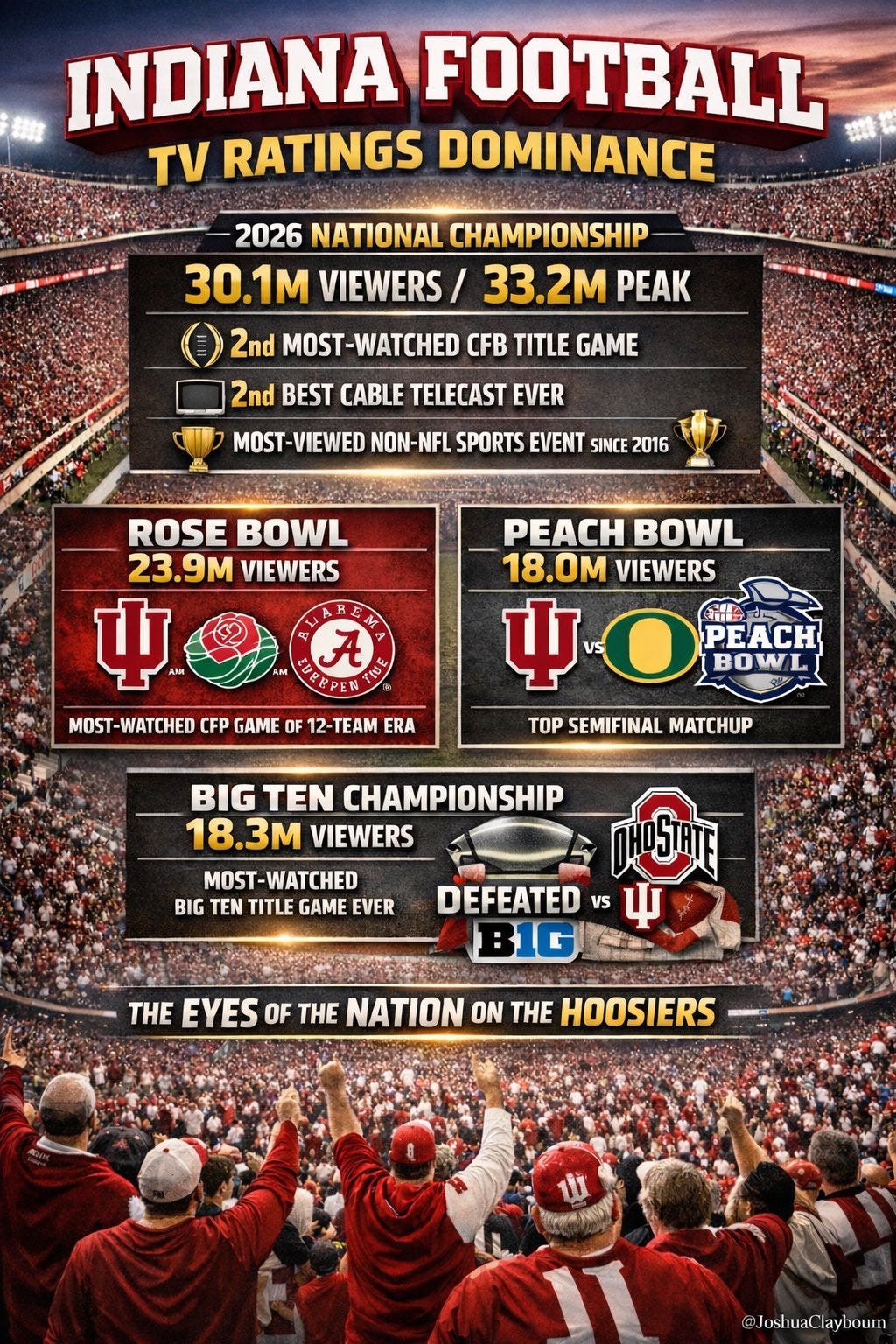
The Indiana University story is a prime example. The victory in the National Championship was not just a normal victory; it was part of a broader Cinderella run that captivated the country. Their games were among the highest-rated events on TV, not just for college football. IU going from one of the worst teams in the country to the best is movie-like, and there absolutely will be a movie about this team. Arguably, their victory was the biggest thing happening in higher education that week.
What this affirms for me is that there is a place for College Towns in the broader landscape of higher education outlets. But it is not just about this specific sector; Substack is providing a platform across every sector to fill these various gaps. It harkens back to an older media landscape of Zines or the early blog days. I am glad to be a part of it.
Links I’m Reading This Week
Education
China may start giving entrance exams to international students who want to attend their universities. I will be curious how this actually plays out, as I am still seeing a lot of their institutions hungry for students from abroad. My guess is that it is selectively used depending on the country.
In similar news, China’s foreign talent visa has proved lackluster so far. I figured this would happen, at least on a broader scale.
More from abroad, some British universities are shutting down their Indology departments. Is K-Pop to blame? It does seem like Korean culture is taking over the world.
Back in the US, Indian international students win lawsuit over microwave food punishment at U of Colorado. It was about the smell of palak paneer. Wild.
University of Oklahoma is opening an extension campus in partnership with the Cherokee Nation. Cool initiative in my home state.
California College of the Arts is set to close and be absorbed into Vanderbilt’s new West Coast campus. The Age of Conquest continues!
In more closing news, I had missed the reports that the University of North Carolina plans to close its area study centers. Bummer.
A mini-doc explores the so-called MAGA for Mamdani. One of the subjects was a young man who changed his mind about studying abroad in Japan. Interesting! More people should go abroad.


Urbanism-ish
NIMBYs in LA are “sounding the alarm” over a proposed Little Tokyo apartment complex. This is in a part of the city that is walkable to Union Station, already has skyscrapers around, and struggles with housing (seriously, it’s next to Skid Row). Absurd.
In more LA news, someone in here is (essentially) scamming tourists with self-driving car tours. Look, I know some foreign phones might not be able to get Waymo, but $80 for what is a $12 ride is exploitation.
World’s worst tourist destination? LA’s Walk-of-Fame. I guess the place is hyped up in pop culture, and it is just a street tile. Sorry, LA.
New Jersey has radically restricted e-bikes, targeting teens, but the laws will impact everyone who rides one. This seems like the exact step backward.
American cities often go for the big, flashy stadium projects over small neighborhood fields. I am seeing this problem in my own area here in Orange County.
Dumpy post-war architecture is starting to come up as “historic” in local communities, like this one from my home state of Oklahoma. We cannot fall for it!
Wikipedia says the site is not doing well, with large dips in page views recently. It seems like AI is siphoning off its viewers.
A new game lets players live out their dream of being a park ranger. I have been thinking recently that this kind of job would be a pretty good career for the AI future. I don’t think we can replicate a park ranger with ChatGPT, so perhaps this game would make a good gateway:


Closing Time… What Do You Think of Vancouver’s Skyline?
There was a bit of a controversy over on X recently that I got wrapped up in. There was a semi-viral post about how bad Vancouver’s skyline is; “absolutely hideous,” wrote the S.D. Wickett account.


I actually did not agree with the original poster; I think that the skyline looks ok, not great. “The problem is no iconic skyscraper. Just one would really bring the whole skyline together,” I posted. In the post, I included an AI image of the Empire State Building in the middle of the Vancouver skyline.
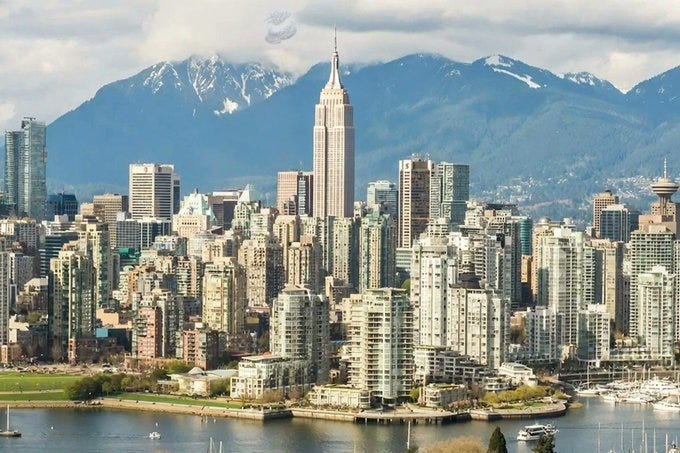
Of course, I was mostly joking about the specific skyscraper, but some people were perturbed. I was told that Vancouver doesn’t need tall buildings because they have mountains. Apparently, the city limits height due to this view corridor. Likewise, other urbanists told me they simply didn’t like skyscrapers and preferred European cities.
My response to these takes was that Vancouver is a city in North America, with a lot of tall-ish buildings already. They aren’t going to knock it all down and rebuild it into Paris. Since they already have a bunch of tall, mundane condos, they might as well add some good-looking buildings to the mix. Honor the mountains with the beauty of the built environment.
Another pushback came from people saying that Vancouver already had iconic buildings, like Harbour Centre. I can see how locals hold value in these buildings already there. That’s normal. Yet, little stands out in the skyline itself; a giant could better fill out the space. A skyline grows, towers get built, and they eventually become iconic. This is how cities work. Some did say that a few were on the way.
So what do you think? Do you think Vancouver’s skyline needs its version of the Empire State Building? Or am I wrong?
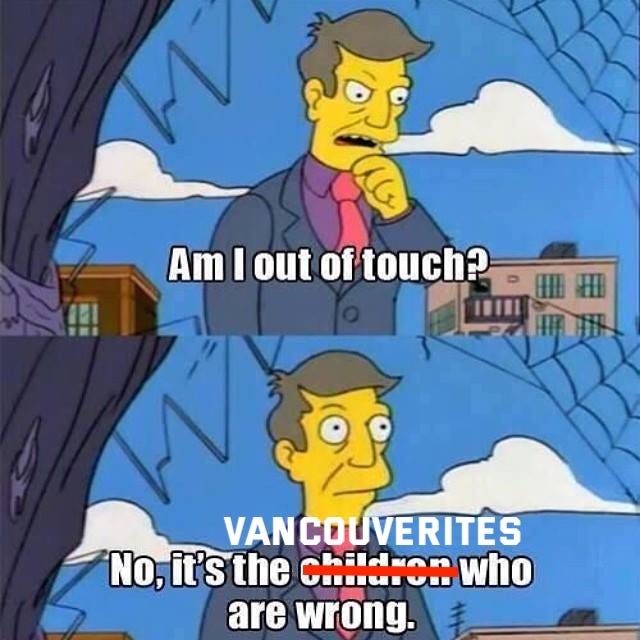
I love the Vancouver area in general (it's a beautiful part of the world) but not only is the city skyline bland but the city itself is one of the most boring I've ever visited. They've done a great job with the pedestrian and biking lanes and the waterfront is lovely to Stanley Park. But it's a lifeless city in most every way.