


Note: Around the College Towns is my weekly links roundup article on urbanism and education. These posts mostly cover news that may have fallen through the cracks rather than the big events. I am a little late due to the holidays. Sorry!
Don’t Trust Google’s AI Overview in 2026
I recently wrote about the sad saga of Westminster Choir College in Princeton, New Jersey. The article tapped into my visit to the campus last winter, along with some recent developments, as the town acquired the space through eminent domain. I used Google to find local media reports to see what the town was planning next. That’s when I noticed something was off.

Google’s AI Overview said that the campus was sold to Princeton University, which was something that I had not heard in any of the many articles I read on the case. “Wait, did I miss something?” I asked myself. I did not, in fact, miss something.
Instead, it was Google, the former world-leading search engine, that was wrong. The AI Overview had confused Princeton the university with Princeton the town. The result was simply misinformation. Google had even embellished that the university was building new colleges on the site, with supporting links. Yet, none of the links actually stated what the overview was claiming.
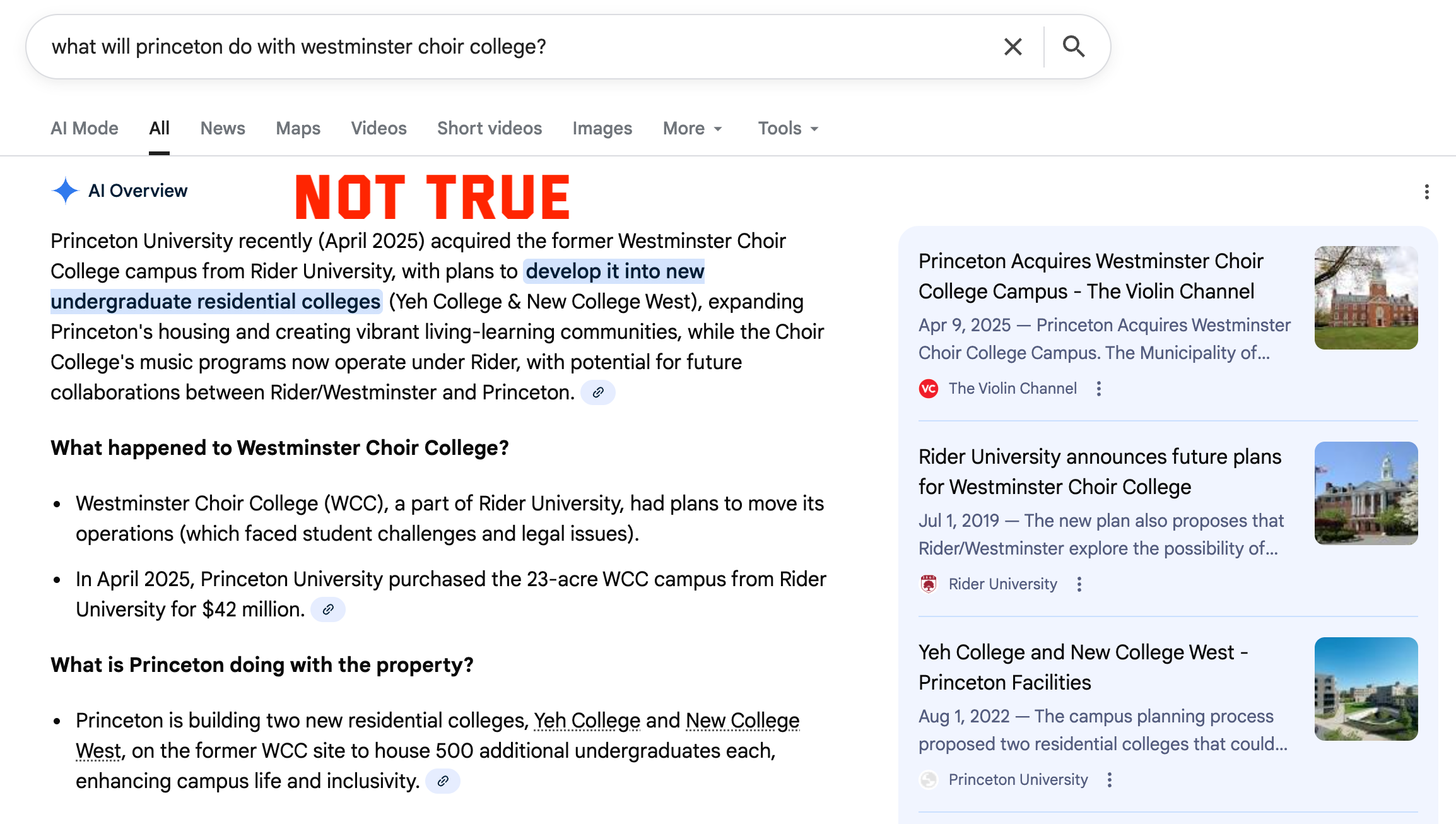
The unfortunate thing about this one case is that more and more people are relying on these kinds of AI summaries. Google places this AI-created info in the most prominent position, at the top of the page. Before AI, the top couple of Google results were basically the only links people clicked on. Now, people are getting even lazier, not even clicking on the supporting links, and just assuming the AI is correct.
But the AI is often wrong! I see it all the time.
In another case, I was looking for the number of international students in China for another article. Google confidently gave me a number that turned out to be basically double the reality, pulling from a source on Australia instead of China. To Google’s credit, I just searched this again as I was writing this article, and the summary now does say estimates are difficult to come by rather than citing the incorrect information. So there is room for improvement.
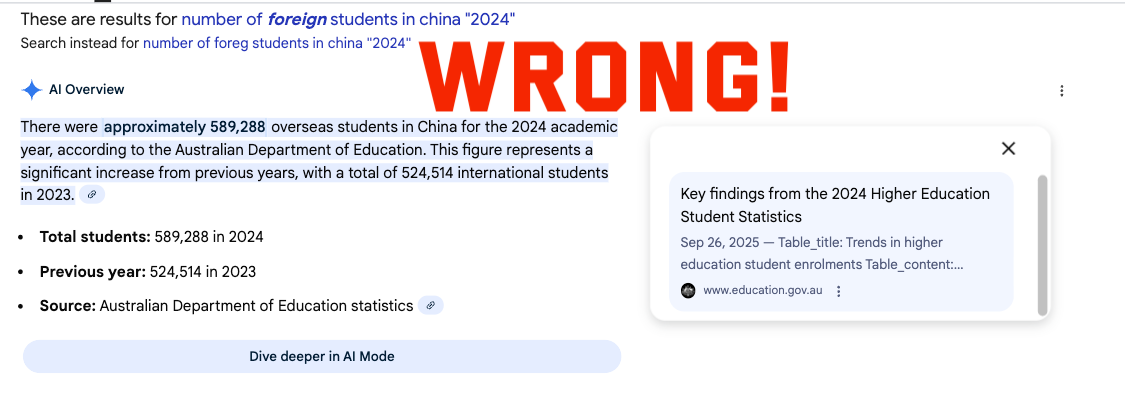
The point isn’t that these summaries are always wrong, only that they are wrong enough that it is impossible to rely on them. AI summaries are fine for arguing with a family member in a bar during a holiday break. But they cannot be used for academic work or professional writing.

It’s not just Google, this is the case for all AI. I have had similar issues with Grok in the past, too. Take this as a warning: relying on AI for information means a high risk of misinformation. In 2026, we still need to teach digital literacy, including search engine skills, perhaps now more than ever.

Happy New Year! Thank you for all the support in 2025 by reading College Towns. Expect more content on urbanism and education as we enter 2026. I have a lot of articles for the year planned already. If you’d like to continue supporting us, keep reading, subscribe, share, and consider becoming a paid funder through the College Towns Research Grant. Thank you!
Links I’m Reading This Week
Education
NYU and LSE launch joint master’s in Media, Culture and Global Cities. Probably a very expensive program, but nonetheless quite interesting to do a degree in New York City and London.
With college sports becoming even bigger businesses, smaller programs must spend more, raising so-called sports fees on their students, such as San Diego State, James Madison, or Wyoming.
In more big business college sports news, here are the top-10 universities in terms of alcohol sales for (most of the) Fall semester. Any surprises?
Texas A&M
LSU
Nebraska
Oregon
Mississippi
Michigan
Minnesota
Indiana
Kentucky
Texas Tech
Inside the closing of the Middlebury Institute of International Studies. One tidbit revealed is that faculty are hoping that the institution can be spun off to another entity. In the Age of Conquest, perhaps we might expect someone to swoop in.
4-year universities are expanding into more 2-year associate degree programs. No surprise in the Age of Conquest. Just remember, we already reached peak students, so the students must come from other pools.
Charlottesville, home of the University of Virginia, is seeing some major development. Some of these spaces are quite handsome.
Urbanism-ish
Given the holiday, vacation is on my mind, but it seems many are leaving Vegas out of their travel plans in recent years. I took an unofficial poll during my Christmas gatherings, and pretty much everyone agreed that they have stopped going because of the costs. Can the City of Sin turn it around in 2026? I have my doubts.


On the flip side, China launched an impressive visitor app to help attract travelers in 2026. I have been critical of traveling to China for those unfamiliar with the country in the recent past, but they have made some good changes and I am more bullish on their tourism prospects going forward.
Tesla's door flush handles are dangerous, with some documented cases of emergency services being unable to open the car. China has even banned these hidden or retractable handles. To me, these were always a solution looking for a problem. Good riddance.
While not my favorite politician, give credit where credit is due for my Governor, Gavin Newsom, with this recent quote: “Huntington Beach needs to end this pathetic NIMBY behavior… They are failing their own citizens by wasting time and money that could be used to create much-needed housing. No more excuses, you lost once again — it’s time to get building.” Hear, hear. Get building, California.
Boston has been putting homes above the library. This is pretty cool. I hope it becomes a trend in 2026.
Rome, Italy, has just completed a new metro line with 31 stations. Commentators pointed out the $8.3 billion price tag is a steal compared to similar infrastructure in the US, especially considering the degree of difficulty in building around all the antiquities.
Closing Time… SimCity for Parking Lots
I was a big fan of SimCity as a kid (I think most urbanists today can say the same). So I was excited to see someone made a game that reflected that childhood classic, with some added realism from the post-War American experience: Car Park Capital.
“I didn't have $1 million for a Game Awards Trailer so I'm posting my parking lot simulator trailer here instead for free!” wrote Hilko Janssen, the creator of the game, who concedes that Car Park Capital is a “satirical retro-styled” game. It is even published by MicroProse (publisher of another childhood favorite of mine: Civilization).
The trailer certainly got my attention, but I do not have Steam. If a reader would like to write a review upon the game’s release later in 2026, reach out to me. I’d love to hear your thoughts, and perhaps we could post a write-up here on College Towns.