


Note: Around the College Town is my weekly links roundup article on urbanism and education. These posts mostly cover news that may have fallen through the cracks rather than the big events. I promise that these are not always about football.
Where Did the Coaches for Super Bowl LX Attend College?
It is now an annual tradition for me to explore where the Super Bowl coaching staffs went to university. In fact, it has become somewhat of a gimmick here on College Towns to do the same with other media properties. But I am actually curious about this kind of thing, and no one else seems to be doing it. AI also does a pretty bad job at compiling these lists, with a lot of mistakes or missing items.
So here we go, this is the most comprehensive list of the colleges attended by the coaching staffs in 2026’s Super Bowl LX: Seattle Seahawks and New England Patriots. I do not care about graduation, just attendance, and I have included graduate school (as denoted by MA). The list also provides state and university categories1, which I created myself since the Carnegie Classification is sort of useless now. If I missed anything, please let me know.
I’m convinced that one reason Americans love football so much is that it breaks the mold of coastal and superstar-city stereotypes. In pretty much every other sector, cities like New York or LA dominate the discourse, led by people who graduated from a handful of Ivy League or elite universities. For football, it’s not that simple!
Of course, there are certain powerhouses that dominate the ranks of collegiate football, such as Ohio State or Georgia—both schools with alumni head coaches in this Super Bowl. Mike Vrabel played at Ohio State, but Mike Macdonald just worked his way into coaching during his time at Georgia, first coaching high school and then later becoming a graduate assistant at the university.
There are other large flagship universities on the list (accounting for almost 40% of the coaching educational experiences; see chart below), but none are dominant. The spread goes across the country, not even concentrated in just the SEC or Big 10: Virginia Tech, Texas Tech, Minnesota, Arizona, Nebraska, and Tennessee. Some coaches were former players, such as Josh Bynes and Neiko Thorpe at Auburn; others were coaches’ sons, like Jay Harbaugh at Oregon State (dad is Jim Harbaugh); others were both, such as Klint Kubiak at Colorado State (dad is Gary Kubiak). While rare, some coaches simply worked their way up the chain like Rob Caprice, who started out as an Equipment Manager at Penn State as an undergrad and is now a Defensive Intern for the Seahawks.
Even more interesting than the flagships are the other schools that coaches attended. They range from programs that are considered “mid-majors” like Northern Illinois and Old Dominion or secondary institutions in the state hierarchies, such as East Carolina or UTEP. These types of institutions account for roughly 27% of all higher ed experiences from the coaches.
I was even surprised to find some Liberal Arts colleges on the list (roughly 18%), such as Lafayette, John Carroll, Assumption, and McMurry. Even as someone as invested in higher ed as I am, I admit that I had not heard of McMurry, which is a 102-year-old Methodist college in Abilene, Texas, and alma mater of Karl Scott, Passing Game Coordinator (Defense) for the Seahawks. There were only a couple of HBCUs, such as Alcorn State, attended by Leslie Frazier, Assistant Head Coach for the Seahawks.
Two coaches seemed to have run the full gamut of university types in their education careers: Quinshon Odom and Justin Hinds, both Seahawks coaches. Odom started his collegiate playing career as QB for Shaw, before doing MAs at Florida State and then Vanderbilt (HBCU → Flagship → Private R1). Similarly, Hinds was a lineman at Rowan before doing three graduate programs at Wagner, Mississippi State, and Florida (Liberal Arts → Liberal Arts → Flagship → Flagship). He has about as many grad credits as I do as a professor! In the age of the transfer portal, I’m sure more future coaches will end up with similar winding journeys.

Finally, two coaches that particularly stuck out to me were Aden Durde and Danny Van Dijk, both for the Seattle Seahawks and both from abroad. Durde is originally from Middlesex, England, and made his way into football through the now-defunct NFL Europe. AI reports he has no college experience, but digging a little deeper, I found he briefly attended North Iowa Area Community College, the only community college on the list this year. I wonder if he enrolled to get a visa/foot in the door in the US? Likewise, Van Dijk is from Australia, with two degrees from universities there: Australian College of Physical Education and Edith Cowan University (MA). He came to American football as a trainer in Rugby (and he was also a K-12 teacher!).
As per last year, the coaches in the Super Bowl come from fairly diverse educational backgrounds. Yes, those who played have a leg up, but playing time does not necessarily mean at the biggest football powerhouses. Plenty of guys from small schools are coaching in this game. Likewise, it helps to have famous relatives in the sport, but what industry doesn’t have some form of nepotism? Yet, even guys from across the ocean, where football is not a cultural phenomenon, can coach at the highest level of the sport. Truly interesting.
Links I’m Reading This Week
Education
New England colleges are missing a certain kind of student: men. My guess is some of these trends are related to those migrating to universities in the South (perhaps related to campus life and, yes, football).
That being said, in an age of chaos and uncertainty, Liberal Arts colleges may actually be the safest places in the sector. Plus, they are certainly best equipped to deal with AI cheating (and learning).
Similarly, theater might be another way for students to overcome screens and digital addictions. As someone who was just three credits short of a theater minor, I say let more students take improv and stage combat classes.
One place with booming student numbers: Atlanta’s HBCU scene, where there has been a housing boom recently to help quench demand.
In more college area development news, Meta is helping to fund new development for Sacramento State in the downtown of California’s capital. I cannot help but think there is some lobbying influence here
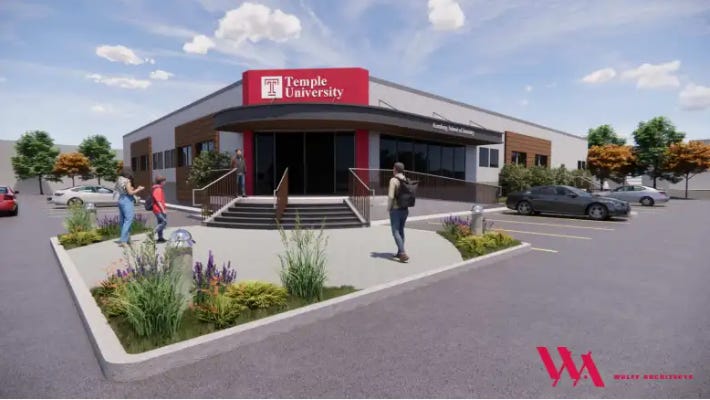
Likewise, Temple is building a new dental school, including dorms, in Tamaqua, PA. Good for the rural dentist shortage, but I just wish the structures looked better. Why build a dumpy suburban dentist’s office!
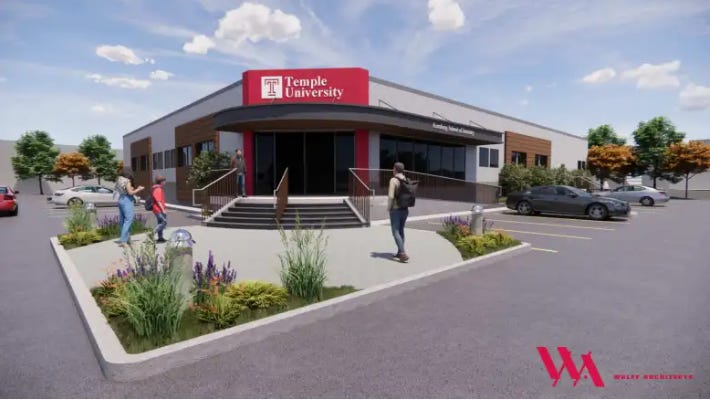
The new Temple dental school in Tamaqua. Not even the renderings look good! In some international ed news, Duke Kunshan sees record applicants, including from Americans. Great to see young Americans might be going back to China again in large numbers.
Korea launches study abroad office in Dehli, India. Top UK universities look to Indonesia for branch campuses. The next great landgrab is upon us in international ed, with South and Southeast Asia the prime target.
Urbanism-ish
Disneyland’s home city is ending bus service that helped with tourist overflow to the park. One tidbit, the report stated that more than 70% of operating costs went towards labor, a similar issue I found with another failed transit program in Orange County. Hungry for self-driving buses?
Waymo released a report about how one of its cars hit a child who was departing from school. Urbanists were quick to point out that the superhuman reaction time of the AV likely saved a life. But this is worth more of an investigation, which I intend to do in the coming weeks, since it happened in LA.
In more LA news, a City Journal Substack by Shawn Regan argues the decrepit roads here should partially be blamed on ADA requirements, which balloon costs and liability. Some in the urbanist community pushed back on the claims. It is certainly a space to continue watching.
The Kansas City Chiefs used bunk math for a new stadium deal. Taxpayers are still on the hook. Bummer.
Christie’s recently launched a We the People: America at 250 auction, which brought in $35.5 million worth of patriotic icons up for sale. There were traditional items like a draft of the Constitution, but also newer things such as old Apple founding documents. Incredible items to scroll through.
Cheaper than a lot of stuff at those auctions, the so-called smallest house in Denmark is for sale. It’s actually pretty big and not a bad price. Would you live there for $200K?

Closing Time… 2 New Urbanists Tools
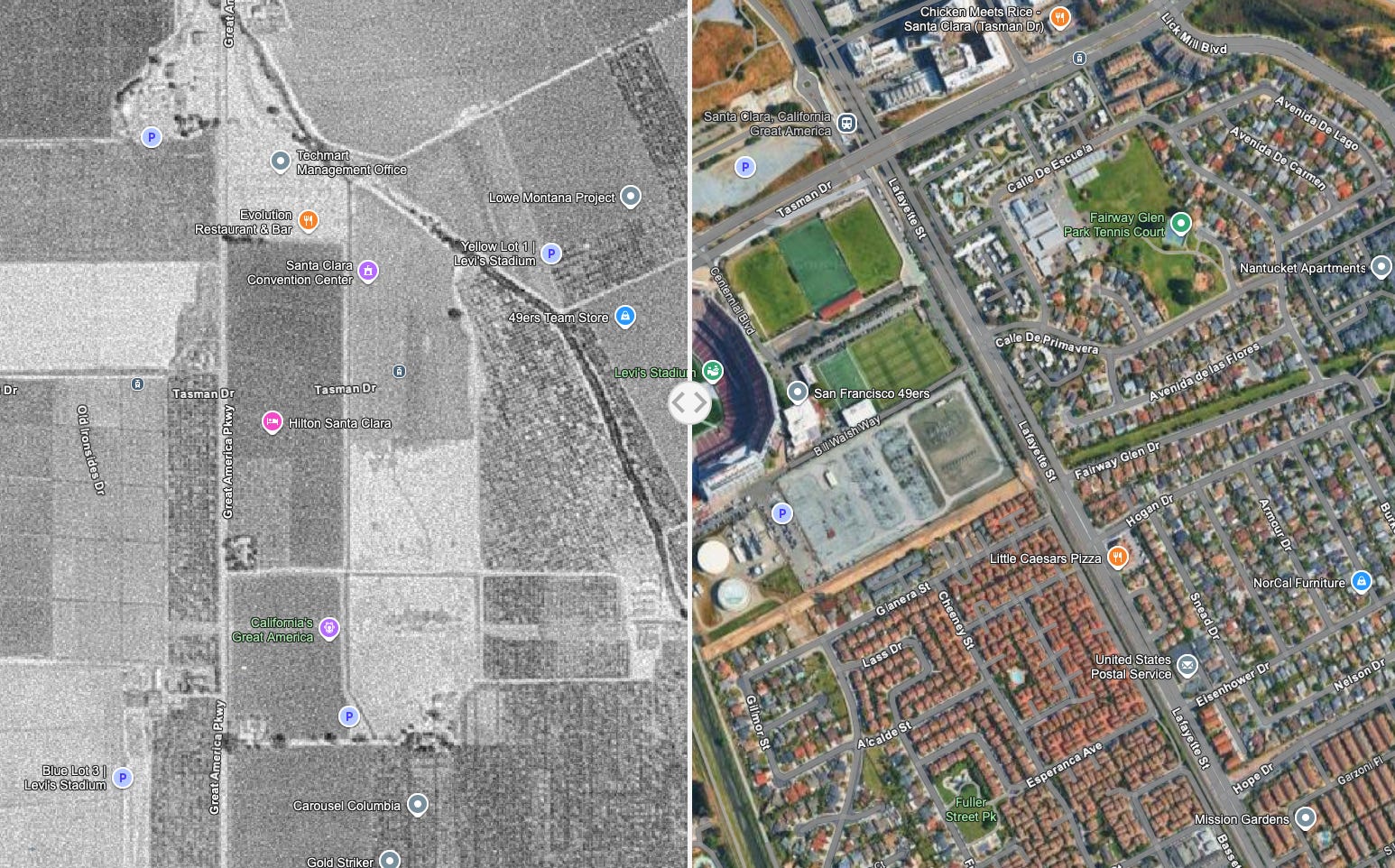
I made a bit of a name for myself on Twitter, back when it was good and still called Twitter, for posting before and after photos of American cities. I dubbed the project “We Ruined Our Own Cities,” critical of the auto-centric infrastructure and development style that hollowed out cities and towns across the country.
It seems everyone loves these before-and-after photos, but they are not always easy to come by. Oklahoma State U has made it easier! The university recently released a tool called Landscape Explorer that shows how land has changed since the 1950s until today.

Landscape Explorer uses Google Maps with U.S. Geological Survey satellite data to automatically stitch together before and after imagery. Users can poke around across the country to see various development patterns and changes. It is a powerful tool for the urbanist message.
Another tool that I found this week came from Magnus Hambleton, who launched Anti-AI Rendering, a site that uses AI to bring renderings to their more realistic life. “No sunshine. No happy families. No impossibly green trees. Just cold, honest, depressing reality,” the promises.

I would like to see more realistic renderings, and many urbanists actually agree, especially the ones who care about beauty and aesthetics. Admittley, there is a divide in the community over these issues. Nonetheless, the truth of what is being proposed is always welcomed over fake renderings.
Perhaps some of this Anti-AI Rendering is more tongue-in-cheek than serious. There are certainly funny results floating around on urbanist social media. I still think it is a tool worth mentioning here (note that I could not actually get the site working today), and one possible toolkit for articles or posts used to advocate for better urbanism.
I didn’t, frankly, know where to categorize Liberty. Years ago, a small religious school would have easily been in the Liberal Arts category. But it has grown to 140,000 students in recent years, mostly online. It sits alone as a ‘private.’