


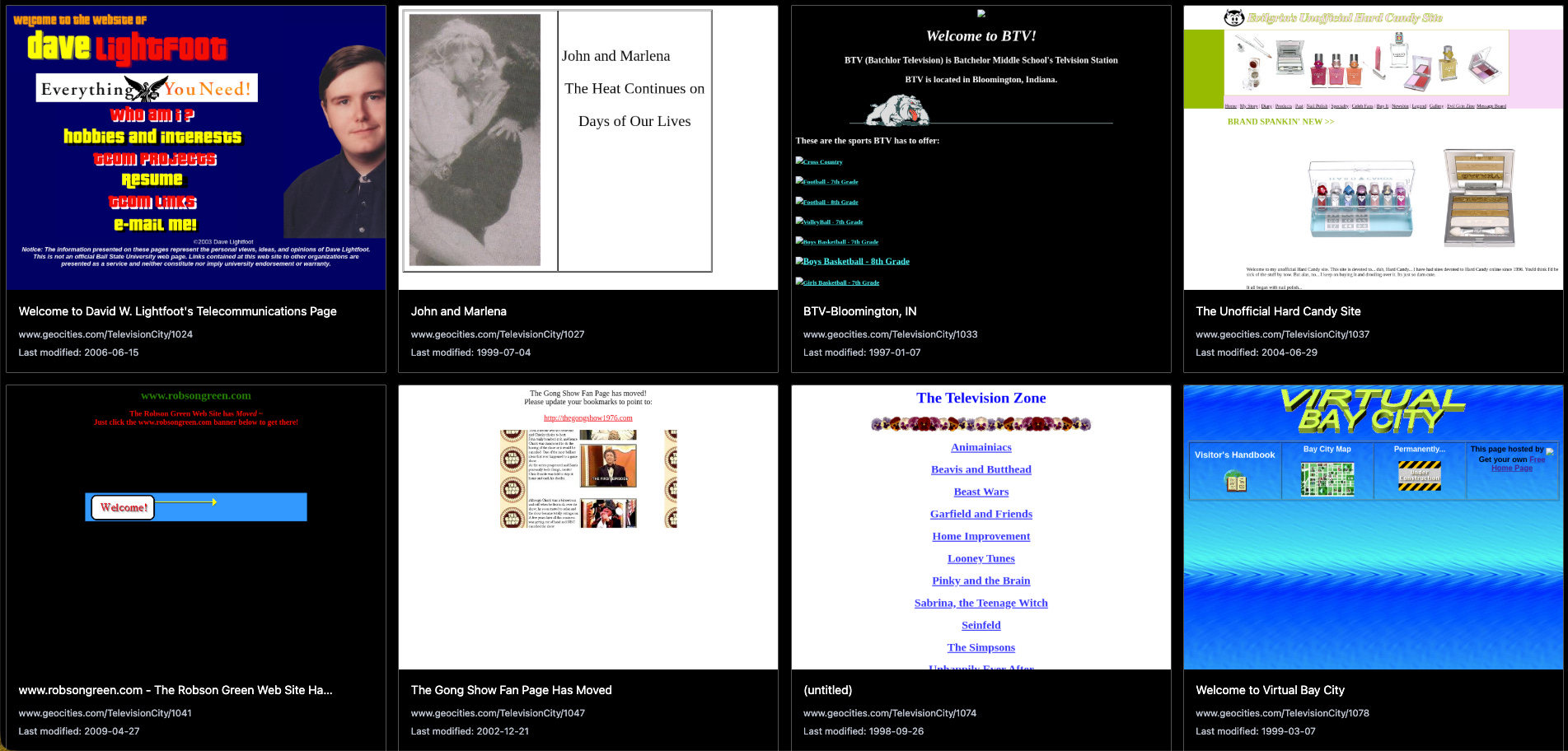
Remember back in the early internet years of our youth? There were weird online chatboards, AIM to talk to friend groups like never before, and, of course, Geocities. Geocities was a web hosting service that let users create and post websites. They were crude given the tech of the day. Nonetheless, it was an exciting time for the World Wide Web. The 1990s really felt like we were living in the future.
Geocities was simple and easy enough that even little 12-year-old me could poke around it. I vividly recall one of the neighbor kids who lived down the street introduced me to the platform, along with Napster (which destroyed my family’s HP, sorry, Mom). We were pretty nerdy, so of course we created a fake Pokémon website. We thought it was the coolest thing in the world. Maybe it was.
Geocities was certainly simple and sophomoric. It was the neophyte net. I’m sure if I saw the sites today I would be horrified by what we were posting back then. Alas, we’ll never know because Yahoo! purchased the platform in 1999 and later shut it down in 2009, scrubbing it from the internet forever, along with all of our Pokémon. Yet, it is not just me; many people are nostalgic about this era of the internet.
Thirty years later, I believe we are in another era that feels like we are suddenly living in the future. Perhaps many of us don’t realize it because the innovation is much more hated than the early internet was. I am talking about AI, LLMs, Super Intelligence (if you want to be a weirdo), all of these things that many have quickly grown to hate. But everything around AI has me wondering about how we might look back on this current era with whimsy one day.
AI usage is pretty divisive in fellow educator circles. Some see the technology as destroying the purpose of education. Others are concerned with the environmental impact. One professor even filed a religious exemption for the use of AI at the University of Kentucky. There is a widespread fear of job losses and resource consumption (e.g., the rapidly growing and bipartisan anti-data center movements).


With that said, I have never been an anti-AI professor. Very early on, before LLMs burst through the door, I was already messing with image generators. So I have always been intrigued. I mostly use LLMs now to help me edit pieces, asking them to spot errors and grammar mistakes. I’ve also used Google’s NotebookLM (or whatever they call it now) to help organize some projects.
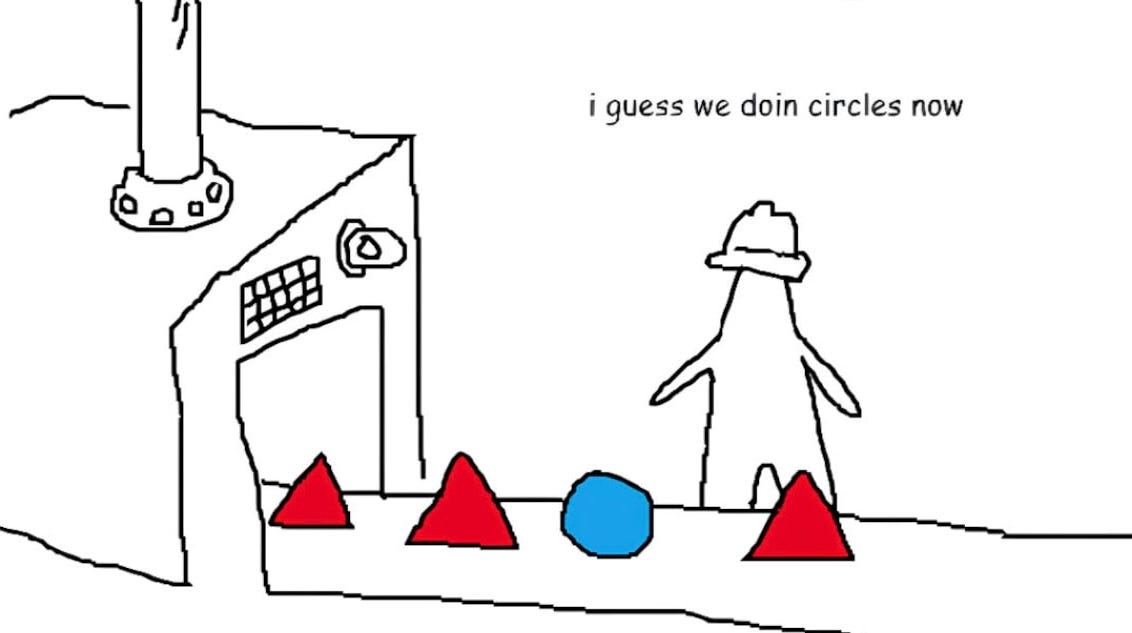
So it’s clear that I had not really embraced the full range of AI capabilities… until very recently. A few weeks ago, I upgraded to Claude Pro ($20 per month). I have been blown away by the results and feeling that same feeling as messing with Geocities again. From the outside view in, admittedly, I might just be Paul Rudd from this Adult Swim sketch:
College Towns App Locker
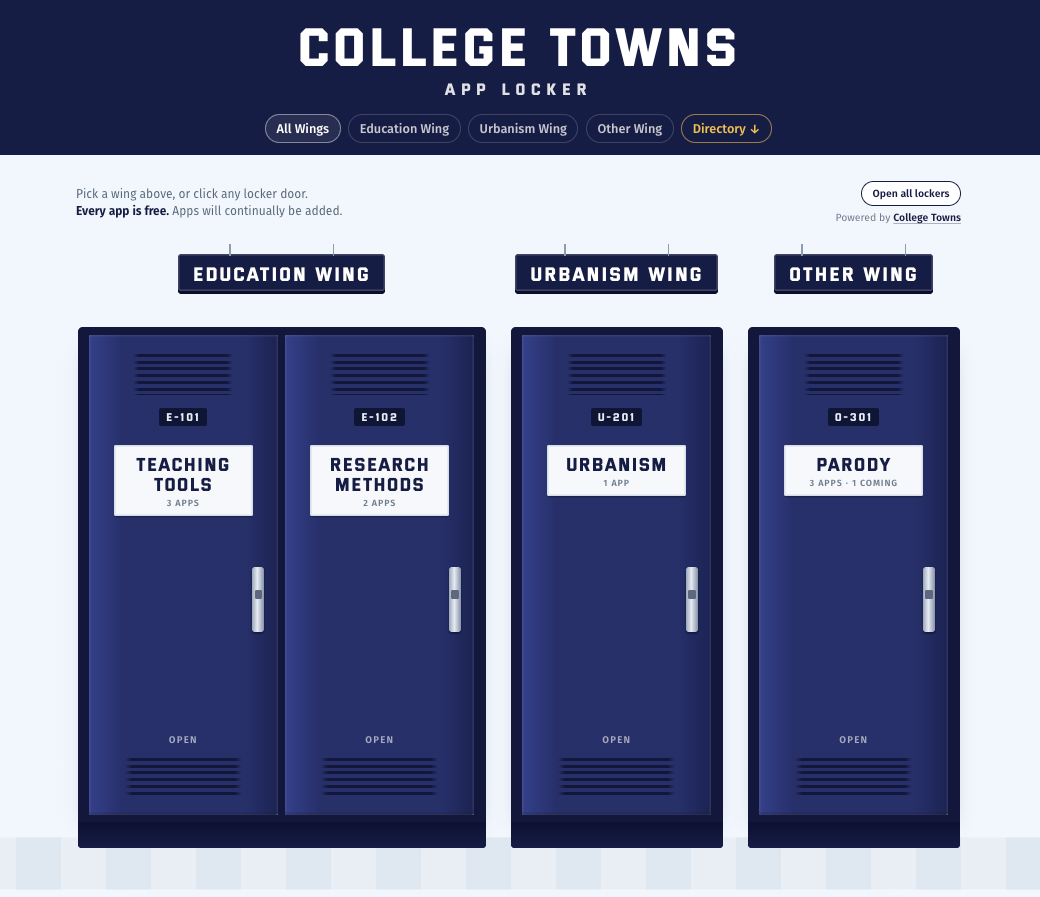
This is the part where I show you the apps I created, like I’m doing some sort of Steve Jobs Apple reveal. You can find them all on AppLocker.CollegeTowns.org. I will continue to update and load them for free as I create/update them, along with still publishing my weekly articles. Warning: all these apps are our modern-day Geocities. Modulate all expectations from there.
Let me preface all of this by saying that I only have minimal coding experience. I did take some rudimentary coding classes in high school, learning QuickBASIC. In grad school, I learned Stata to do my dissertation analysis. I gave up Python after a week. For all of these apps here, I did zero coding. I merely used the Claude desktop app to prompt Cowork Opus 5.5.
Through the prompts, mostly what I was doing was a lot of debugging and testing. In some ways, I’m more like a UX designer here, which is funny because a lot of people leave academia to go into UX design. I did have to learn how to use GitHub and APIs before getting some of this to run. Asking Claude for detailed instructions helps. Plus, sometimes I would upload a screenshot and ask the robots where to click.
This is all basic, Mickey Mouse stuff, I know. The code is certainly a mess and limited. I’m sure there are problems with the coding. “Claude is AI and can make mistakes,” Claude likes to remind. Like the early internet and Geocities, proceed with caution.
Please let me introduce the College Towns App Locker, with apps ranging from Education to Urbanism and beyond. They are all free. I hope they can help, or at least bring some kind of entertainment. The apps here may end up being pointless, and no one will use them. Well, no one except me. I am already using these tools on my own work. That alone is already a win.
Education Wing
Since my job is to be an educator, the Education apps have taken most of my attention. For these, I mostly just think of things that I can use in teaching my classes or helping my students. I created a simple Course Planner that teachers can use to manage, plan, and develop their classes. Clear Cite is a citation tool à la EasyBib from back in the day, before they ruined it. Try them.
I also took some activities that I had already been doing in my research methods class and turned them into apps. One, called Interview Detective, is geared toward giving students practice writing interview protocols using real journal articles. The other, called The Research Table, helps students think about research topics and questions. These are pretty basic classroom activities that are editable to add your subject/ topic. Try them out.


I think the app I am most excited about is one that will help conduct research. I have been teaching research methods for almost a decade now and have long been annoyed by qualitative research tools. They usually are not very good and are needlessly complicated. Some of them are relatively expensive for what students get. I just decided to create my own.
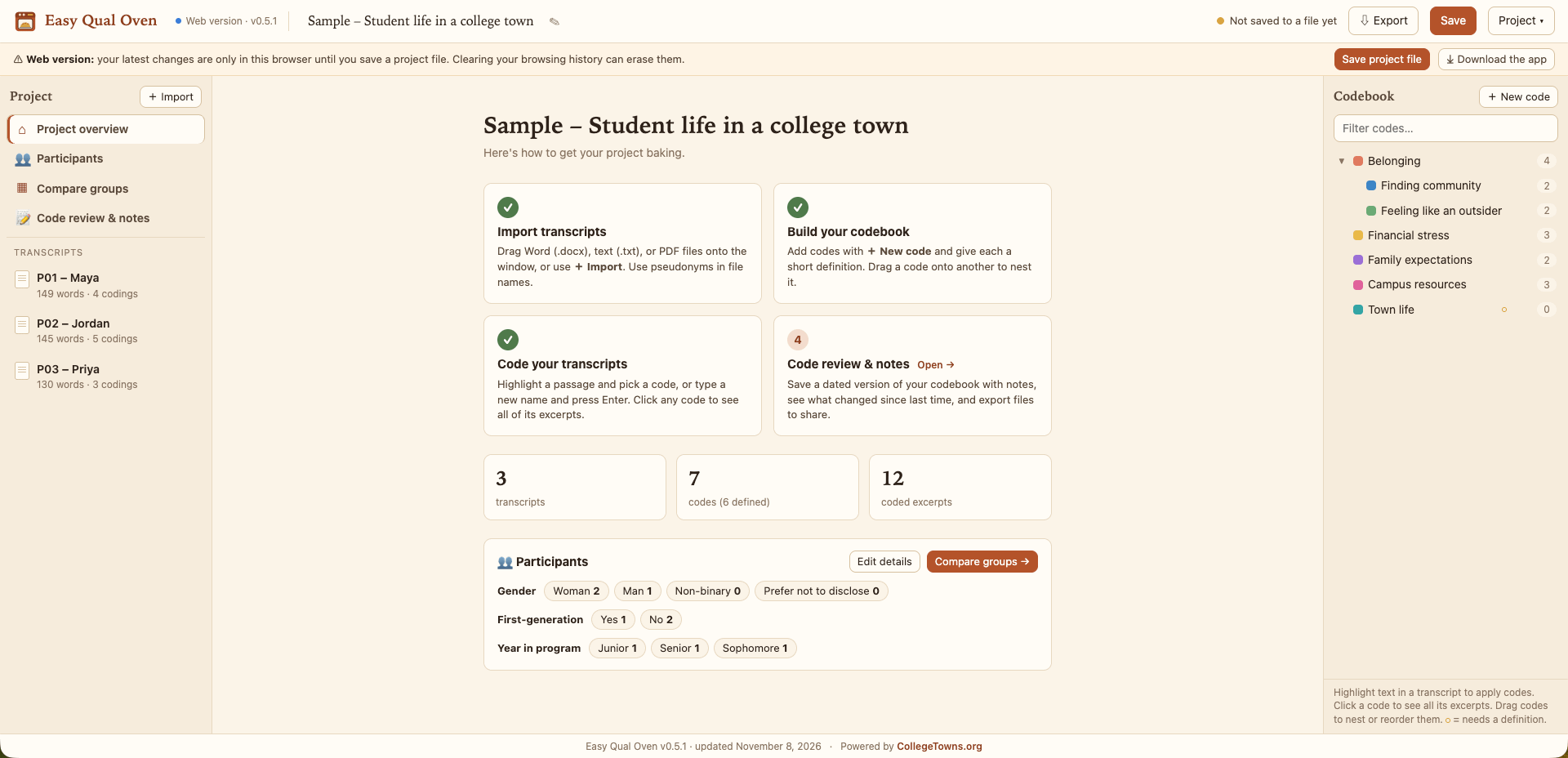
I call it Easy Qual Oven, a play on words from the old Easy Bake Oven of my youth. The tagline even pays homage: Where coding isn’t half-baked. The app has the same basic functions that a student researcher might need when coding interview transcripts. Users can tag texts with various labels, create demographics for the interviewees, keep track of all kinds of codes, and it even exports a codebook.
It is simple, yet functional. The app can be run from your own computer, even without the internet, which should alleviate any concerns about privacy and IRB. It does not connect to any AI system. Easy Qual Oven is also free, so it won’t have all the cool functions, just the basic ones. The app, though, should be enough for capstones, theses, and smaller research projects. Let me know what you think.
Urbanism Wing
I recently lauded the urbanist app landscape that has been created through AI. It is likely worthwhile to chronicle all of them in one place, which I may do soon if it hasn’t been done already. My submission is not as good as those, but I still think it can be fun.
I only have one app (so far) in my Urbanism Wing. I call it Adaptive Reuse Corner, where users get to choose which home they like the best. All of the homes are converted from some other, former use, like a church, hotel, or even some very bizarre ones. It’s just the game form of the segment by the same name in my weekly-ish links roundup articles. I will update the app each week with the new additions.
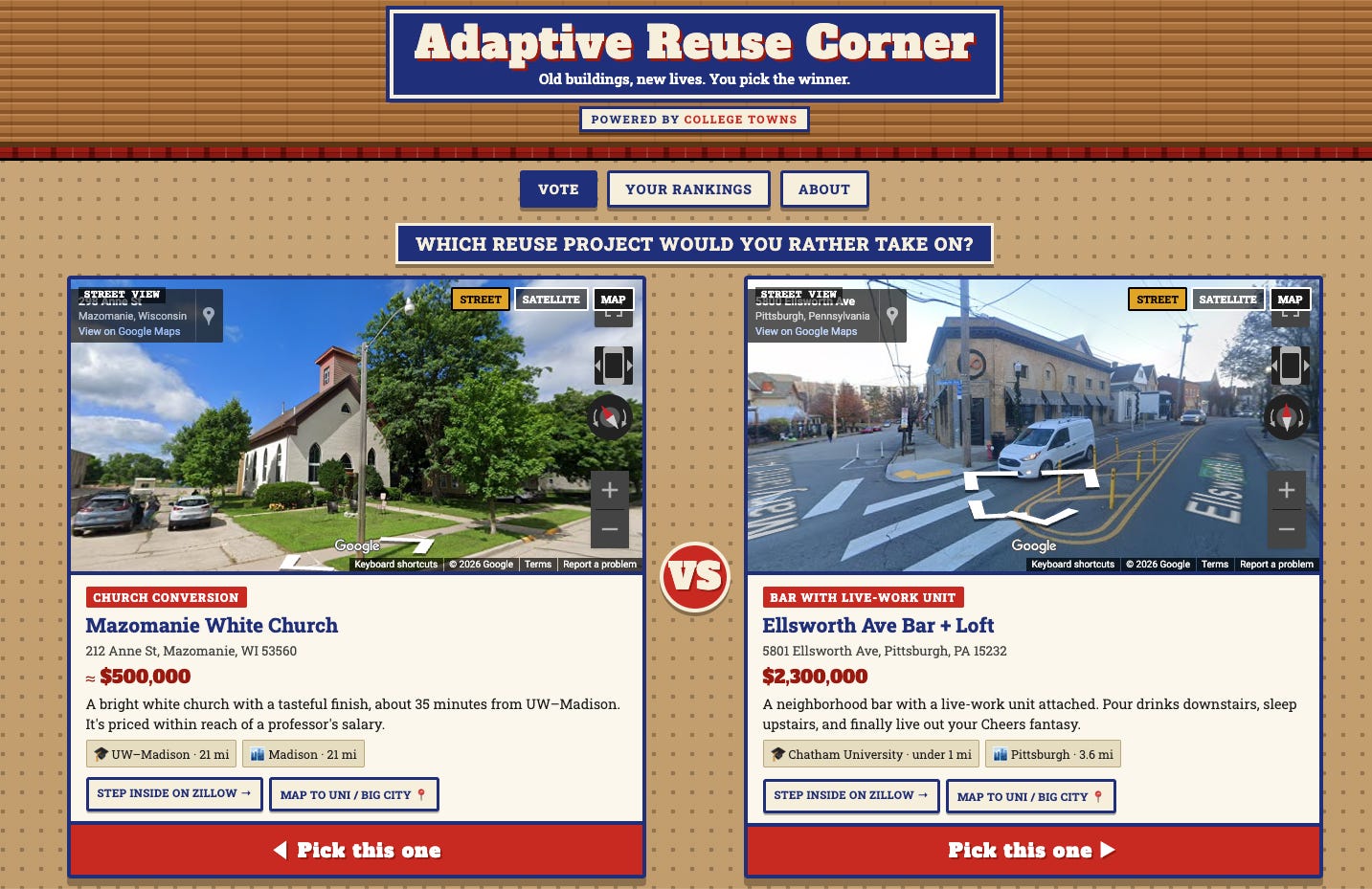
The challenge was that Claude suggested that I do not rip the photos from the real estate sites (so I have just added a link to the listing) and instead use Google Street View. I had to set up some API keys for Google, which was a bit scary because I have never really done anything like that (plus they had my credit card). Claude walked me through it and added some safeguards. The game is free; check it out!
Other Wing
The Other Wing of the App Locker is where I am storing my weird or joke apps that don’t really fit into a real category. These are more just for fun. Since I often keep my College Towns posts lighthearted and have even done some parody, I am keeping that trend going with these apps. I also want to pay homage to one of my favorite comedians, Nathan Fielder. His Dumb Starbucks bit from Nathan for You helped inspire some of my work.
I hate the reimbursement process. We use Workday here, and it’s cumbersome and esoteric. I usually end up messing one detail up when I submit. Are any of the platforms good? Why don’t they make it simpler? My half-conspiracy theory is that organizations keep the terrible processes in hopes that workers just eat some of the costs because it’s too annoying to file for reimbursements. The biggest promise of AI app tool creation is to get around these annoying tasks.
The plan? To create my own reimbursement app that makes people realize how bad these other platforms are. I call it Jobweek. It has all the same functions as a typical reimbursement system, except when users upload the receipts, the app automatically fills in all the little details itself. All workers need to do is click confirm. Wow! What an innovation.
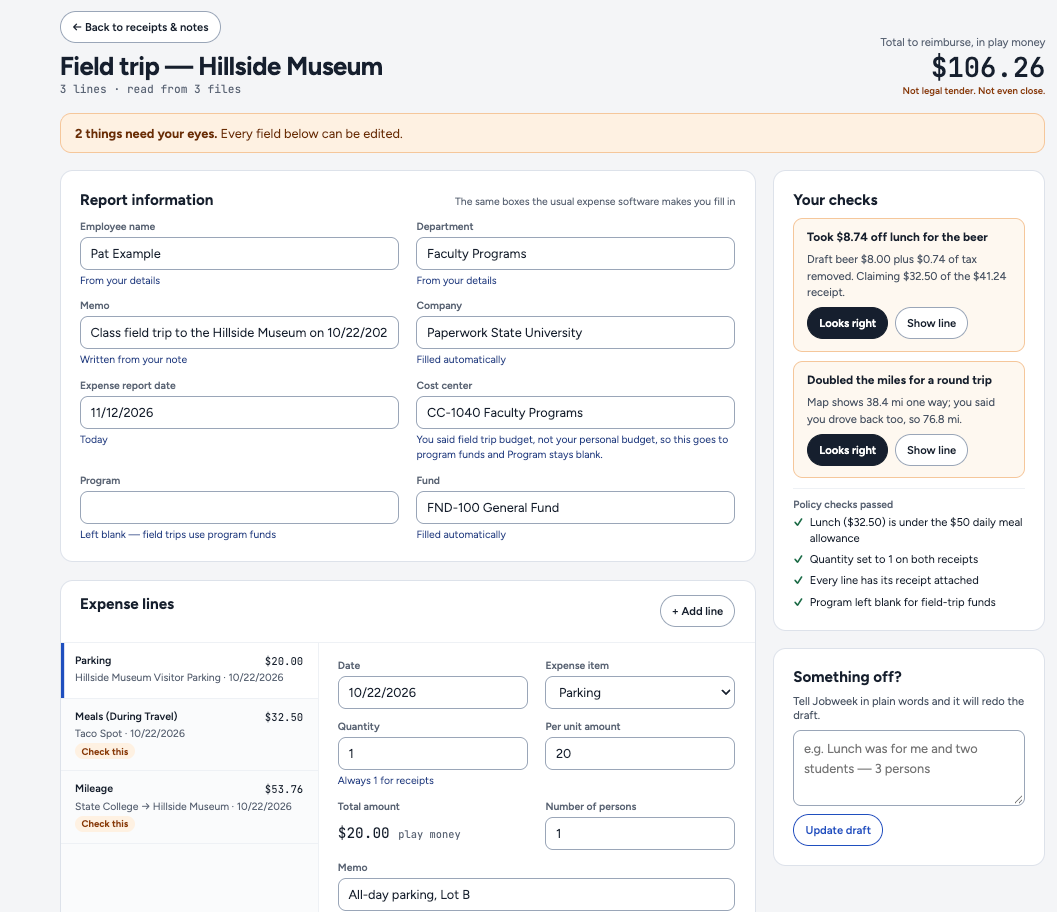
Jobweek is not intended for real use. I just wanted to show what is possible. If I could create this with no experience, skills, or background in a short time, then it has to tell us that the companies who sell the real versions likely could make them better if they wanted to do it. In the future, I’m sure AI will save us from these dreary tasks. Until then, we can pretend we live in a better future with Jobweek.
A couple of weeks ago was the second anniversary of College Towns. I mentioned in that post that a big media publisher basically ganked the name of my site for their own higher ed Substack, joking that I should do the same to them. The Plan? Create a parody news site poking fun at this situation that doesn’t fly too close to the sun.
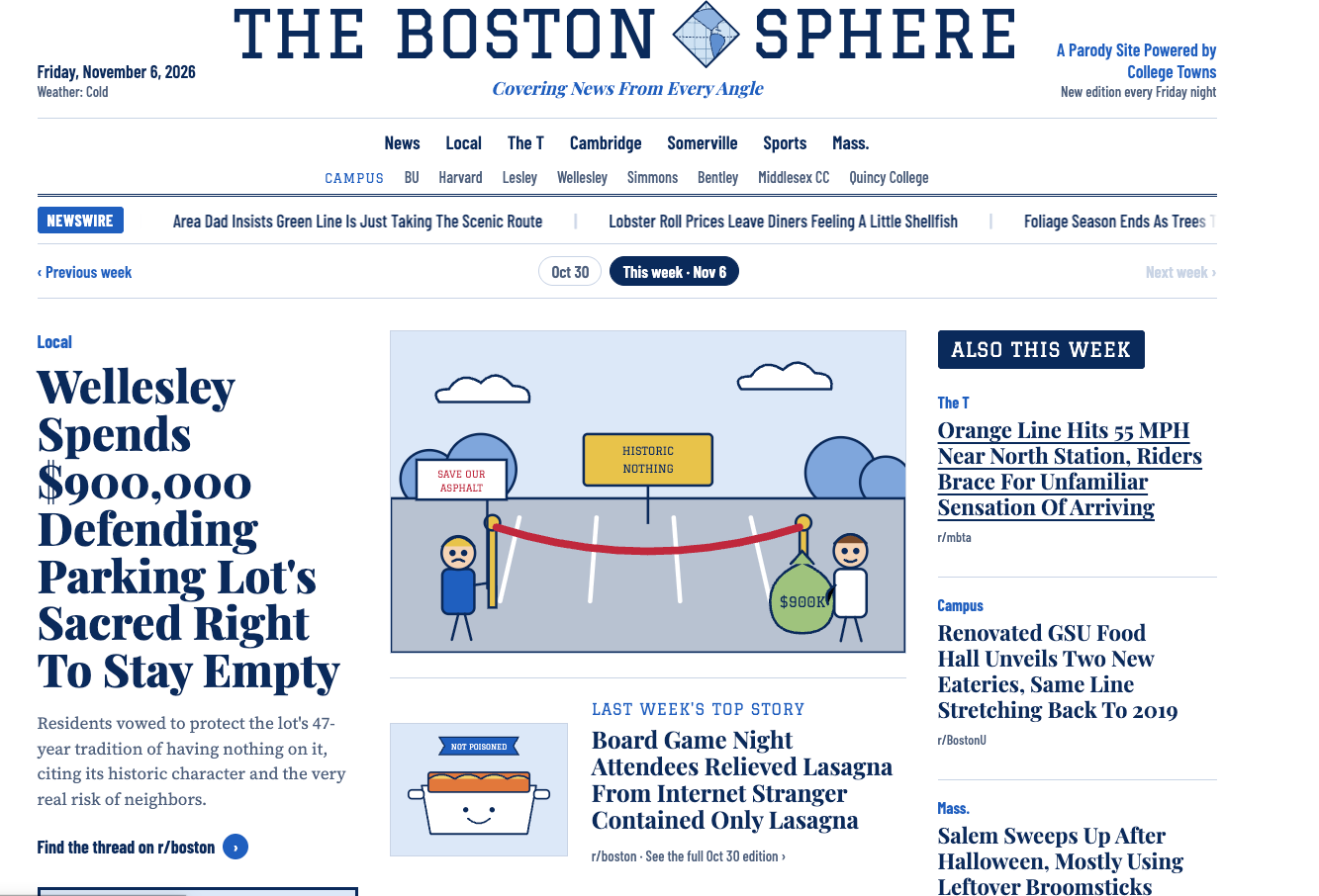
Introducing: The Boston Sphere. It’s a news headline site that lampoons the happenings in Boston, Massachusetts, and the New England area. All of the material is AI-generated from the top posts and popular comments of the week from various area subreddits. I instructed Claude to keep everything clean and to stick to mostly dad jokes. The site posts The Onion-style headlines and a small comic, linking back to the Reddit conversations.
The Boston Sphere will be published weekly, with a new edition coming out each Friday night at 5 PM Eastern. I’m curious how well AI can do comedy, which is no easy thing for a robot. Quite a human task. So this app also works as some experimentation for me, too. Check it out!
I will have some others coming soon.
The Ethics of College Towns App Locker
It’s impossible to be dabbling in AI like this and not think of some of the critiques that many have for the technology. I certainly must ask myself if I am part of the problem. In the end, I believe that I at least have some kind of duty to mess around and comprehend this technology. As educators, we must know the world that we are sending our students into to some degree.
That being said, some of the things I am doing here could certainly be criticized for wasting energy and resources. One of the broadest arguments against AI comes from the environmental impact, especially water consumption.
I don’t really have an answer for that line of attack. I can only say that it seems like the only way to remove yourself from AI in general is to cut off the internet completely. Everything is AI now. Any simple Google search is AI. I believe we are now stuck. I am just going with the flow, even if it's down the drain.
The critiques of AI also make me think about being part of Dead Internet Theory now. This is a theory that posits most of the action happening online has become automated. Huge communities are really just mostly bots, with a few humans unknowingly sprinkled in like The Truman Show. Obviously, the Boston Sphere parody app is doing just this. While I am transparent on the site, I do wonder if the joke is worth it.
There may also be some who see my use of AI here and question the writing on my site. I guess I am costing myself some credibility by admitting here that I am using AI for projects. But I have never and will never use AI to write my articles (check any of them with Pangram). I only rely on it to spot errors and misspellings (I reject most grammar suggestions).
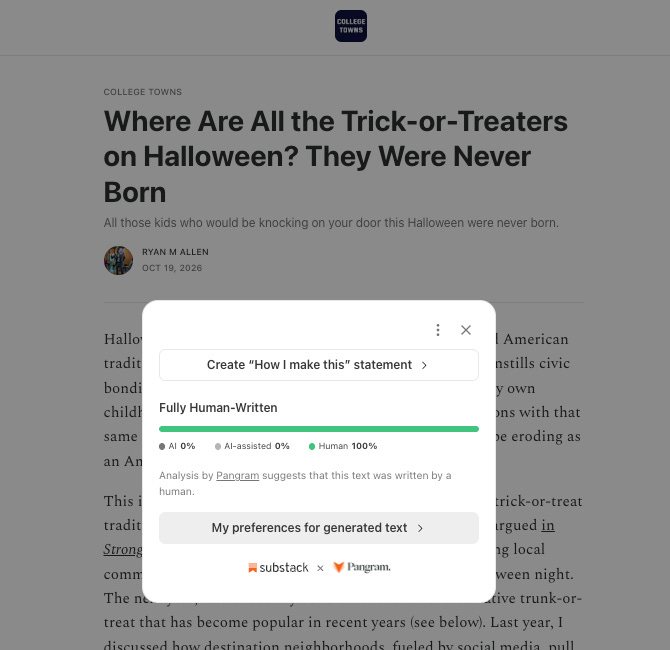
I view AI as a tool to liberate us from drudgery (hence Jobweek) or supercharge our imagination (pretty much all the others). College Towns isn’t homework; it’s not even work. I actually enjoy writing the articles. Having AI write my articles would be like feeding ice cream to the garbage disposal. Defeats the purpose. No, AI will give me more time to actually write.
Then another huge critique comes from worries about putting people out of a job. I do actually think this is going to happen. My view, which I will write up in further detail in a future post, is that we will see some sort of major spike in unemployment for a few years before things level off and normalize again. Even some of the apps I’ve created could certainly play into that effect.
I remember meeting a guy at a conference a few years ago who was a former professor pitching his new qualitative research tool. He had an app that was supposed to be easier and cheaper than the big players in the space. It was fairly basic and cheap, yet good enough. It still cost something to support the guy. I don’t even know if that guy’s company has survived to today, but I do know that Easy Qual Oven does all the same stuff for free.


These innovations make me wonder about all those campaigns to “Learn to Code,” or coding bootcamps. I am not saying they are totally irrelevant; they just are not going to be the saviors promised in education. Karin Fischer even reminds us that while it is true that computer science is bleeding students, the field has gone through something like that before. I think there will always be a need for guys who know code so they can clean up the messes that AI makes. It’s still a job and career, just one a bit different. More maintenance and curation than invention (see mess described above).
So, I guess I do admit that I am part of the problem now. All these concerns outlined here are fueling the broader anti-data center movement. I should always try to keep one foot grounded in reality, in the criticisms of AI, because there is always something to them, even if I reject outright abstinence. The real key is not letting myself fall off the Slop Cliff, as Thomas Jiralerspong calls it.
I think far too many educators simply used ChatGPT when it was first released, saw its hallucinations and limitations, and have not really tried it since. I agree that the slop papers can be annoying (and pointless to grade), but the technology is simply much, much more than a tool for cheating. The fact that it is great for cheating should make any teacher want to understand the systems to some degree.
So I decided to test out what Claude could do, really thinking creatively about how I could use it for all kinds of purposes. I am now seeing how much I have been missing. As an educator, I have to make sure my students also do not fall off the Slop Cliff. I need to be up there on the peak first, supervising.
Or maybe I’m just making excuses because I want to relive my early internet days. The days of Geocities. Either way, the College Towns App Locker is here on the World Wide Web, part of the problem or not. Try them; let me know what you think.
You never cease to amaze! These are fantastic! I will give the 'oven' one a try later, but what type of sorcery is behind the citation one? I have been giving it just some random pieces of info like an author and a keyword and it finds the paper! For instance, I just wrote your paper as "Allen and Bista international students suspicious" and found it! Or my paper "Whatley Castiello reopening plans"... perfect every time!