


We just passed the second anniversary of College Towns. That’s right, this site is now two years old, launched on Oct. 10, 2024. I joked in the article from a year ago, marking the first birthday, that these reflections are a bit like those old clip shows from pre-streaming TV. Remember in The Simpsons, Homer would be telling stories that were just clips from previous episodes? Clip shows were always the lowest rated of any series.
So that being said, this one is for me. I almost just included it in an ‘Around the College Towns’ links round-up post. But it started to get a bit unwieldy. We will return to our regularly scheduled programming next week. In this article, I discuss some milestones for the site, fun added segments from this year, and even a note about our newly created rival.
College Towns Year 2: The Good, the Bad, the Ugly
In year two of College Towns, I have maintained the momentum from the first year. The site has continued to grow in readership, now with over 1,300 subscribers. I hope to hit 2,000 when I am writing the year three reflection.
I have seven paid subscribers. This might not seem like a lot, but I honestly never imagined people would pay for a subscription when I first opened the paid option one year ago. I promised myself that I would get a year under my belt before I tried to add payment. That was probably a mistake, as the Substack algorithm favors accounts with more paid subscribers.
So I must say “thank you” to all of the subscribers, especially the paid subscribers. I believe College Towns should always be freely available. Yet the funders are helping to fuel the research that goes into the analysis here and beyond. I promise that once my book on shuttered colleges is published, I will send a copy to each paid subscriber who supported the College Towns Research Grant (CTRG).
More subscribers mean there are more people to get angry at your work. In year two, I have had a quick trigger finger on blocking accounts that are rude or even just annoying. The internet can be a nasty place; I don’t want negativity to impact the quality of College Towns.
How Do We Get the Boys to Study Abroad?

Exploring the gender disparities in study abroad for young American men.
This works both ways. If someone doesn’t like what I write, then they can simply walk away. And they have! That’s fine; it's their prerogative. I usually hardly notice, as new subscribers balance out the losses. But my article on study abroad disparities for men (see above) seemed to hit some kind of nerve, with 15 readers hitting the unsubscribe button. I will not, though, get wrapped up in audience capture.
The Good
New milestones and accolades for the site.
Success for this site is not just about subscriber numbers; I have also seen accolades from my field and popular media. The Chronicle of Higher Ed reached out to repost a version of my Age of Conquest article, which was well received by their readers. Likewise, College Towns has been cited in many of the leading education outlets, such as the aforementioned Chronicle, Inside Higher Ed, and University World News. Even mainstream outlets like The Atlantic and Spectrum News have cited College Towns (see my interview below). The site even ended up getting cited in a congressional report.
US Higher Ed is in the Age of Conquest

Everyone is focused on the recent shrinkage, cuts, and closures but the backdrop of American higher ed has long been competition and expansion.
The success of College Towns is not just about my writing; I have had some amazing guest posters this year. This year they were all part of the“Summer School at College Towns” series that ran over the summer. They are all doing fantastic work on their own sites:
Matthew J. Camp, PhD at The Berkshire Beat on higher ed advocacy.
Seth Zeren at Build the Next Right Thing on a new way to teach and learn urbanism.
Jeremy Levine at Jeremy's Quarterly on housing restrictions in UC Santa Barbara’s college town.
Nico Hohman at Plans & Principles on graduate students getting younger.
If you have an idea for a piece, reach out. I’d love to open up guest posts on College Towns year-round. I will also make a bigger Call for Contributors this summer again, too.
Substack Notes is the New Twitter
My quest to find the new Twitter has been a topic of discussion throughout my couple of years on Substack. I think I have finally found my Twitter replacement: Substack. Or should I say through Notes.
I have had a few viral posts (see example below). And many of my notes get way more engagement than my actual articles. Although sometimes those two things are tied together. I appreciate that Notes can give a greater audience, but it is also sometimes frustrating that a throwaway comment can garner magnitudes more attention than a well-crafted post.
One thing I miss about the Old Twitter is the community we had there. Since Musk took over, you rarely see content from people you follow. Substack has recreated that here. And it has been a joy to connect with other Substackers doing interesting work. Shout out to Angie Schmitt🚶♀️, Brett McKay, Oliver Bateman Does the Work, and Hollis Robbins, all of whom I have connected with on Substack this year.
Because Notes gets a lot more interactions these days, I have been able to add a new fun segment: Adaptive Ruse Corner. This is where I highlight a few houses that were once another use (like a church that became a condo). Readers can vote for the best one via Notes each week. I appreciate the cheering on for this segment by Mike Bergin. Make sure to check out my interview on his podcast, Test and the Rest: College Admission Podcast.
With the growth of Notes, it has become an important part of the arsenal for Substackers. Other social media are hit and miss, and many sites want to keep you in their little walled garden now. I will continue my weekly articles in year three of College Towns, while also posting daily on Notes. It is a nice symbiosis.
No One Wants to Be the Internet Town Square, 16th Century Faculty Salaries, & More

Around the College Towns: Links and commentary related to urbanism and higher ed for the week of April 10 - 17
The Bad
Substack Exposes Annoyances in Academic Publishing
I was already annoyed with academic publishing when I first started College Towns, which I talked about in my first year reflection. After two years of writing here, I am now even more annoyed. Writing on Substack is so much freer, quicker, and more efficient. I can get my ideas out no matter the gatekeepers. Maybe they’re bad—so be it. The readers can decide.
In the academic publishing world, our writing is at the beck and call of reviewers. Certainly, peer review can be helpful sometimes, but other times the feedback can mostly be pedantic. Jargon is the preferred language. Trying to write a sentence that a regular person might be able to comprehend or maybe (*gasp*) enjoy is anathema to academic writing. As I switch back and forth now, my brain is more stuck in Substack mode.

An example comes from two recent works. One started over four years ago. My co-author and I initially presented some of the early work at a conference, but then the project got lost in the shuffle. I have been trying to revive it through a call for book chapters. It is a good fit, so I hope it works. But I noticed that the anticipated publishing date is not until 2028! So basically, almost a decade from the ideation of the project to publication.
Another one comes from a different journal article that is stuck in development muck. Admittedly, it is interdisciplinary and trying to do something a little different. This cuts out the more traditional journals in my field—fine enough. But as I’ve been trying to place it with other journals, the process is beset by delays.
It initially took six months for the journal to find reviewers, then another few months for them to get back with the reviews. The review comments and requested edits were extensive, but I remained confident, brought on a second author to grapple with the task, and sent it back. A few months later, I received more negative reviews, even worse than the first time.
Peer review is supposed to be about science, but many of the quibbles I have gotten about this specific paper were about framing the topic and citations. The process is less science and more philosophy. Not to mention the academic journal space exploits academics and makes the publishers rich.
I have half a mind to just trim all the fat and publish the meat here on College Towns. Yet, given my job is in academia, I still have to keep one foot in the journal world, no matter how frustrating.
The Ugly
College Towns has a New (Friendly) Rival.
I have long believed that this site works in symbiosis with traditional media. They have a beat that they cover, and I have mine. For instance, I thought the ‘Cornell 7’ case was too dark for the theme of the page. Conversely, none of the major higher ed outlets covered last year’s miraculous turnaround by Indiana University to win the college football championship. There is certainly overlap in our coverage, but I think the place of Substack is to be a little weird.
The Education and Urbanism of Breaking Away

From limestone quarries to the National Championship: How this 1979 film captures the evolution of Indiana University, Bloomington, and the classic American college town.
Recently, I’ve had a bit of friction with one traditional media outlet. Two months ago, The Boston Globe launched a higher education-focused newsletter, which would be fine and even welcomed on its own. However, the newspaper also decided to borrow the name of my Substack, calling it College Town. When I first saw this over on LinkedIn, I was obviously irked.
I commented on the announcement with a snarky comment like “sounds familiar” with a link to my site (yes, a little childish. I know). To the journalist’s credit, who is running the newsletter, they reached out afterward to give a kind of half-hearted mea culpa. They said that the team had looked for names and did not see that College Towns had already existed.
After they reached out, I actually figured that I would just leave it alone. “It’s just a Boston Globe vertical that will appear on their own site,” is what I (wrongly) thought. A few weeks after the announcement, I saw their site on Substack. Joining Substack annoyed me even more.
They told me they searched for the name and didn’t see anything. But on Substack, they could not even get the handle for their desired name. Not only was “College Towns” taken by me, but “College Town” was taken by someone else! The Boston Globe had to add “global” to the name for their handle here on Substack.
I must question if they even did a search for names. Of course, when starting this Substack, I did a lot of searches. Before ultimately deciding on “College Towns,” I did consider “College Town,” “Town & Gown,” and “Town vs. Gown,” among others. You know, due diligence, and I’m just one guy with another full-time job. I just don’t think the Boston Globe really made the effort.
A few colleagues told me that I should sue. After poking around with AI, I decided against it. But it did get me thinking that I should start a new newsletter called “The Boston Globes.” I wonder if I would get any letters from Legal for that one?
In the end, I’m just going to look at the other College Town as a rival, a friendly rival, but still a rival. They have the full weight of one of the country’s biggest newspapers behind them, so I think they will be successful. I have actually even liked some of the stuff they published!
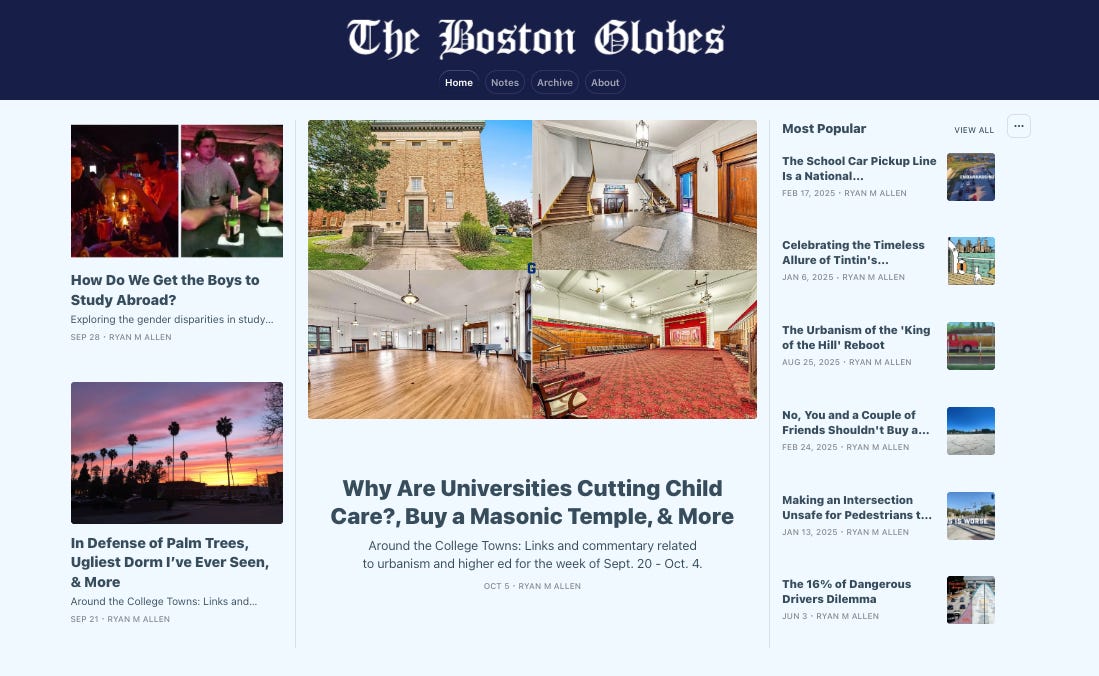
My main worry is that readers from the sector will think that I am an imitator. It would actually be kind of funny if they tried to sue me for impersonation in like five years. Likewise, I do not want their existence to impact the flexibility of the site, such as scaring off potential partners. In the end, it will probably just be fine. I just want to be clear on record: I was here first, the original, the only College Towns.
My Favorite Articles in Year Two of College Towns
Like I did in the first-year retrospective, I have ranked my top-10 favorite articles from the year. Most of these are original analysis articles, but I did sneak in one ‘Around the College Towns’ links round-up. This second year coincided with the American Semiquincentennial. So I was excited to do a series that celebrated the country’s birthday, even as the rest of the country didn’t feel like it. This Semiquincentennial Series dominates the list this year.
Please take some time to read through any of these and more in the College Towns’ archive, now with hundreds of articles. Thank you for reading! Here’s to year three. Cheers.
10)

9)

8)

7)

6)

5)

4)

3)

2)

1)
