


Note: Around the College Town is my weekly links roundup article on urbanism and education. These posts mostly cover news that may have fallen through the cracks rather than the big events.
There is No New Internet Town Square
I have long written about my journey leaving Twitter to greener pastures. It was my very first piece announcing College Towns on October 11, 2024. I also wrote about my trial and ultimate failure in Bluesky. Sadly, the journey to find the new Internet Town Square continues, and I am only finding more dead ends.
Recently, I was threatened with a ban from my local subreddit because I linked to my site in a comment. It was relevant to the conversation, so I thought it might be some auto-mod issue, as I have successfully posted there before. However, when pressed further, the moderators made it clear that they do not want Substack links on the site.
Reddit mods have a stereotype of being pushy, control-freaks with a Napoleon complex. To be fair, it’s a pretty thankless job, and one done on a volunteer basis. But there are far too many cases where they take things too far, treating the subreddit like their own private fiefdom.
I have written articles that have not been covered locally, such as the closure of the OC Flex micro-transit program. Neither the Orange County Register nor the Voice of OC bothered to cover this service change. When you Google OC Flex, my site is the only source of information on what happened other than the public statement from OCTA.
My Substack, like many others on the platform, fills in the gaps that the corporate media does not cover. Yet, a large portion of subreddits essentially view anything not from the corporate media as spam. Funny enough, fellow urbanist Substack, Jeremy Levine, recently had a very similar situation in a subreddit. It is believed that any self-submission is out of bounds of the site. This is Reddit’s right as a private platform, they can do what they want. But the limitations also mean Reddit simply is not the Internet Town Square.
The Internet Town Square should be the connective tissue across sites, open to all kinds of sources and users. The old Twitter was a place where small blogs or publications could get massive attention. There are big name recognizable writers who rode that wave to massive followings, such as Noah Smith and Matthew Yglesias, both of whom are successful writers here on Substack with their long-form writing.
Another writer who saw success in those early days of Twitter was Nate Silver. The founder of the blog FiveThirtyEight, Silver’s commentary would constantly go viral. Sometimes he would become the “Main Character” for the day, angering people with his data—both left and right. Recently, he wrote a takedown of the new X algorithm:
And “siloed” is on a good day: at other times, Twitter feels like a ghost town. It’s still useful for some topics: the AI discourse on the platform is often relatively robust, for instance. But for something like the war in Iran, it’s next to useless. Links to external websites are substantially punished, and none of the workarounds are particularly helpful. So the tangible rewards from still having 3 million followers can be surprisingly marginal. However, my account is hardly alone in this regard. The New York Times has 53 million followers, and yet its tweets often produce only a few hundred likes, retweets, and replies even when they reveal urgent, breaking news.
The full article is worth a view on his Silver Bulletin website. The link issue he brought up is something I have long been frustrated by. Other users have also commented on the demise of Twitter in terms of traffic generation. Ryan Burge from Graphs about Religion offered actual numbers to back up the fall:


Elon Musk initially started throttling links after he bought the company in 2022, especially targeting Substack, who he considered a competitor. Due to the complaints, Nikita Bier, Head of Product X, claims that the platform no longer deboosts outside links. He and Silver got into a debate on the issue, with Bier arguing that posters just need to learn how to post better. Given what a lot of us have experienced, we are not buying this company line. New research from Nieman Lab confirms the suppression we are all feeling.


This issue is not even just a Musk and X problem alone; the conventional wisdom for social media platforms is to deboost outside links. All the big ones basically believe that outside links are bad because they pull users off their site to another site. LinkedIn certainly does it, so too does Facebook. To me, this is short-sighted, consultant talk. Deboosting links might maximize eyeballs in the short run, but the practice rapidly degrades the health and utility of a social media platform.
What deboosting links does is to hollow out the user base. Users start getting less and less useful information, they then spend less and less time on the platform, and finally leave the site completely. This scenario is very clearly what has happened to X. Another high profile exit from the platform illustrates this cycle; Electronic Frontier Foundation (EFF), with over 470K followers, announced their exit this week due to low engagement.


While I’m still on X myself, I don’t use it as much these days. I have been trying to migrate most of my activity here to Substack. Ironically, Musk’s lame attempt to throttle Substack due to fear of competition just pushed more users to this site. But I did make a decision to leave my local subreddit and delete all my engagement there. I will no longer post or engage with content there. They will miss out on my original reporting.
I am still lost in the wilderness, looking for that elusive Internet Town Square. I know friend-of-the-page Dave Deek at Governance Cybernetics likes Hacker News. Another friend and fellow educator thinks I’m crazy to not be on TikTok. What do you think? Are we just doomed to never have another Internet Town Square?
Links I’m Reading This Week
Education
Hampshire College is closing down. There was an outpouring across the sector for this small Massachusetts college with experimental curriculum. RIP
Even though we are losing these small liberal arts colleges, Nils Gilman argues that this style of education will only get more valuable in the coming age of AI. Hey, I couldn’t agree more!
Some of these places can be saved through partnerships; one recent example comes from Messina College, also in Massachusetts, which was formed when Boston College bought struggling Pine Manor College. with the resources of BC, the college can offer affordable programs to a broad range of students.
Speaking of university acquisitions, Nature has a new commentary on how these institutions are not just offering degrees but have become landlords. The Age of Conquest brings with it complications.
On the international front, American institutions are losing their luster from students abroad. US fumbling dominance in international education is akin to the American automotive industry's downfall.
At the same time, the US is running out of China Experts. The bottom dropped out of Americans studying abroad there. I have long warned of this issue!
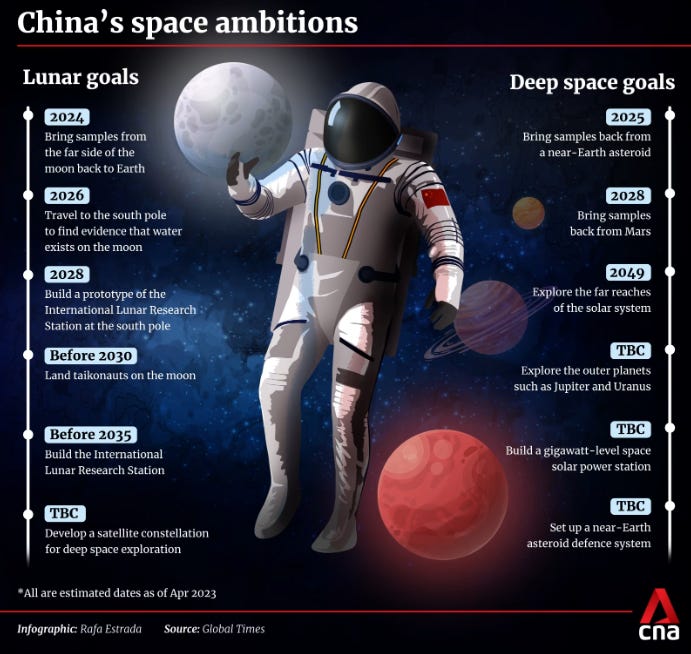
Continuing the US-China relationship, NASA squashes a planned Mars mission and experts now worry that China is in the lead on exploration of the Red Planet first. The new Space Race is heating up!
Urbanism-ish
High-tech plane company moves from the American South to California. Narrative Violation! We are not dead yet here on the Left Coast.
Honda has no chance against China according to its own CEO. It’s sad to see this giant fall so hard. Honda was my first car that I owned and I have a soft spot for the Japanese company.
But the company made some bad moves. The New York Times covered one problem in a recent infographic article. It used the Honda Civic as an example of how modern cars have become so bloated. The visuals are really worth a look.
Even rival Toyota has felt some heat, with Prius sales lagging recently. Apparently, the Prius is manufactured abroad, meaning the car model gets dinged by the new tariffs. At the same time, the Camry has gained popularity, as the model is manufactured in the US and not subject to tariffs.
Giacomo Prandelli has a breakdown on flight increases via The Merchant's News. I may end up just canceling my planned trip back to China scheduled for later this summer. Bummer.
 Jack Prandelli@jackprandelliOne month of war Here's what it did to your flight ticket. ✈️ Bangkok → Frankfurt: $474 → $2,870 ✈️ Hong Kong → London: $503 → $3,318 ✈️ Sydney → London: $733 → $3,875 ✈️ Singapore → London: $598 → $1,953 ✈️ Kuala Lumpur → Paris: $490 → $1,931 Some routes went up
 10:49 AM · Apr 7, 2026 · 134K Views66 Replies · 565 Reposts · 1.18K Likes
New tool called Urban Fabric lets you customize a real urbanism wishlist for your town, with a generated proposal ready to bring to the next city council meeting. It comes from one of my subscribers, Quinn Vaughn. Cool!
San Diego finally sees rents drop after a long decade and a half of increases. Building more housing works!
New research confirms these suspicions on US restrictive building, specifically showing how US codes are typically created without much cost-benefit analysis.
Richard Florida has a new concept: Urban Knowledge Campus. I am a little skeptical of these rebrands; it’s basically just the rebrand of a traditional city that wasn’t dissected by zoning. But he is influential in the urbanist space, so need to at least think about it.

Closing Time… How Much Did Professors Get Paid 500 Years Ago?
Misha Teplitskiy, a scholar who explores the “Science of Science” at the University of Michigan, had a fun note on faculty salaries in the 16th century. Look at that, the Classics at the top… by far! Unlike today, the STEM fields are somewhere in the middle. And like today, the language teachers are at the bottom.


It’s fun to see some details about my colleagues who lived a half-millennium ago. I wonder if they complained like we do now back in 1558? Perhaps about pay, admin, and students. I suspect that that they did. Time immemorial.
Sub-reddit moderation provides an important career path for hall monitors.
great read! never developed a taste for heavy reddit usage, personally; i like to get my answers and skedaddle 😂
musk would like to turn X into an everything app. this includes commerce and peer to peer payment. how he plans to accomplish this with low trust in his person (for any number of reasons) as well as actively suppressing out-links or generally anything he doesn’t personally like is beyond me