


Note: Around the College Town is my weekly-ish links roundup article on urbanism and education. These posts mostly cover news that may have fallen through the cracks rather than the big events like the new war.
Should We Give Boomers a Break?
Generational warfare is constant between the Boomers and Millennials. There is a general antagonism across these cohorts that arises in our cultural discourse. It makes sense considering this is basically a parents and offspring relationship, e.g., the Boomers had Millennial kids.
Since I have written about this generational divide before, I was intrigued to see the headline “Don’t Blame the Boomers for Millennials’ Struggles” in the LA Times by Joel Kotkin. Kotkin is a faculty member at Chapman University (incidentally, my former place of work; though we never cross paths), a prolific author, and a highly cited urbanist. Or perhaps the label suburbanist is more fitting.
He is the champion of the master-planned city model à la Irvine, California. This model is a suburban-style development. While I have been critical of Irvine, I have come to appreciate the city more recently, at least the early visions of the city. I especially appreciate the neighborhood schools, and College Towns may have a future piece on this soon.
So Kotkin and I probably only half agree on things, and that was emblematic in his Op-Ed. Kotkin cites dim prospects for younger generations to buy housing in California as one of his key consternations in the piece. Likewise, he lauds rising trends in skilled trades and vocational education as positive movement.
But like my love-hate relationship with Irvine, Kotkin also took an asinine shot at my generation that I thought was unbecoming of the essay. He falls into the old trope of calling Millennials lazy and entitled:
Rather than blame the boomers, perhaps young adults need to do as the boomers did: Get real and work harder. Right now millennials are not impressing employers, notes the Harvard Business Review. Even the students know the score: More than half (53%) of recent college graduates feel unqualified for an entry-level job in their field, with nearly half (42%) admitting they did not have all the skills listed in the job description. A recent survey of more than 1,000 employers found that millennials and Zs had the worst work ethic of any generation, more concerned with their lifestyle and leisure than their careers.
This description is basically the tired stop eating avocado toast trope that was bandied against the generation in their 20s. For some, that age was 20 years ago, as Millennials have already entered their 40s. The essay lazily lumps “recent college graduates” data with Millennials. Some of my friends from high school literally have kids in college right now. The swipe at younger generations in the essay is a sophomoric take at best, and obtuse at worst.
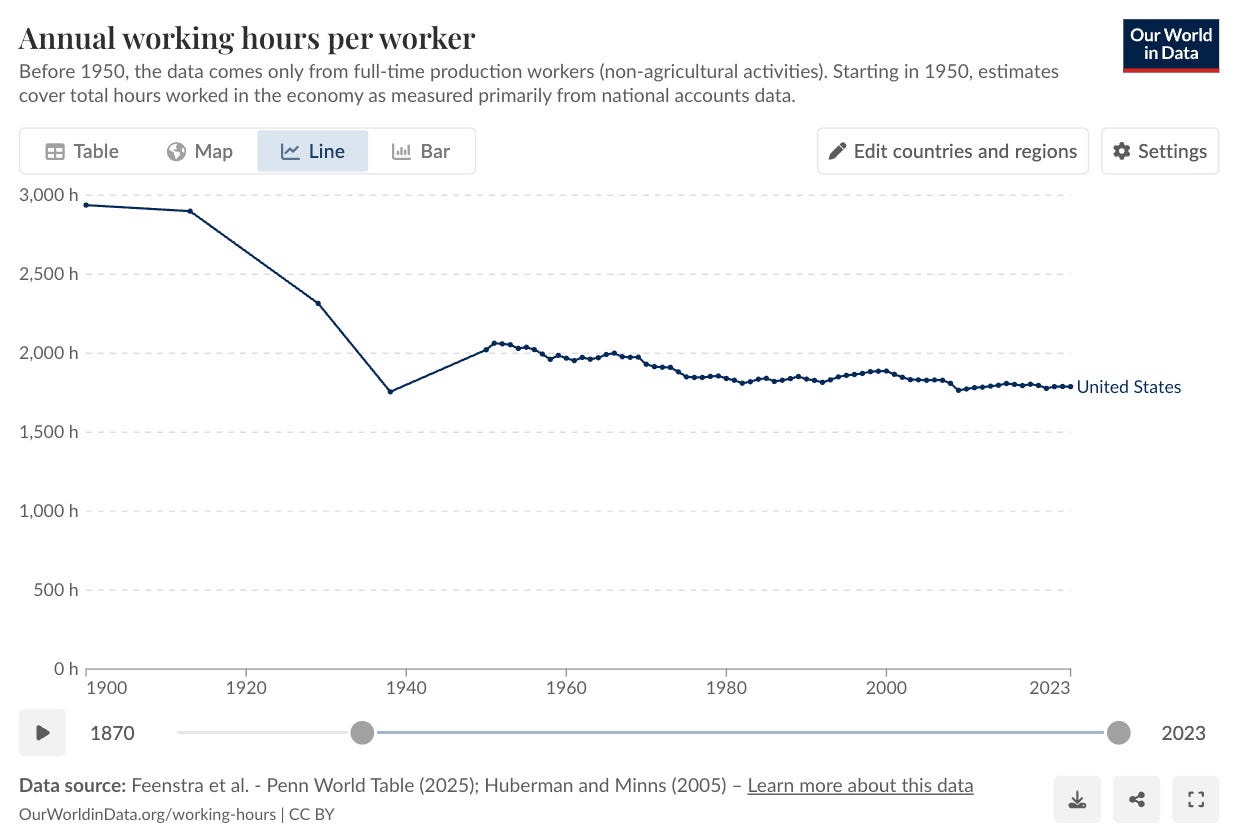
American working hours had been on a steady decline since the 1950s, leveling off in recent years. That means Boomers worked fewer hours than their Greatest Gen parents. And while following generations followed these trends, the gains in efficiency and output dramatically climbed higher. Wages, though, did not remain parallel, and that was certainly a problem that hit Boomers when they dominated the workforce in the 1980s and 1990s. Yet this bifurcation has only exacerbated, hence the Millennial malaise.
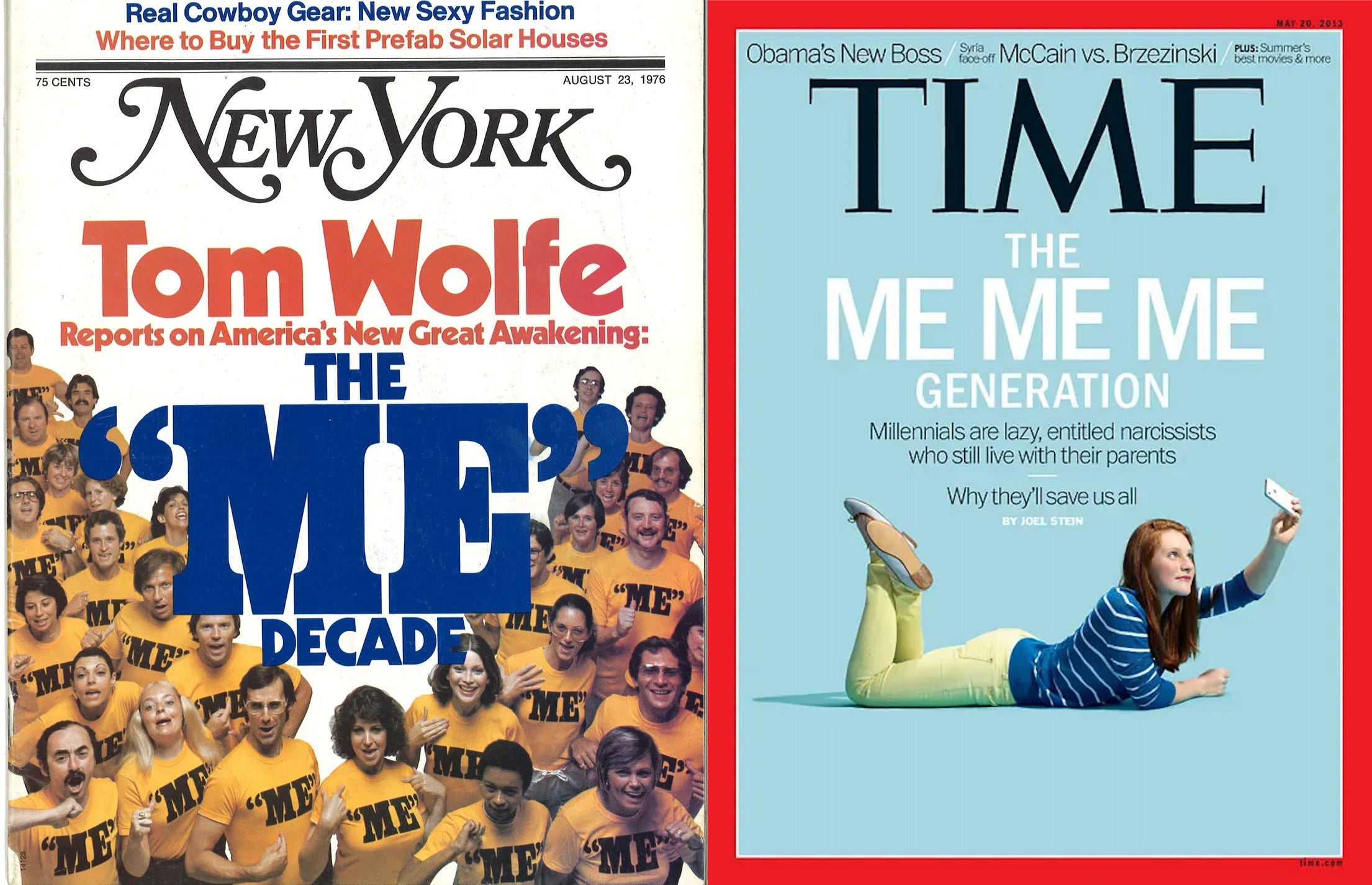
What I find most entertaining about this discourse is that Boomers were once maligned in the same way as Millennials have been. In 1976, Tom Wolfe labeled "The 'Me' Decade" as a shot against the coming-of-age Boomers. In 1967, Time magazine claimed of the generation, “today’s young people are the most intensely discussed and dissected generation in history,” along with some labels like “alienated,” “uncommitted,” and “noninvolvement.” Certainly, the veterans of World War I and II were annoyed by the counterculture, “Turn on, tune in, drop out,” ethos.
There are numbers to back up the qualitative criticisms of the then-young Boomers. The following comes from Work in America (1972):
Yankelovich also found a shift in student opinion on the issue that "hard work will always pay off" from a 69% affirmation in 1968 to a 39% affirmation in 1971. This certainly was, in part, indicative of the conditions in the job market for college graduates in 1971. But more basically, we believe, it highlights a paradox inherent in a populace with increasing educational achievement. Along with the mass media, education and its credentials are raising expectations faster than the economic system can meet them. Much of what is interpreted as anti-work attitudes on the part of youth, then, may be their appraisal of the kinds of jobs that are open to.
A 1960 survey of over 400,000 high school students was repeated for a representative sample in 1970 and the findings showed a marked shift from the students valuing job security and opportunity for promotion in 1960 to valuing "freedom to make my own decisions" and "work that seems important to me" in 1970.
Given these results, my guess is that if we could go back in time to administer that same poll Kotkin cites in his op-ed, Boomers would be firmly at the bottom behind both the Silent and Greatest Generations. Like father, like son, I guess.
So did Baby Boomers work harder than younger generations? Absolutely not. Ahistorical nonsense. They were blessed with a post-War world in which the US had unimaginable dominance. From investment in building housing to cheap college, they reaped the success of the United States in that era. Kudos to Boomers for taking advantage of those conditions.
Those conditions, though, have drastically changed in modern America. Younger people are facing the brunt of these challenges. These generations, overeducated and underemployed, are locked out of housing and swamped in debt, all against the tide of inflation. But as Kotkin notes, these struggles are not just on youth alone. Aging Boomers are stuck in their suburban single-family homes, quickly losing their ability to drive, with nowhere in their unwalkable neighborhood to downsize, while their kids moved to Texas. Everything is downstream of housing, and the generational stereotypes just flatten complexity.
We have artificially constrained the solutions to many of our problems. The strict zoning laws and government regulations hampering construction have dried up the supply. This is a space where Kotkin and I find agreement: “scaling back regulations that make it difficult to build affordable, and family-friendly, housing,” he says. There are growing movements to make progress on these very issues—led by subsequent generations with movements like YIMBY, Abundance, and Strong Towns (founded by a Gen X).
Taking a cue from Boomers, these generations are looking to take power to remake society. Some of the new directions are scary to Kotkin’s generation, such as the rise of Mamdani in New York, while others are likely more palatable, like AB 1154, which makes it easier to build ADUs in California. “Without such changes,” Kotkin writes, “Boomers inevitably will face a generational war over their assets, one they will likely lose.” Us Millennials agree. So let’s start building housing together, Boomers.
Links I’m Reading This Week
Education
About 10% of Cal State University system students are homeless. Awful.
About 41% of all sociology BAs conferred in the entire country are given by California universities. This stat was surprising, and I am still processing, but I guess I have to ask: are there too many sociology majors?
New College of Florida diverts housing budget to build new baseball field. The university already faces a dorm bed shortage, with its main IM Pei structure moldy and dingy.
Stanford has a new database of historical policy reforms. I haven’t played around with it much yet, but looks intriguing.
Harvard’s ugly new medical campus is turning into a billion-dollar boondoggle.
NYU is now as selective as Harvard was a decade ago.
China is getting rid of language majors in favor of Area Studies. Different from the US where we are just cutting both.
The Atlantic cited College Towns in a recent article on universities trying franchise-like tactics with domestic branch campuses.
Urbanism-ish
Traffic cameras are working in the Bay Area to change some bad driver behaviors. I’m usually more for street re-design, but doing so in tandem with these kinds of automatic cameras seems to be helpful.
You know what else works? Protected bike lanes. San Diego’s bike ridership skyrockets with a newly installed network of protected bike lanes.
Perhaps free buses, too? I’ve been against free buses, but here is one positive example from the small French city of Dunkirk. I’m always open to hearing other sides to these issues.
Teens in NYC stole a subway train for a “joy ride.” This is incredibly dangerous, and I hope the city can get it under control.
Speaking of reckless, Tesla has a higher crash rate than human drivers. This is one reason I’m concerned Musk’s bad choices will sully the broader self-driving tech.
In California, inheriting housing makes up 18% of all such transactions! No wonder younger generations are revolting.
LA spent 13 years on one bus stop shading. This kind of story is emblematic of so many problems in California:
Closing Time… Restaurants All Taste the Same Now
I recently spotted this viral video of cooks talking about how food in restaurants all tastes the same now. The reason? An overreliance on one-mega provider, Sysco. Watch the claim below:


I must confess, I don’t eat out a lot. If I do, it’s more to local mom and pop East Asian restaurants, which usually have their own unique supply chains. Likewise, I haven’t worked in the food industry since college, so my content knowledge on the topic might be dated. I am, nonetheless, intrigued by the phenomenon of standardization in broader American society.
Perhaps I am out of my element here in the restaurant world, but I have not noticed the trend of them all tasting the same. How about you? Is this something you’ve come across? Let me know what you think.
Short doc mentioned in the video above: