

Note: Around the College Town is my weekly links roundup article on urbanism and education. These posts mostly cover news that may have fallen through the cracks rather than the big events.
The Job of the Future is Here Today
Last year, I wrote the first edition of my Future Jobs series on what I called “AI Wranglers.” I described this type of job as “part IT guy, part psychiatrist, and part detective.” You can read the full article below. While it drew a lot of interest, it also had detractors skeptical of AI. There is considerable anti-AI sentiment in the US, especially in education circles. However, I recently found out that this future job is not really the future… because it already exists in the present.
AI Wrangler: Job of the Future Combines Tech and Humanities

Jensen Huang, founder and CEO of NVIDIA, was recently asked if he could share any advice for students and young people trying to navigate an uncertain tech future. His response revealed a future job that is just on the horizon:
There are now real AI Wranglers at top companies. Google has hired Henry Shevlin, a faculty member at the University of Cambridge, in the role of Philosopher at DeepMind. His role will center on exploring “machine consciousness, human-AI relationships, and AGI readiness.” He’s not alone. Amanda Askell is another philosopher working at a high-level company, Anthropic. She is tasked with shaping Claude’s personality and trying to understand how the AI works.
Askell described her job in a recent interview:
I’m mostly focused on the character of Claude, how Claude behaves, and I guess some of them were kind of like nuanced questions about how AI models like should behave, but also even just things like, how should they feel about their own position in the world?
So trying to both teach models how to be, like, good in the way that by sometimes think about it is like, how would the ideal person behave in Claude’s situation. but then also these, I think these interesting questions that are coming up more now around how they should think about their own circumstances and their own values and things like that.
Commenting on the interview, tech writer Ole Lehmann wrote, “[It] feels weird to tell an AI it's doing well, but it measurably shifts the next 10 responses.” He continued, “tone, trust, permission to take a position, the absence of threats… Claude picks up on all of it.” This kind of humanistic approach to AI is exactly what I described with the AI Wrangler. The job is already here.
My preferred AI Wrangler term, though, did not catch on. Instead, these kinds of skills are likely better known as something like “prompt engineering.” I still think AI Wrangler is a more apt label, given that these skill sets include not just STEM but also humanistic approaches. “Prompt engineering” sounds too technical. There is art to AI wrangling.
The full interview is worth a watch:
The Skeptics
I should add that there are skeptics who do not believe these kinds of skills are relevant or even real. “It just shows how disconnected we are from the small group of people making decisions that will impact our future heavily,” wrote the popular software developer and streamer ThePrimeagen. “These people have so much AI psychosis.”
Even (or perhaps I should say especially) my fellow professors are skeptical of these new developments. On the r/Professors subreddit, anti-AI sentiments are strong. Just offering a little bit of sympathy with AI brings the hammer of downvotes. A popular post recently complained, “‘Prompt Engineering’ is just a corporate rebrand of ‘Question Asking.’” Many applauded the rant:
The central point of my post is that there is nothing new to learn or teach. We’ve been formally teaching students how to question since the Hellenistic Era.
This is essentially Google on steroids. We didn’t have to teach students to use Google, students were usually better at it than their professors.
prompt engineering is far more insidious than question asking, imo
To be fair, there were professors in the group who defended the concept, pushing back on the assertion that the innovation is overblown. But the voices on the thread and in the broader academia usually coalesce around dislike for AI. A group of scholars even recently published an article that argues qualitative researchers should not use AI on ethical grounds.

Professors Cannot Bury Their Heads in the Sand
I do understand the disdain for AI from teachers. Students are 100% using it to cheat. It makes our job much more difficult. An example comes from the r/PromptEngineering subreddit, where one student admitted, “My professor told me my essay ‘finally sounded like me.’ I had just run it through an AI humanizer.” Of course, the group wanted to know which exact app he used.
I do also understand that there are broader environmental concerns. However, given that every company has shoehorned an AI feature into all apps, websites, or digital services, it is starting to become impossible to avoid interacting with them. The only way to avoid AI these days is to go totally analog, off the internet completely. Short of that, it is just making a showy complaint.
Just because we don’t like something doesn’t mean we can ignore or ban it. One colleague who agrees is Alexander Kustov, Associate Professor at the University of Notre Dame’s Keough School of Global Affairs and owner of Popular by Design Substack, who has been publishing a series entitled Academics Need to Wake Up on AI. He drew ire from the professorate with the first post in the series when he later revealed it was written by Claude. His interview on the situation in The Chronicle of Higher Ed is worth a read:
There is a big divide. You have senior folks, or folks who are not on social media, who have not heard anything about agentic AI. They just know ChatGPT as this thing that students use to cheat. They’re like, Let’s ban AI everywhere. Meanwhile, their junior colleagues run all their data through Codex. The closest analogy would be to imagine if half of your colleagues didn’t know the internet existed. This is not a stable equilibrium.
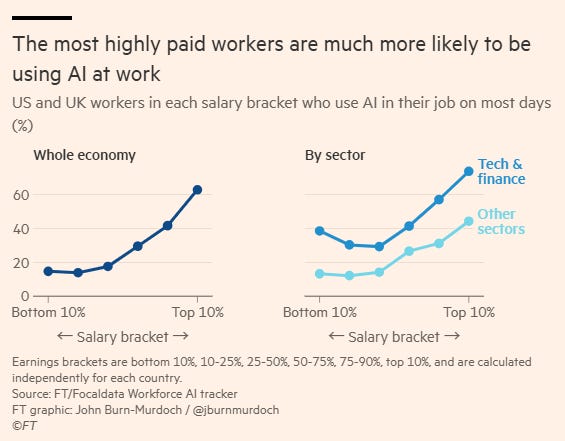
I am not saying that every class needs to have full AI integration, just that every teacher needs to understand the capabilities to some degree and how students may use the technology. Even if classrooms have not found much use for AI, the same cannot be said of the workplace. The Financial Times reported this week that the highest earners and most experienced are using AI at much higher rates than other workers:
Lawyers, accountants and software developers are using these tools at similar rates whether junior or senior but are using them much more than people in lower-paid occupations in the same industries.
The strong relationship between pay, education and AI use suggests the technology may increase earnings inequality by boosting the productivity of workers at the top but not at the bottom.
An example of the business sector’s embrace of AI comes from ChatGPT announcing an Excel add-on. I already use AI to remind me of macros. I think this is a good use case for AI. Any class that relies on Excel must consider the tool since Microsoft is putting it front and center. This obviously does not mean every class needs AI, just like not every class needs computers or other software.
While my concept of an AI Wrangler is still something we mostly see only at the very highest levels of the tech sector, I believe things will trickle down to the rest of the industry. There is already mass adoption of the tech, with high-paying industries expecting their workforce to use and understand AI capabilities. Educators must pay attention to this job of the present, whether we like it or not.
Links I’m Reading This Week
Education
In more closure news, Anna Maria College is shutting down. The second Massachusetts institution to shutter this month, joining Hampshire College.
A community college in Washington is closing a branch campus. This is exactly the trend I have been seeing in my own research.
There have been some new data sites popping up that explore closed or closing colleges. One comes from Kyle Saunders’ personal website. The other from James Long, Chair of the Division of Business at Friends University, with a pretty cool interactive map. I may do a full article on these closure metrics, as AI has really supercharged analysis and data here.
It’s not just the US making cuts to higher education; Shenzhen University in China is taking a buzzsaw to its major offerings. Bummer.

On the flip side of budget cuts, Yale is considering expanding with a campus in San Francisco. The biggest continue getting bigger in the Higher Ed Age of Conquest.
There is no end in sight for donations to big football programs. I have heard growing concerns that there will be donor fatigue due to players washing out or renegging on deals. This does not appear to be happening yet, at least not at the very top.
In student housing news, an open house for a $4.6K per month rental in a California college town has a line out the door with eager applicants. Build more housing…
Student housing in Belfast, Northern Ireland, may have reached a saturation point. I will be interested in seeing how rents are impacted.
Community college student in Seattle protests the exorbitant housing prices by setting up a tent right in front of the campus.
Tulane University is building new student housing. Locals are concerned it will bulldoze a historic restaurant. I understand nostalgia, but this is basically a dumpy strip mall with a cool sign (which the university is keeping up).

My lone K-12 news today comes from Stephanie H. Murray, a writer and mother lamenting having to move to the US because it means she will have to give up on her kid’s independence, This is the sad reality that many parents find themselves in due to our terrible built environments.

Urbanism-ish
Where did all the public benches go in American cities? One urbanist explores this lost amenity.
Over here in California, Hollywood, the town, is in rough shape. High rents coupled with street degradation undercut the glitz of the supposed tourist destination. Some locals have a plan to fix it.
In more California news, LAX gets a fancy new terminal upgrade. I’m not impressed. Call me when the People Mover starts moving people.

In some global urbanism news, China is helping Brazil build its train infrastructure. The US has no answer to this other than to complain.
China has selected two Pakistani astronauts to train on board the Chinese Space Station (CSS). The New Space Race continues!
Dubai is planning a massive metro line as part of securing confidence after the disastrous Iran conflict.
Going across the pond, Britain’s “UNESCO model village” shows the best of town-building. Saltaire in West Yorkshire, built in 1851, is really just the traditional model. Retvrn.

Closing Time… Rats Love Driving Cars
Rats love driving cars, even if not rewarded with a treat. Ok, this is an old video and story, but I just recently stumbled on it again and thought it was pretty fun. But rat urbanists worry this newfound love of driving will lead to rat urban renewal and the end of walkable rat cities.
Great round-up coverage of AI and academia.