


Note: Around the College Towns is my weekly links roundup article on urbanism and education. These posts mostly cover news that may have fallen through the cracks rather than the big events.
Jensen Huang’s Higher Ed Philanthropy
Ok, I am mostly breaking my rule on this one, since I usually like to cover stories that have fallen through the cracks. The Jensen Huang scandal has very much not fallen through the cracks. I’m sure most of you have consumed news stories, social media posts, takes, and memes around the case (oh, how memorable the memes have been).
One angle I have not seen covered is how the fallout from the case will impact higher education. Huang and his wife, Lori, are huge philanthropists, with reports that their foundation manages $9 billion. Through the Jen-Hsun & Lori Huang Foundation, the couple has donated hundreds of millions to various educational efforts.
Just this year, Vanderbilt announced that its new campus, located at a closed college in San Francisco, would be named for the couple. The Jen-Hsun and Lori Huang College of Art, Architecture and Design in San Francisco was set to open in 2027, with doubts growing about keeping the name after he stepped down from his role at Nvidia due to an affair with an alleged Chinese spy, among other possible affairs.
Billionaires Revitalized Dead Colleges, Guerilla Bike Lane Sweeper, & More

Around the College Towns: Links and commentary related to urbanism and higher ed for the week of July 12 - July 26.
Vanderbilt has not yet made an announcement and is likely mulling its options. The case is still obviously ongoing, too. There have been no reports that a divorce is imminent. I should also note that Lori is the head of the foundation. All of this got me thinking about the couple’s impact on higher ed.
With so much funding through the foundation, there is bound to be some kind of disruption or change to the efforts. So I downloaded all of the foundation’s 990 tax forms, which are public disclosure forms every nonprofit has to post, available through ProPublica’s Nonprofit Explorer. Adding in recent media reports of donations, I had Claude map out the gifts to educational entities across the country (seen below).
Overall, I found almost $200 million in gifts or pledges from the Huangs and their foundation to schools, colleges, or other NGOs. Vanderbilt had the highest reported total at $75 million in a matching pledge. Both Oregon State University (OSU) and Stanford University also received tens of millions. The subreddit for Corvallis, where the university is located, wondered if the name of the Jen-Hsun and Lori Mills Huang Collaborative Innovation Complex would be changed. The top comment in the group joked, “We could nickname it ‘The Honeypot.’”

Outside of the Bay Area and the Pacific Northwest, where there was a clear affinity, there were a few other institutions of note. One came from a reported $2 million donation to the Oneida Baptist Institute for Jen-Hsun Huang Hall, a girls’ dormitory and classroom building. This boarding school in a small town in Kentucky is where Huang first arrived in the US as a 9-year-old international student from Taiwan. Outside the US, the couple gave $1.3 million to the Hong Kong University of Science and Technology (HKUST) through the so-called Leather Jacket Auction (ok, that’s pretty funny). HKUST had recently awarded him an honorary degree.
There were a few other smaller donations to NGOs, which can be found on the map. Some donations were missing, as they went to donor-advised funds that are not required to disclose disbursements. Also not on my map is Princeton. A viral post reporting that the university was naming a school after Huang turned out to be fake news.


Lori Huang has been central to the philanthropic arm of the Huang fortune. My guess is that we will see continued or even increased efforts if she is given even more latitude. We have seen these kinds of cases of divorce or loss of a billionaire spouse create a boom in philanthropy.
MacKenzie Scott had a high-profile divorce from Jeff Bezos in 2019. Scott ended up with the equivalent of $38 billion in the settlement. She put that money to work in an expansive philanthropic network, much of it in education.
In another case, Steve Jobs’ widow, Laurene Powell Jobs, was left with the Apple fortune when her husband tragically passed in 2011. She has taken on projects and other philanthropic efforts, especially in education and the arts. She bought out the old San Francisco Art Institute to build a community art space that is set to open next year.

One more thing about this case in relation to higher ed. The Donald Trump administration was very close to Huang. This guy was on the president’s plane, sitting next to him at dinners with Xi Jinping. While all of this was happening, Secretary of State Marco Rubio and War Secretary Pete Hegseth were attacking higher ed for having so-called relations with hostile forces.
When I looked into the alleged security concerns, they were mostly low-level exchanges in subjects like education and business. So we have dialogues between American and Chinese undergrads getting maximum scrutiny, while the highest levels of government, literally sitting right next to the president, are exposed. All the higher ed stuff was just a big show against perceived enemies.
War Department’s Uni Witch Hunt, Last NYC Bohemians, & More

Around the College Towns: Links and commentary related to urbanism and higher ed for the week of Aug. 17 - Aug. 30.
My scathing critique of the administration is only more apt today:
If you actually care about foreign influence and espionage targeted at American interests, then this Mickey Mouse operation by the US Department of War should be concerning. This is not intelligence; this is a brainless witch hunt. We can do much, much better than this.
Aside from the Huang case, we have the national airline shutdown, the Microsoft outage, and now the banks on the fritz. The last couple of weeks have been a train wreck, and it all points back to the bozos at the top. Disasters.
Links I’m Reading This Week
Education
In some closing college news, York College is set to buy a planned-for-closure Penn State campus. This is one of the best-case scenarios for dead colleges.
In the same state, two other Pennsylvania Catholic colleges merge. Also not a terrible outcome, certainly better than closure. Although there are often merger pains.
An article outlines students upset that they must still pay loans even after their universities close. I get the feeling, but I’m not totally outraged. They can still transfer and use the credits.
On the other side of the Higher Ed Age of Conquest, the University of California system buys a Ritz-Carlton hotel. They aren’t going to put classes there; this is their investment arm.
Down in Texas, UT Arlington is building a massive new campus in Ft. Worth. Funny, the Facebook post where I saw this was full of comments complaining. Why is building anything so antithetical to our culture these days?
In more elite college news, UPenn claims the oldest uni label in the US on a technicality. Reminds me of the college football teams claiming absurd national championships.
Next, Harvard might change the name of a bunch of its grad schools, including the infamous “Extension School.” Two years ago, I predicted that these kinds of extension brands would change their names in the next five years.


In some good advice news, I’ve finally seen some from the business class: go to college to become a whole person, says a former Goldman Sachs exec.
Urbanism
I was thinking about whether I should put this one in Education or Urbanism. It’s the perfect balance of both: a new degree in city building, flagged by Aaron Lubeck.
The Cybertruck Dead. Tesla and Musk are constantly annoying me, so I will shed no tears. I guess if Tesla falls, we will have to open up to Chinese EVs.
 Aaron Lubeck@aaron_lubeckThe nation's first “Citybuilding Degree” is about to launch in Florida.
 3:41 PM · Nov 6, 2026 · 1.88K Views10 Replies · 1 Repost · 51 Likes
In more new urbanist initiatives: a lab is opening in LA with the aim of helping disabled passengers on public transport.
The Bay Area is getting so expensive that Davis is becoming a commuter suburb. The state of California is so frustrating.
Is the answer to our housing crisis in Legos? Well, at least prefabs like in Sweden. Look at this beaut!


Urbanism Tool of the Month
I’m adding a new subheader under my links segments. It’s called Urbanism Tool of the Month. In recognition of new AI and other innovations that have given us tools to help us make our places better, College Towns will scour the internet to curate these all in one place for your convenience.
I will be posting them in the new Urbanism Tool Trophy Case. It will act as a repository for urbanism tools, apps, and services that are useful to the broader movement of building and improving our neighborhoods and cities.
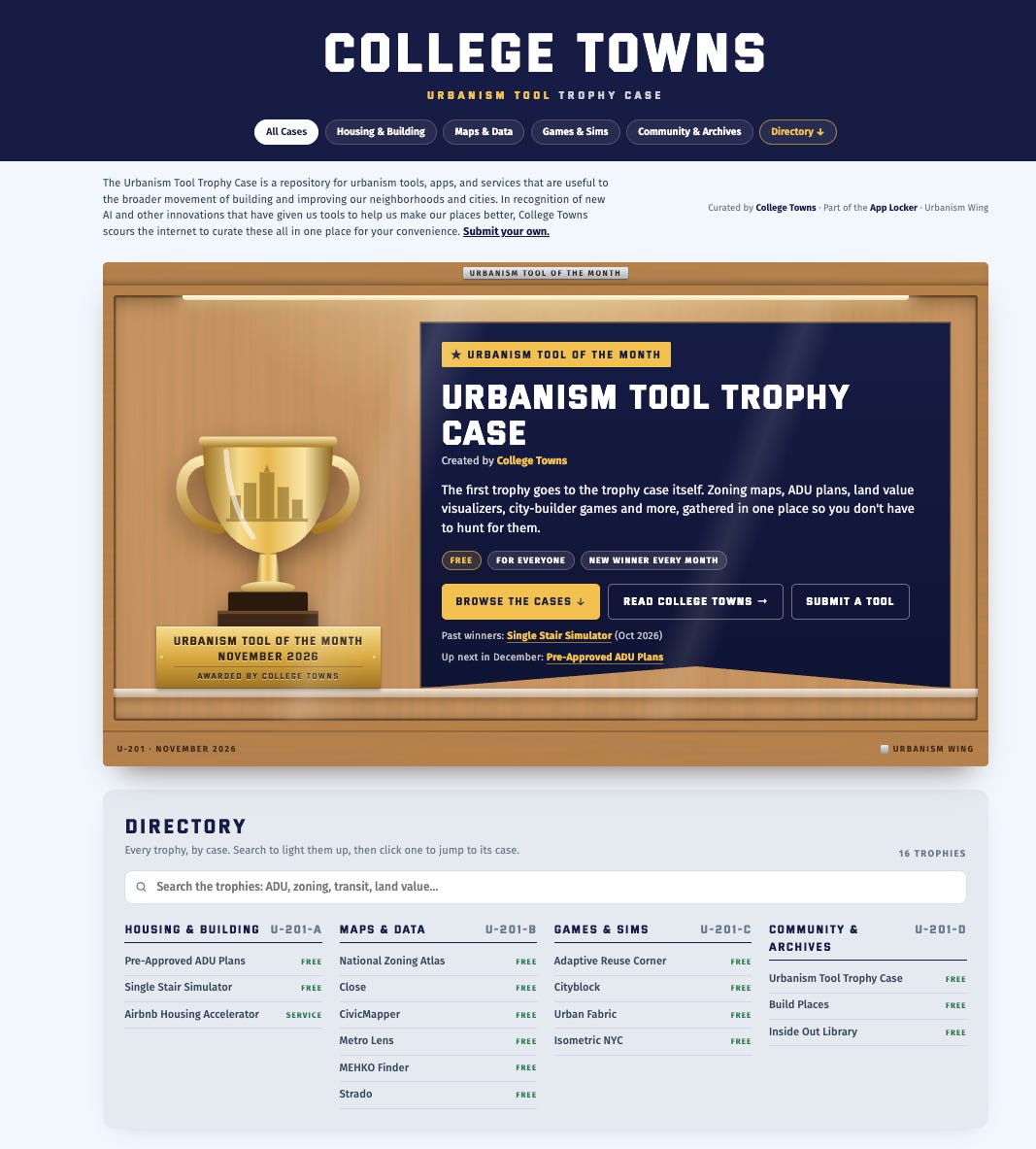
For the month of November, I am awarding the Urbanism Tool of the Month to… Urbanism Tool Trophy Case. Yes, I am awarding the first official month to myself, mostly to just make this announcement. I retroactively gave October’s award to the Single Stair Simulator by Single Stair North Carolina and Build Better Places, since I mentioned it in the last links roundup.
Send in your submission today.

Big Ten Adaptive Reuse Corner
In the previous edition of Adaptive Reuse Corner, a pump house in Virginia won pretty handily, when adding in the votes from the post itself. I agree with the readers on this one. That reuse is stunning, and it's in a pretty good location, not in the middle of nowhere. This week we have five more adaptive reuse homes from across the Big Ten (for no good reason; I just noticed the listings were from those states, and college football is heating up).
First up, we have a bank in rural Ohio. While not the most impressive structure, it is somewhat interesting with the drive-thru still intact. The property is also in the middle of nowhere, next to a propane storage site, so the $235K price tag might not be the best deal.

Moving one state over, I found a military facility in Pennsylvania for sale. Very unique! It doesn’t look like much on the surface, but it goes deep down with an underground operations facility. The bunker looks like a level from the old GoldenEye video game, all for just $999,999. A deal! And it’s not too far from Bucknell University. This one has to be seen to be believed.

Staying in the conference, we have a church in rural Illinois. This is right in the middle of a farm, if that is your thing. It looks totally redone, with nice design, but almost $600K for something in the Driftless Area seems high. It’s about a half an hour from Dubuque, Iowa (home to a few small universities like Loras College).

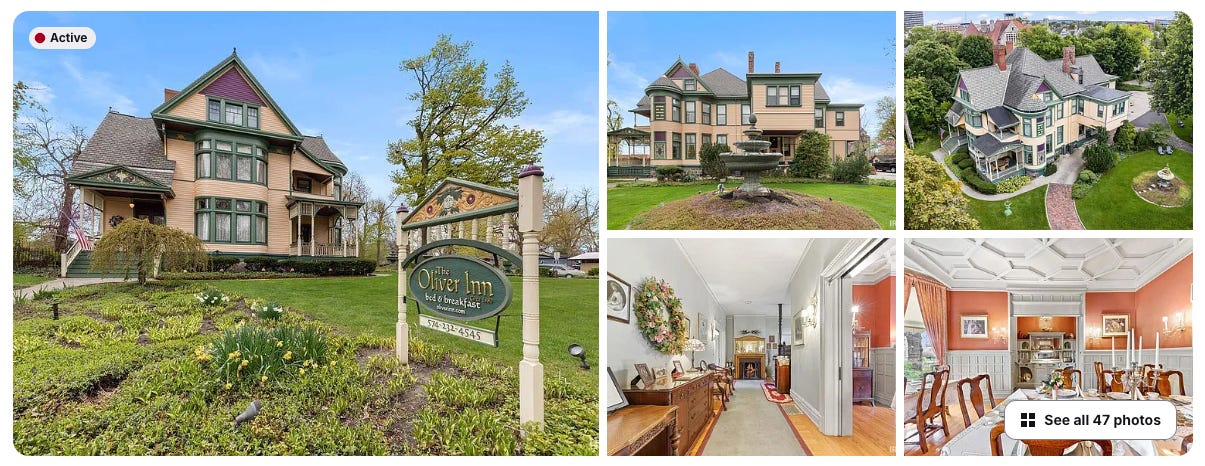
Moving over one state to Indiana, we have an inn in South Bend (a phrase that sounds like the title to an Americana folk song), home of the University of Notre Dame. I know the Fighting Irish are not in the Big Ten, but they should be and the state flagship is. Anyways, the place is a stunner. The Oliver Inn was built in the 1880s in the Queen Anne Victorian style. It has been converted into a 13-bedroom bed-and-breakfast. I’m sure it fills up on college football Saturdays—it better for $1.6 million.
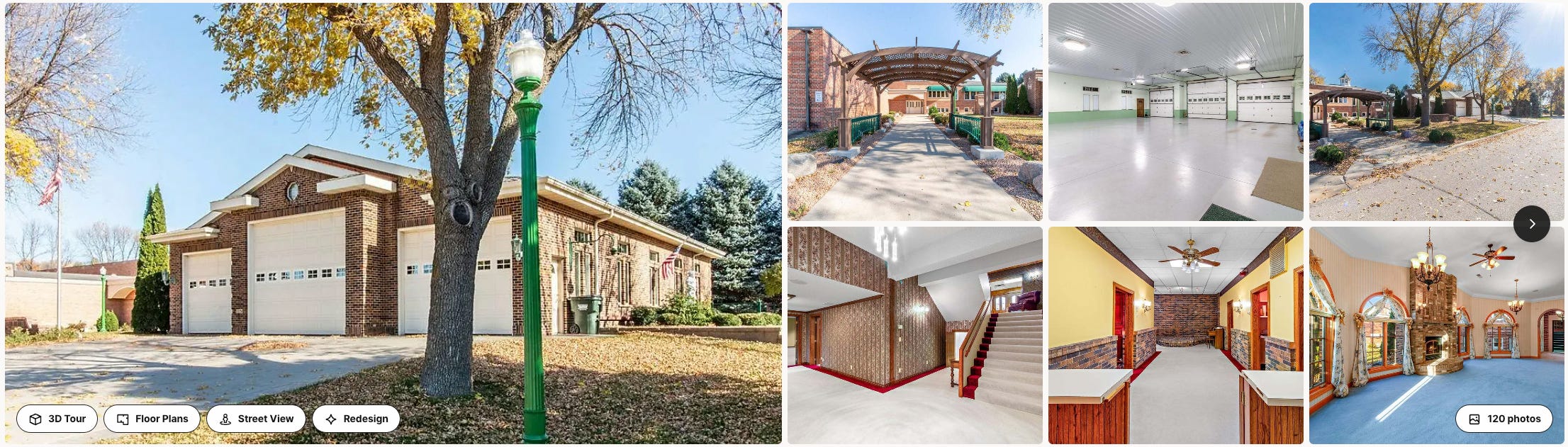
The last entry comes from a schoolhouse in Minnesota (not the most famous Big Ten state, but solidly in the conference—unlike New Jersey). Built in the 1930s, the school has now been zoned residential and priced under $400K. It still looks very much like a school on the outside, except for the massive garage doors; the inside, though, is not that clear. It looks like they haven’t done much, and the virtual staging is a total joke.
So think about which of these you would want the most as your own home. Or maybe just choose your favorite football team. For me, I’m not much of a Big Ten fan, so I will weigh both price and location. To each their own. Vote with your heart here or on Notes. Don’t forget, you can play Adaptive Reuse Corner the game in the College Towns App Locker.
Closing Time… Best Dorm Pizza
I know a lot of people hate Dave Portnoy; he is a pretty controversial figure. I actually enjoy his pizza reviews. It’s something I would do if I had unlimited time and money. I love the one he just posted from South Bend, Indiana, while visiting the University of Notre Dame for a football game. He got invited to review pizza made by students in their dorm restaurants (a tradition I didn’t even know about).

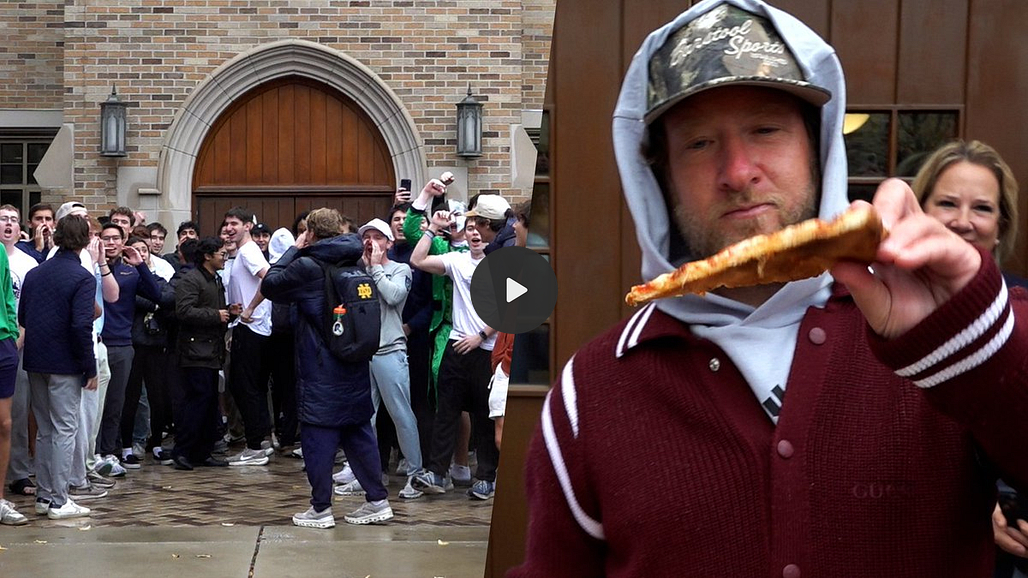
What transpires is much more than just a typical pizza review. We get an insight into the college life at Notre Dame. It looks so fun. You can just see the fun and energy that comes with college dorm days. This is every day for a few formative years of your life. My joy from the experiences certainly has influenced my continued interest in this subculture through College Towns.
Portnoy has been on a college tour for the Barstool College Football Show, in the same vein as College Game Day. In conjunction, he is also now doing university bookstore reviews, mostly focusing on sports apparel and vibe on or around game day. This is, again, the kind of content I love: getting an insight into colleges across the country. In a time when so many are negative about American higher ed, I appreciate framing our institutions in a positive light, even from a guy whom a lot of people do not like.